Italy
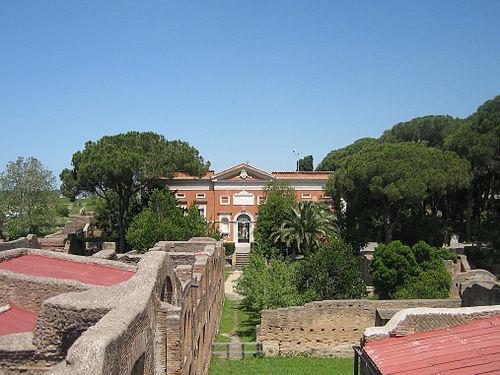
Museo Archeologico Ostiense
National museum · Rome
Archaeological site

Ostia Antica (lit. 'Ancient Ostia') is the modern name given to the ancient Roman city of Ostia. It became the port city of Rome located at the mouth of the Tiber and is near modern Ostia, 25 km (16 mi) southwest of Rome. Due to silting of the coastline from the river the site now lies 3 km (2 mi) from the sea. The name Ostia (the plural of ostium) derives from Latin os 'mouth'. The city continued to be prosperous into late antiquity despite harbour deterioration. After its abandonment sand dunes covered the site and aided the city's preservation which is surpassed only by Pompeii and Herculaneum. Ostia Antica is now a large archaeological site noted for the excellent preservation of its ancient buildings, magnificent frescoes and impressive mosaics. As in Pompeii, Ostia's remains provide details about Roman urbanism that are not accessible within the city of Rome itself.
Ostia may have been Rome's first colony. According to legend, Ancus Marcius, the fourth king of Rome, was the first to destroy Ficana, an ancient town that was only 17 km (11 mi) from Rome and had a small harbour on the Tiber, and then proceeded with establishing the new colony 10 km (6 mi) further west and closer to the sea coast. An inscription seems to confirm the establishment of the old castrum (military camp) of Ostia in the 7th century BC. The oldest archaeological remains so far discovered date back to only the 4th century BC. The most ancient buildings currently visible are from the 3rd century BC, notably the Castrum ; of a slightly later date is the Capitolium (temple of Jupiter, Juno and Minerva ).
Ostia probably developed as a naval base and in 267 BC, during the First Punic War, it was the seat of the quaestor Ostiensis in charge of the fleet. It had an important commercial and military role during the Second Punic War, so that it obtained exemption from military service for its inhabitants.
During the 2nd century BC its role as a commercial port for the import of grain to Rome gradually became prevalent and buildings began to spread outside the castrum. The ancient dock on the right bank of the river became insufficient for the growing needs of Rome, so that the praetor Gaius Caninius appropriated a large portion of land on the left bank for new docks.
As the city of Rome grew, Ostia did not have the capacity to supply all its needs and Puteoli became the major port of Rome.
Ostia was a scene of fighting during the period of civil wars in the 80s BC. In 87 BC Marius attacked the city in order to cut off the flow of trade to Rome, aided by his generals Cinna, Carbo and Sertorius, and captured the city and plundered it.
In 68 BC, the town was sacked by pirates, who set the port on fire, destroyed the consular war fleet, and kidnapped two prominent senators. This attack caused such panic in Rome that Pompey the Great arranged for the tribune Aulus Gabinius to pass a law, the lex Gabinia, to allow Pompey to raise an army and destroy the pirates. Within a year, the pirates had been defeated.
The town was then re-built and provided with defensive walls started under Marcus Tullius Cicero according to an inscription.
During the Augustan age, Agrippa had the theatre built (18-12 BC), the city forum was probably built under Tiberius and under Caligula (37-41 AD) an aqueduct was built. In 14 AD Claudius replaced the ancient office of the Ostian quaestors with a procurator annonae of the equestrian order, in charge of the grain supply ( annona ).
Due to the small size of the harbour at Ostia, Claudius commissioned a massive new harbour at Portus on the northern mouths of the Tiber ( Fiumara Grande ). Insufficiently protected from storms, Claudius' project was later supplemented by the hexagonal harbour built by Trajan and finished in 113 AD. Trajan also developed the harbour of Civitavecchia ( Centum Cellae ), 20 km away.
The development of port activities increased the prosperity of Ostia, which maintained its function as an administrative centre for the corn supply so that it is estimated that in the 2nd century AD it had around 50,000 inhabitants; the city underwent major construction under Hadrian, who twice held the main city magistracy of duumvir, and under his successors. Construction continued at least until the end of the Severan age when the theatre was restored and a large market and the Via Severiana were built.
Ostia itself was provided with all the services a town of the time could require; a large theatre, many public and private baths (such as the Thermae Gavii Maximi, numerous taverns and inns and a firefighting service. The popularity of the cult of Mithras is evident in the discovery of eighteen Mithraea.
Ostia also contained the Ostia Synagogue, the earliest synagogue yet identified in Europe. Archaeological and architectural analysis indicates that the synagogue was likely constructed in the late 1st century AD, making it contemporary with the early imperial development of the city. Scholarly reassessment of the building's masonry, foundations, and spatial organization suggests that it was monumental and purpose-built from its earliest phase. The synagogue underwent several renovations between the 2nd and 4th centuries, including structural reinforcements, interior reconfiguration, and the installation of a Torah shrine.
The crisis of the third century brought about a decline in population, as demonstrated by the collapsed and never rebuilt buildings, and the lack of local magistrates when the city was placed directly under the procurator annonae.
At the beginning of the 4th century, Maxentius founded the mint of Ostia transferring that of Carthage here (308/309).
After Constantine the Great made the city of Portus independent, renaming it Civitas Flavia Constantiniana, it used to be thought that Ostia entered a period of slow decline, indicated by some apartment blocks being replaced by houses of the rich, but recent excavations show that the town continued to thrive. Economic activity largely moved to Portus, but Ostia was transformed into a luxurious residential centre, with the ancient production areas now abandoned but with a resumption of construction often with the reuse of older materials.
It had become an episcopal see as part of the Diocese of Rome as early as the 3rd century AD, and Constantine built an episcopal basilica in Ostia dedicated to the saints Peter, Paul and John the Baptist located in the south-east of the city.
The city was mentioned by St Augustine when he passed there in the late 4th century. On their way back to Africa after Augustine's conversion to Christianity, Augustine's mother, Saint Monica, died in 387 in Ostia. The church ( titulus ) of Santa Aurea in Ostia was built on her burial site.
Numerous baths are recorded as still operating in the 4th (when 26 remained in operation) and 5th centuries with major repairs of the city's Neptune Baths in the 370s.
Towards the end of the 4th century, the settlement was concentrated in the extra-mural area of Porta Marina along the Via Severiana which connected Portus with Terracina while many of the city's buildings were now in ruins, so that Ostia was not involved in the sack of Rome, as Portus was.
Closest places in our Italy guide.
More places to explore in Italy.


