Sweden
Vaxholm Fortress
Tourist attraction · Vaxholm Municipality
Church building

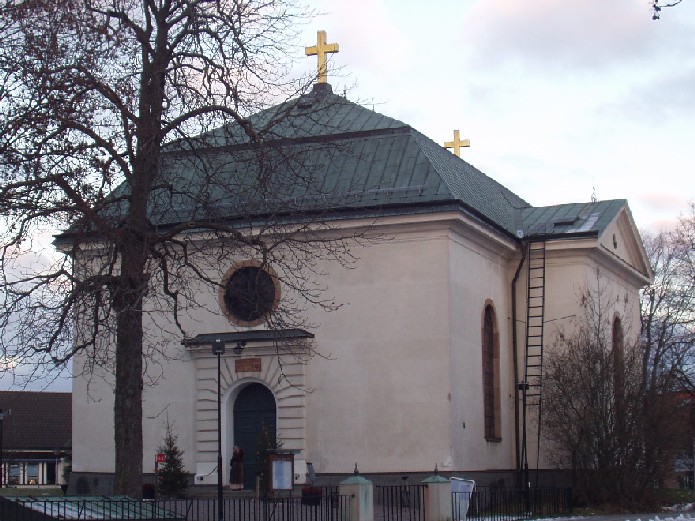
Vaxholm Church (Swedish: Vaxholms kyrka) is a church in central Vaxholm, Sweden. The chapel is a single-nave building built in the Neoclassical style. It was completed in 1803 according to drawings by Carl Fredrik Adelcrantz and Olof Tempelman. It replaced an earlier wooden church in Vaxholm.
As early as the 16th century Vaxholm had a small chapel or meeting house to gather for worship located where the customs house has stood since 1738, by the water across from Vaxholm Fortress ( Kastellsundet ).
In the middle of the 17th century, plans were made to expand Vaxholm. Tax breaks were introduced and the population grew to 163 residents. Vaxholm became its own parish in 1644, and the construction of a more solid wooden church was begun. The church building was financed by mantal and livestock allowances. Drots Per Brahe made the largest contribution, and the church was named St. Peter's Church ( Petrikyrkan ) after him.
There is some question about where this church was located. The old church was either higher up in Vaxholm, slightly west of today's church, or down by Kastellsundet. It was made of wood and chipboard and had a tower, 28 rows of benches and three stands. Two of the stands were intended for the citizens of the city and the crew of the third fortress. It is featured in Erik Dahlbergh's book.
In 1735, lightning destroyed the belfry. In 1746, the old church was considered to be in such poor condition that it was not worth repairing, but several fixtures were transferred to the new one. The only thing today that attests to the old church is a memorial stone outside the new building with this inscription:

Anno 1644 funderades sanct Petri kyrckia uthi Waxholm genom fordom praepositi och pastoris then ehrewyrdige och wällärde Herr Erichsons Hellbergs påkostnad anno 1678. On the other side of the stone is the image of "a poor man's rifle" and a text about donating to the house of God and the poor.
The first stone for the present church was laid on 20 September 1760, on the rear east side of the church. The construction took time, and the sign above the entrance indicates that the church was not consecrated until 1803. Superintendent Carl Fredrik Adelcrantz was the architect who designed and would finally approve the church building. Architect Olof Tempelman worked under Adelcrantz as an assistant. When Adelcrantz resigned his public duties in 1795, Tempelman completed the construction. The funds raised were not enough to build the planned tower. The idea was to add this later, and a temporary wooden belfry was built instead. It is still used today. The church was dedicated to the then king, Gustav IV Adolf, and was named Gustav Adolfskyrkan.
Vaxholm's church is an aisleless (single- nave ) building with a short cross arm and a full-width quire. The building faces east–west with its sacristy to the north. The church is covered by a mansard and hip roof. The sacristy was built in 1896 by architect Johan Laurentz [ sv ], when the south entrance was blocked and arched windows were inserted into the gable end. In 1962, the roof was replaced with copper plate. The well-preserved interior is covered by a coffered ceiling.
- 1896 – a major renovation was carried out led by Johan Laurentz [ sv ]. A small sacristy was added, along with an arched chancel window with stained glass, replaced the altar and put in a pulpit, both by the artist Karl Nilsson [ sv ], put in windows in the arms of the transept and in the east gable, re-walled the south side entrance, took removed penthouse in the transept and built new benches.
- Early 20th century – the 18th century crucifix was renovated

- 1909 – the organ was installed by Erik Adolf Setterquist [ sv ]
- 1926 – renovation was carried out by architect Sven Brandel [ sv ]
- 1950 – the belfry was repaired, and the front rows of pews of the church were removed.
- 1962 – a major renovation was carried out led by Vaxholm's city architect Lars O Åkerlund. The metal roof was replaced with one of copper, the cross was gilded on the roof, the outer walls were plastered, the windows were given new dimensions and the stairs at the entrance were renewed.
- 1967–69 – a cloakroom, toilet, cleaning room and waiting room were built under the organ gallery. The organ was modernized by expanding it to 22 parts. The sacristy was repaired and the lighting in the church was changed.
- 1986 – the main entrance was rebuilt with a new staircase and wheelchair ramp. These were changed again a few years later.
- 1994–95 – the floor of the church room was redone, the interior was repainted and the buildings under the organ gallery were changed, by, among other things, enlarging the window to make it brighter. All according to a proposal by Hilding Lögdberg who also built the Resarö chapel [ sv ] parish house.
- 1998 the outer walls of the church and the Åkerberg Funeral Choir were plastered.
As early as the 16th century Vaxholm had a small chapel or meeting house to gather for worship located where the customs house has stood since 1738, by the water across from Vaxholm Fortress ( Kastellsundet ).
In the middle of the 17th century, plans were made to expand Vaxholm. Tax breaks were introduced and the population grew to 163 residents. Vaxholm became its own parish in 1644, and the construction of a more solid wooden church was begun. The church building was financed by mantal and livestock allowances. Drots Per Brahe made the largest contribution, and the church was named St. Peter's Church ( Petrikyrkan ) after him.
Closest places in our Sweden guide.
More places to explore in Sweden.