
Italy
Molfetta Cathedral
Cathedral · Molfetta
Church building

The co-cathedral of Santa Maria Assunta in Giovinazzo stands on a pre-existing church dedicated to Santa Maria dell'Episcopio. It is the mother church of the city.
The building was constructed in 1113 and consecrated in 1283.
It is attested that the first bishop of the co-cathedral was a certain Grimoaldo or Grimaldo, around the year 1022.
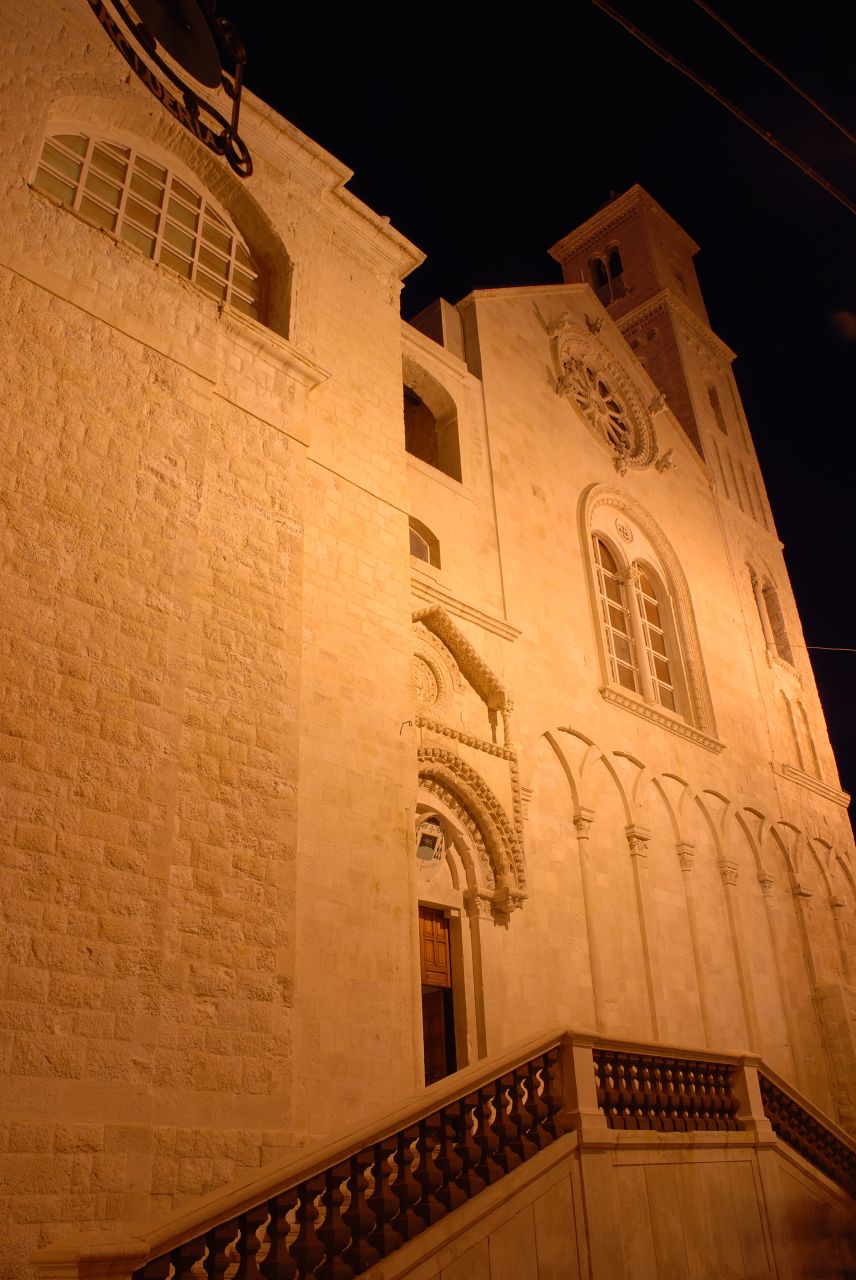
The current cathedral, which stands on the site of an older building, called by the sources Santa Maria de Episcopio, was built during the 12th century in the Norman age, dating back to between 1125 (beginning of the construction of the crypt) and 1180 (completion of the upper church).
The building was consecrated only a century later, on 23 May 1283. The Romanesque cathedral had three naves divided by columns, with a trussed ceiling, false galleries and a mosaic floor. Few traces remain of this church today, due to the renovation works on the building during the eighteenth century (between 1730 and 1752 under bishop Paolo de Mercuzo ), which led to the total renovation of the interiors according to the baroque taste: they belong to the ancient Romanesque church the rear façade, closed between two bell towers (of which the smallest, however, is from the seventeenth century), part of the presbytery area and the crypt.

It is known that on 16 July 1522 Duke Don Ferdinando of Capua received homage from the two mayors of the squares and the body of the Universitas (city title).
It is worth noting that some members of the noble Chyurlia family held important religious positions in the co-cathedral during the 16th century.
The city of Terlizzi was declared co-cathedral of Giovinazzo by Pope Benedict XIV due to a dispute over the acquisition of Pious Institutes between the city of Terlizzi and the prelates of Giovinazzo ; the title of co-cathedral was later abolished.
The new organ dates back to 1779, commissioned by La Pegna.
On 25 April 1843 the insignia of the mozzetta of the cathedral of Giovinazzo was granted, with the cappa magna.

In the 1970s, various ancient documents were lost due to theft in the diocese of Piglia but the Carabinieri of Apulia made a major discovery of the various manuscripts, including some of those from the co-cathedral of Giovinazzo, recovered in 2010.
On 6 January 2025, the bishop of the diocese H.E. Monsignor Domenico Cornacchia presided over the mass and opened the holy door of the Co-Cathedral.
In the 1970s, various ancient documents were lost due to theft in the diocese of Piglia but the Carabinieri of Apulia made a major discovery of the various manuscripts, including some of those from the co-cathedral of Giovinazzo, recovered in 2010.
On 6 January 2025, the bishop of the diocese H.E. Monsignor Domenico Cornacchia presided over the mass and opened the holy door of the Co-Cathedral.
Inside, the church has three naves divided by pillars, with a large transept, three side chapels on each side, and a large main altar. The apse is completely covered with canvases by the Giovinazzo painter Carlo Rosa from 1676, which depict Maria Assunta and other saints. In the right arm of the transept and in the presbytery area, during the restoration work of the 1990s, traces of mosaics from the ancient Romanesque flooring of the cathedral were brought to light, dating back to the end of the 12th century.
The altars of the side chapels are dedicated to the Blessed Sacrament, Santa Maria delle Grazie, Blessed Nicola Pagla, the Crucifix, Santa Maria di Loreto and San Francesco Saverio. The most important is the chapel of the Blessed Sacrament, built in 1768 by Gennaro Sammartino and Crescenzo Tronchese. Of particular historical-artistic value are two panels: one from the thirteenth century, of Byzantine workmanship, depicting the Madonna of Corsignano; and the other fifteenth-century one depicting the Redeemer.
An ancient organ could be found above the presbytery in the altar of the royal chapel, according to the documents written in a pastoral visit of Bishop Joannes Antolinez Brizianos de la Ribeira.
The current organ of the Giovinazzo cathedral dates back to the 15th century. XVII, from the year 1724, commissioned by the bishop mons. Giacinto Gaetano Chiurlia (or Chyurlia), replacing an earlier one, dated 15th century. XV.
Monsignor Paolo de Mercurio, who succeeded Bishop Chiurlia, in 1741, through his money and that of Monte dello Spoglio (view as Mount of piety, it was a local Christian religious credit institution of the time, still extinct), built a new organ in Bari to be placed in the co-cathedral.
The organ was restored a second time, in recent times by Pagliarulo Pierfrancesco, taking it to Castellana Grotte, between the years 2002–2003.
Closest places in our Italy guide.
More places to explore in Italy.


