Spain
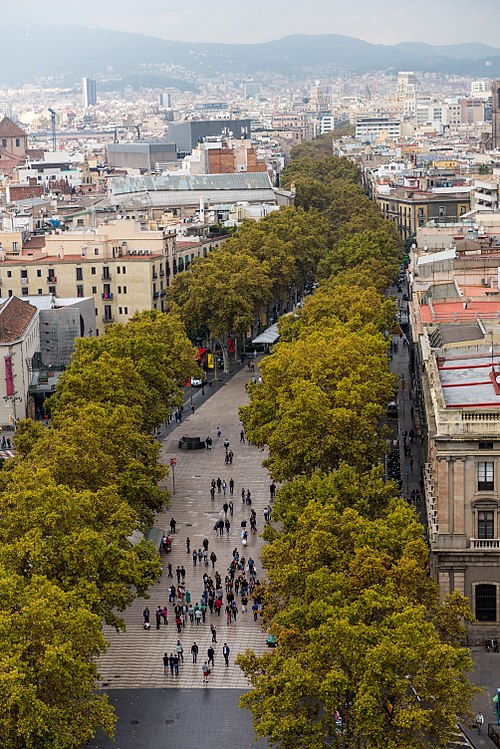
La Rambla
Street · El Raval
Opera house

The Gran Teatre del Liceu (Catalan: [ˈɡɾan teˈatɾə ðəl liˈsɛw]; Spanish: Gran Teatro del Liceo [ˈɡɾan teˈatɾo ðel liˈθeo]; English: "Great Lyceum Theater"), or simply Liceu, is a theater in Barcelona, Spain. Situated on La Rambla, it is the city's oldest theater building still in use for its original purpose. Founded in 1837 at another location, the Liceu opened at its current address on 4 April 1847. The theater was rebuilt after fires in 1861 and 1994, and reopened on 20 April 1862 and 7 October 1999. On 7 November 1893, on the opening night of the season, an anarchist threw two bombs into the stalls. About twenty people were killed, and many more were injured. Between 1847 and 1989, the 2,338-seat Liceu was the largest opera house in Europe by capacity. Since 1994, the Liceu has been owned and managed by a public foundation whose board of trustees represents the Ministry of Culture, the Generalitat de Catalunya, the Provincial Deputation of Barcelona and the City Council of Barcelona. The theater has its own choir (the Cor del Gran Teatre del Liceu), symphony orchestra (the Orquestra Simfònica del Gran Teatre del Liceu) and college of music (the Conservatori Superior de Música del...
In 1837, the Liceo Filodramático de Montesión (Philodramatic Lyceum of Montesión, now named Conservatori Superior de Música del Liceu) was founded in Barcelona to promote musical education (hence the name "Liceo", or lyceum.) It organized opera productions performed by Liceo students.
A theater (Teatro de Montesión, or Teatro del Liceo de Montesión) was founded in a convent building, and plays and operas were performed. The first performance was Vicenzo Bellini 's Norma, on 3 February 1838. The repertoire was Italian, the most-performed composers were Donizetti, Mercadante, Bellini and Rossini. The Barcelona premiere of Hérold 's Zampa was held here.
In 1838, the society changed its name to Liceo Dramático Filarmónico de S. M. la Reina Isabel II (Dramatic Philharmonic Lyceum of H.M. Queen Isabel II). Lack of space and pressure from the nuns who formerly owned the convent and had the right to return motivated the Liceu to leave its location in 1844. The last performance there was on 8 September of that year.
The Trinitarian convent building in Barcelona's central La Rambla was purchased, and the Liceu's managers entrusted Joaquim de Gispert d'Anglí with construction of a new building. Two societies were created: a "building society" and an "auxiliary building society." Shareholders of the building society obtained the permanent right of use of some theater boxes and seats in exchange for their economic contributions. Auxiliary-building-society shareholders contributed the rest of the money necessary in exchange for rights to other spaces in the building, including some shops and the private Círculo del Liceo club.

Unlike other European cities where the monarchy was responsible for the building and upkeep of opera houses, the Liceu was funded by private shareholders of what would become the Societat del Gran Teatre del Liceu (Great Liceu Theater Society, organized similarly to a trading company or societat ). This is reflected in the building's architecture; there is no royal box. Since the queen did not contribute to construction, the society's name was changed to Liceo Filarmónico Dramático.
With Miquel Garriga i Roca as the architect, construction began on 11 April 1845. The theater was opened on 4 April 1847.
Opening, fire and rebuilding (1847–1862)
The opening presented a mixed program which included the premieres of a José Melchior Gomis musical ouverture, the historical play Don Fernando de Antequera by Ventura de la Vega, the ballet La Rondeña ( The Girl From Ronda ) by Josep Jurch, and the cantata Il regio himene with music by Liceu musical director Marià Obiols. The first complete opera, Donizetti's Anna Bolena, was presented on 17 April 1847.
Liceu was the biggest opera house in Europe, with 3,500 seats. Other operas performed during the first year were (in chronological order) I due Foscari (Verdi), Il bravo (Mercadante), Parisina d'Este (Donizetti), Giovanna d'Arco (Verdi), Leonora (Mercadante), Ernani (Verdi), Norma (Bellini), Linda di Chamounix (Donizetti) and Il barbiere di Siviglia (Rossini).

The building was severely damaged by fire on 9 April 1861, but was rebuilt with a design by architect Josep Oriol Mestres and re-opened on 20 April 1862 with a performance of Bellini's I puritani. Of the old building, only the facade, the entrance hall and the foyer (Hall of Mirrors) remained.
On 7 November 1893, during the season's opening night and the second act of Rossini’s opera Guillaume Tell, two Orsini bombs were thrown into the Liceu's stalls. Although only one of the bombs exploded, about twenty people were killed and many more were injured. The attack by anarchist Santiago Salvador shocked Barcelona, and became symbolic of the era's social unrest. The Liceu re-opened its doors on 18 January 1894, but the seats occupied by those killed were not used for a number of years. The second bomb was displayed at the Van Gogh Museum in 2007, during the exhibition "Barcelona around 1900".
In 1909, the auditorium was renovated. Spanish neutrality during World War I allowed the Catalan textile industry to amass enormous wealth by supplying the warring parties. The 1920s were prosperous; the Liceu became established, welcoming leading singers, conductors and companies such as Sergei Diaghilev 's Ballets Russes.
When the Second Spanish Republic was proclaimed in 1931, political instability triggered a financial crisis for the Liceu which was overcome with subsidies from the Barcelona City Council and the regional Catalonia government. The theater was nationalized during the Spanish Civil War and was renamed Teatre del Liceu – Teatre Nacional de Catalunya (Liceu Opera House – the National Theater of Catalonia); its opera seasons were suspended. After the civil war, in 1939, the Liceu was returned to its original owners.
From 1940 to the 1960s, the seasons were high-quality. In 1955 the Bayreuth Festival Company visited. They performed Parsifal, Tristan und Isolde and Die Walküre, with innovative sets by Wieland Wagner and were enthusiastically received. An economic crisis affected the theater during the 1970s; the privately based organization could not afford the increasing cost of modern opera productions, and overall quality declined.

New direction and second fire (1980–1994)
The death of Joan Antoni Pàmias [ es ] in 1980 revealed the need for the intervention of official bodies if the Liceu was to remain a leading opera house. In 1981, the Generalitat de Catalunya, Barcelona's City Council and the Societat del Gran Teatre del Liceu created the Consorci del Gran Teatre del Liceu (Consortium of the Great Liceu Theater) responsible for the theater's management.
The Provincial Deputation of Barcelona and the Spanish Ministry of Culture joined the consortium in 1985 and 1986, respectively. The consortium attracted the public back to the Liceu quickly with improvements in its artistic standard. This included a more complete and up-to-date perspective of the nature of an opera performance, improvements to the choir and orchestra, careful casting, and attracting public interest to aspects of productions other than the leading roles. This approach, coupled with new economic support and a more-discerning public, resulted in quality productions.
The consortium maintained high standards in casting, production and public loyalty (measured by attendance) until a 31 January 1994 fire which destroyed the building, caused by a spark that fell on the curtain during a routine repair during the run of Paul Hindemith 's Mathis der Maler. The following opera was scheduled to be Puccini 's Turandot.
Public and institutional response was unanimous on the need to rebuild the opera house on the same site with improved facilities. The new Liceu is the result of efforts to preserve parts of the building unaffected by the fire which had also survived the 1861 fire. The auditorium was rebuilt with the same layout, with new the roof paintings by Perejaume and state-of-the-art stage technology.
Closest places in our Spain guide.
More places to explore in Spain.


