
Australia
Bolte Bridge
Cantilever bridge · City of Melbourne
Ferris wheel

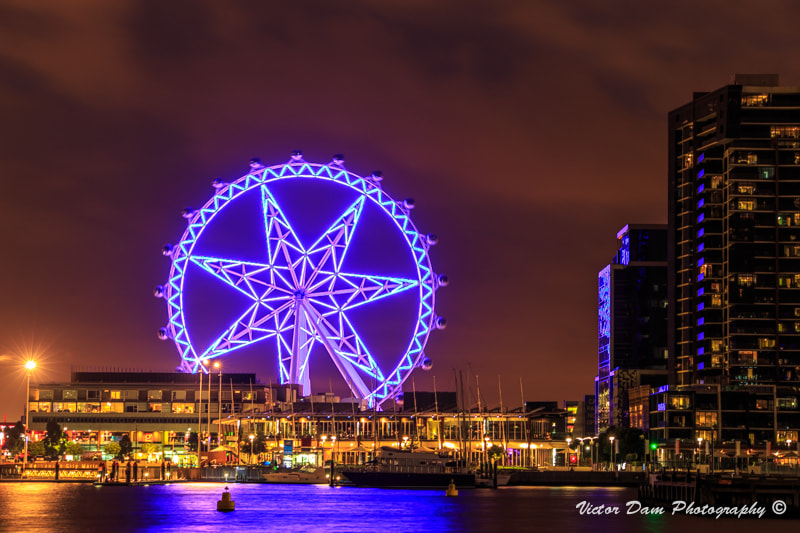
The Melbourne Star (previously Southern Star) is a closed 120-metre-tall (390 ft) Ferris wheel in the suburb of Docklands in Melbourne, the state capital of Victoria, Australia.
Described by its operators as an "observation wheel" and claimed to be "the Southern Hemisphere's only giant observation wheel", it is 120 m (394 ft) tall and has seven spokes, reflecting the seven-pointed star of the Australian flag. It opened two years behind schedule in December 2008, but closed 40 days later due to structural defects. The wheel itself was scrapped and replaced, but the original support structure and passenger cabins were retained. It was originally thought that reconstruction might be completed in late 2010, but repeated delays meant it did not reopen until 23 December 2013. A ride (one complete rotation) takes 30 minutes and, according to the Star's website, provides uninterrupted 360-degree views of up to 40 kilometres (25 mi) "encompassing the Docklands precinct, Melbourne’s CBD, Port Phillip Bay and as far as Mount Macedon, Arthurs Seat and the Dandenong Ranges." The wheel closed on 6 September 2021, due to the COVID-19 pandemic; however, it's planned to be reopened in 2026.
The project was undertaken by ING Real Estate, and the construction consultant was Hansen Yuncken. The wheel was designed and built by Sanoyas Rides Corporation, a wholly owned subsidiary of the Japanese ship and amusement park ride builder Sanoyas Holdings Corporation. The steel builder was Alfasi Steel Constructions.
Construction began in 2006. By 1 March 2008, the outer rim had been completed; by 21 October, air-conditioned enclosed passenger cabins, built in Osaka, Japan, were receiving their fit-out. Each cabin weighs 13 tonnes, is 5.7 m (19 ft) long and 3.7 m (12 ft) high, has floor to ceiling glass walls, and can accommodate up to 20 passengers.
The wheel first opened to the public on 20 December 2008, two years behind schedule. Its ceremony, scheduled for 28 November 2008, was cancelled due to bad weather and delays in procuring parts. It had cost an estimated A$ 100 million to construct and was expected to attract more than one million visitors annually. At opening, tickets cost $29 for adults and $17 for children; as of 2018, tickets cost $39 for adults and $27 for children.

On 30 January 2009, 40 days after opening, the wheel was shut down by WorkSafe after cracks up to three metres (9.8 ft) long were discovered by a contract worker installing LED lighting. One node was almost completely torn from its welded joint. Initially, the operators blamed the 2009 Southeastern Australia heat wave for causing the damage, and it was not known when the wheel would reopen.
Upon further investigation, engineers working on the wheel discovered the cracks were not caused by the heatwave but rather a problem in the original design. Fourteen cracks were found in the steel.
An undated press release on the operator's official website stated: "The Southern Star Observation Wheel was temporarily closed in January 2009. As a result of extensive design and technical reviews a conclusion was reached to build a new wheel."
Sanoyas, who designed and built the wheel, accepted responsibility for the cracks and undertook its reconstruction under warranty. Consulting engineers Arup, steel builder Alfasi, and construction consultant Hansen Yuncken signed confidentiality agreements preventing them from commenting publicly. Most of the original wheel was sold for scrap, but the main support columns and the passenger cabins were retained and reused.
The reconstruction process began in a factory in Dandenong South in December 2009, at which time it was expected that a year would pass before the wheel would reopen.
In October 2010 it was reported that the viability of the wheel was in doubt after contractors stopped work because they had not been paid, although a spokeswoman for Southern Star Management Group denied this, stating that "the construction process is extremely intricate and highly influenced by adverse weather conditions, including rain, wind, [and] hot and cold weather".
In January 2011, the first of the seven replacement spokes, manufactured by BMC in the Latrobe Valley, was delivered to Docklands. In July 2011, the wheel was expected to be turning again by the end of the year.
On 28 November 2011, reconstruction work was in progress when the wheel broke free from its restraints and began turning in strong winds, resulting in minor injuries for one of the workers as they fled the site. The next day, Southern Star Management issued a statement saying that bracing used to erect the wheel had failed, and that no final completion date for the wheel had yet been confirmed. In December it was reported that the wheel was not expected to reopen before Easter 2012.
In January 2012, it was reported that an international team of experts including Arup (who were involved in both the London Eye and the Singapore Flyer projects) and Hyder Consulting had been engaged in the redesign, and that reconstruction was now expected to be completed before the end of the year. In June it was reported that the then owner ING Real Estate had repeatedly refused to announce an estimated completion date, but that an estimated date might be given at a briefing of state government officials planned for July.
In August, it was reported that the wheel could reopen in January 2013, but only if there was "no wind, no rain for the next four months" – an unlikely scenario for Melbourne, "a city renowned for extremely windy springs and rain that washes out the first cricket matches". According to spokesman Ken Davis, 70 per cent of available construction time was being lost each week as cranes and lifts on the site could not operate in bad weather. He also stated that "due to the complexity of the construction process, we are not in a position to make any announcements regarding a 2013 opening date". However, later that same month, after the final section of the rim was installed, he stated "we're hoping it will be completed by the middle of next year".

In January 2013, ING Real Estate advised that the wheel would not reopen until the second half of the year.
The project was undertaken by ING Real Estate, and the construction consultant was Hansen Yuncken. The wheel was designed and built by Sanoyas Rides Corporation, a wholly owned subsidiary of the Japanese ship and amusement park ride builder Sanoyas Holdings Corporation. The steel builder was Alfasi Steel Constructions.
Construction began in 2006. By 1 March 2008, the outer rim had been completed; by 21 October, air-conditioned enclosed passenger cabins, built in Osaka, Japan, were receiving their fit-out. Each cabin weighs 13 tonnes, is 5.7 m (19 ft) long and 3.7 m (12 ft) high, has floor to ceiling glass walls, and can accommodate up to 20 passengers.
The wheel first opened to the public on 20 December 2008, two years behind schedule. Its ceremony, scheduled for 28 November 2008, was cancelled due to bad weather and delays in procuring parts. It had cost an estimated A$ 100 million to construct and was expected to attract more than one million visitors annually. At opening, tickets cost $29 for adults and $17 for children; as of 2018, tickets cost $39 for adults and $27 for children.
On 30 January 2009, 40 days after opening, the wheel was shut down by WorkSafe after cracks up to three metres (9.8 ft) long were discovered by a contract worker installing LED lighting. One node was almost completely torn from its welded joint. Initially, the operators blamed the 2009 Southeastern Australia heat wave for causing the damage, and it was not known when the wheel would reopen.
Closest places in our Australia guide.
More places to explore in Australia.


.jpg?width=1200)


.jpg?width=1200)
.jpg?width=1200)
.jpg?width=1200)


