Romania
Castrum Argamum
Castrum · Jurilovca
Archaeological site

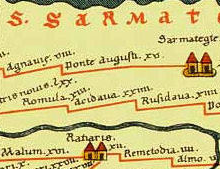
Histria or Istros (Ancient Greek: Ἰστρίη) was founded as a Greek colony or polis (πόλις, city) on the western coast of the Black Sea near the mouth of the Danube (known as Ister in Ancient Greek) whose banks are today about 70 km away. In antiquity, it also bore the names Istropolis, Istriopolis, and Histriopolis (Ἰστρόπολις, Ἰστρία πόλις) or simply Istros/Histros (Ἴστρος). It is now located on the inland shore of a Black Sea lagoon, Lake Sinoe, north of Năvodari and near the modern town of Istria, province of Dobruja, Romania. It may be considered the first urban settlement on today's Romanian territory, founded by Milesian settlers in the 7th century BC and inhabited for at least 1,200 years. Earlier settlements related to the Cucuteni–Trypillia culture precede the settlement at Histria by several millennia, however lack key aspects which characterize urbanization in the concept of Polis and in our modern world. Therefore, it may be most accurate to categorize the Cucuteni-Trypillia settlements as proto-cities, and Histria as the first planned city in Romania. It was under Roman rule from the 1st century AD in the Roman province of Moesia. The Tabula Peutingeriana shows it 11 miles...
Histria was situated on a peninsula on the Black Sea linked by marshy ground to the mainland and near the river known today as Istria. The ancient seashore has since been transformed into the western shore of Sinoe Lake, as the Danube's silt deposits formed a shoal which closed off the ancient coastline. Parts of the city lie under the murky waters of Lake Sinoe which at the time was an open northern bay, while another bay on the southern shore served as the port. The acropolis with sanctuaries was established on the highest point of the city overlooking the sea. The residential town of the 6th century was 1/2 mile (800 m) to the west of the acropolis.
In the Archaic age, Miletus, which Herodotus called "the jewel of Ionia", was one of the most active cities in Greek colonisation. It founded a large number of colonies admired by ancient writers such as Seneca the Elder, Strabo and Pliny, mostly in the Propontis (Sea of Marmara) and Black Sea regions. Many of these were identified and partially discovered in the last two centuries. The Milesian colonisation led to a fundamental change of the Black Sea region, integrating it as a Greek region for the first time in history. The first colonies were founded near the mouths of the great rivers, the Danube and the Don.
Established by Milesian settlers in order to facilitate trade with the native Getae, Histria is considered the oldest urban settlement on Romanian territory. Pseudo-Scymnus (ca 110 BC), dated its founding to 630 BC, while Eusebius of Caesarea set it during the time of the 33rd Olympic Games (657-6 BC). It is believed all six Milesian tribes (Greek: phylai ) were represented in the colony, yet only four tribes are attested: the Aigikoreis, Argadeis, Boreis and Geleontes. It became a Greek city-state with its own large chora (territory) extending to approx. 20 km to the west. It was situated near fertile arable land with fishing and agriculture as additional sources of income.
Trade with the interior followed the foundation of Histria as demonstrated by finds of Attic black-figure pottery, coins, ornamental objects, an Ionian lebes and many fragments of amphoras found in great quantity at Histria, some imported but some local. Pottery, metal and glass objects were produced locally and increasingly before the mid-6th century. Its port traded soon after its establishment with intensive trade with large Greek cities to the south including Miletus, Rhodes, Samos and Athens. Histria flourished during the Archaic and Classical periods.
In 600–550 BC new city walls were built probably in connection with the frequent raids of the Scythians. Nevertheless, at the end of the 6th or beginning of the 5th c. BC the city was destroyed probably by the Scythians following the Scythian campaign of Darius I. It was rebuilt with new temples and industrial production increased.
In the 5th century BC Histria was situated between the Odrysian kingdom and the Scythians ruled by Ariapeithes who were in conflict. Histria was probably forced to join the Delian League and, following a revolution by inhabitants, passed from an oligarchy to democracy.
The earliest documented currency on today's Romanian territory was an 8- gram silver drachma, issued by the city around 480 BC and its coins were widely circulated in the region.
The town was flourishing in the period of Athens's Peloponnesian Wars (431–404 BC) when the Athenian fleet came to the Greek colonies on the Black Sea to collect contributions for the Delian Treasury.
In the early 4th century the city walls were destroyed when the Scythians led by Ateas, who often crossed the Dobrogea area for plunder, were eventually fought off by the Macedonians. The result was Macedonia's domination of the Greek colonies of Dobrogea, and Lysimachus occupied the area after the death of Alexander. Histria suffered significant damage towards the end of the 4th century possibly in the revolt of Pontic Greeks in 313 BC against the Macedonians which failed.
A new temple for a "grand deity", a gymnasium and the theatre were built. Histria became an important supplier of grain for Greece.
In 260 BC Histria was defeated by Byzantion although allied with Kallatis. In the 2nd half of the 3rd century Histria was in constant conflict with the Getae, as shown by inscriptions. Around 200 BC the Getae under their chief Zoltes attacked Histria, calling off the siege only after receiving 5 talents.
Another destruction of the city around 175 BC was most probably wreaked by Bastarni passing through after being called upon by Macedonian king Philip V or Perseus to reinforce the army.
Mithridates installed a military garrison in Histria (175–100 BC) which probably caused the third destruction of the city in the Hellenistic period. Staters of Mithridates were minted in Histria.
In 71 BC the Romans under Marcus Terentius Varro Lucullus, the proconsul of Macedonia, occupied the city and the rest of Dobrogea, but did not leave garrisons afterwards.
At the Battle of Histria in c. 62–61 BC the Bastarnae peoples of Scythia Minor defeated the Roman Consul Gaius Antonius Hybrida, Governor of Macedonia.
At the end of the Hellenistic era (before 30 BC), the city was subjugated by the Dacian king Burebista.
In 29 BC Histria came under Roman domination when Marcus Licinius Crassus, proconsul of Macedonia, annexed the whole of Dobrogea after his military campaign against the Bastarnae who had crossed the Danube and threatened Roman allies in Thrace. This was part of Augustus 's strategy after establishing himself as sole ruler of the Roman state, of advancing the empire's south-eastern European border to the line of the Danube to increase strategic depth between the border and Italy and also to provide a major fluvial supply route between the Roman armies in the region which required the annexation of Moesia.
During the Roman period from the 1st to 3rd centuries AD, a prosperous era began again notable by the construction of a new enclosure wall, new public buildings, including two bathing complexes (Thermae I and II) and temples and laws, as described in inscriptions. In 100 AD the governor of the province of Moesia Inferior, Manius Laberius Maximus, confirmed in a long inscription the Histrian's territorial limits ( fines Histrianorum ) extending to the Danube Delta, rich in fish, where most of the city's income came from at that time ("almost the only income of your city is from salted fish"). Under Caracalla (r.211-217) Histria appears in several inscriptions, "the most brilliant city of the Histrians", a formula that refers both to the glorious past and to the development of the city from that period.
This prosperity was dramatically interrupted in 238 when the city was razed to the ground by the Carpi (Goths). Histria was again rebuilt, although with a much reduced area of about 6-7 hectares, enclosed by a stronger wall, though Histria managed to preserve its identity as a Greek city. The walls were destroyed again by the Goths in 295 and rebuilt under Diocletian and Constantine I. In the 4th-6th centuries Histria represented an important Christian centre, revealed by archaeology. An episcopal basilica was built in the centre of the city where there were at least five other Christian basilicas.
Closest places in our Romania guide.
More places to explore in Romania.