Spain
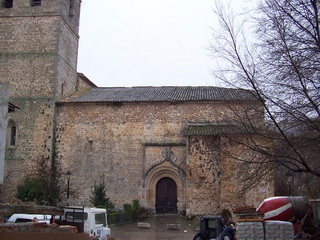
Church of San Salvador
Church building · Cifuentes
Monument

Santa María de Óvila is a former Cistercian monastery built in Spain beginning in 1181 on the Tagus River near Trillo, Guadalajara, about 90 miles (140 km) northeast of Madrid. In 1835 it was confiscated by the Spanish government and sold to private owners. American publisher William Randolph Hearst bought parts of the monastery in 1931 with the intention of using its stones in the construction of a grand and fanciful castle at Wyntoon, California, but after some 10,000 stones were removed and shipped, they were abandoned in San Francisco for decades. These stones are now in various locations around California: the old church portal was erected at the University of San Francisco, and the chapter house was reassembled by Trappist monks at the Abbey of New Clairvaux in Vina, California. Other stones are serving as simple decorative elements in Golden Gate Park's botanical garden. In Spain, the new government of the Second Republic declared the monastery a National Monument in June 1931, but not in time to prevent the mass removal of stones. Today, the remnant buildings and walls stand on private farmland.
The monastery of Santa María de Óvila was founded in 1175 by a grant of land from King Alfonso VIII of Castile to the Cistercian monks of Valbuena Abbey in Valbuena de Duero, Valladolid Province, Castile-León, Spain. In this endeavor, the king was following a general strategy of establishing Catholic institutions on land he had recently won in battle from the Moors of Iberia. The Cistercian "white monks" (wearing undyed habits ) first chose a site in Murel (now called Carrascosa de Tajo) on the Tagus, but after a few years, had to relocate to more fertile zone a few miles nearer to Trillo, Guadalajara, where a flat hilltop by the river commanded a modest view.
The construction began in 1181. The monastic quarters and the church were built over the following three decades. The central cloister was bordered on the north by the church, on the west by a barrel-vaulted great nave, on the east by the sacristy, the priory cell, and the chapter house, and on the south by the kitchen, the pantry and the refectory (dining hall). Some of the buildings were given seven-foot-thick (2 m) walls with slit windows, to serve as a refuge in case the Moors returned to the area. The church was built in the shape of a Latin cross with a nave divided into four sections, and a sanctuary with three square apses. Its presbytery had a central square topped by a pentagon.
In 1191, the king confirmed the monastery and its surrounding fields as belonging to the Cistercian Order. The aged abbot of Santa María de Huerta, bishop Martín de Finojosa (later canonized ), consecrated the church in September 1213 and died days later. The surrounding area of Murel and Trillo along the Tagus prospered, giving tithes and gifts of land to the monastery. The cartulary, Cartulario de Óvila, is preserved at the University of Madrid.
The first buildings were completed in the Gothic style, including the church. The refectory (dining hall) shows an architectural style in transition between earlier Romanesque and contemporary Gothic. A fine High Gothic chapter house was built of best quality hard limestone. The church was rebuilt sometime before 1650 in a late Gothic style with a prominent vaulted ceiling. The cloister was rebuilt around 1617, and is of a simple design with little adornment surrounding a High Renaissance arcade. The final phase of building took place around 1650, with a new doorway for the church, completed in late Renaissance and Plateresque style full of detail. Because of its prosperity and the multiple expansion projects, Santa María de Óvila exhibited examples of every Spanish religious architectural style used from 1200 to 1600. However, even at its height, Óvila remained one of the smallest Cistercian monasteries in the region of Castile.
From the 15th century, changes to the areas surrounding Santa María de Óvila initiated a slow decline. Civil wars depopulated the villages of the upper Tagus valley. The monastery's land holdings passed one by one into the hands of the new regional aristocracy: first the Count of Cifuentes, followed by Rui Gomes da Silva, Duke of Pastrana, and the Spanish Army. Neighbors looted more lands.
A fire destroyed part of the monastery during the War of the Spanish Succession. During the Peninsular War, French troops looted the buildings and used them as barracks. The monks were forced to leave in 1820 because of confiscations by a new liberal government, but they returned in 1823 after King Ferdinand VII restored conservative institutions. However, the nearby villagers denied support to the monastery despite its protection by the king. The monastery ceased to operate in 1835: the Ecclesiastical Confiscations of Mendizábal enforced a law declaring that minor religious holdings housing fewer than 12 residents were to be forfeit to the state; the monastery had only four monks and one lay brother, who were cast out.
After the Confiscations, many of the furnishings and artistic treasures of Santa María de Óvila passed to the surrounding parish churches, especially Ruguilla, Huet, Sotoca de Tajo and Carrascosa de Tajo. Other valuables, such as books and historic documents, were stolen and sold. The remaining contents were auctioned, including wine-making equipment and an oxcart. The precious 328-pages cartulary of the monastery (Spanish: libro tumbo de Santa María de Óvila ) went to a private owner but was donated in 1925 to the Monastery of Santa María la Real of Oseira. The thick manuscript holds copies of royal privileges granted to the monastery throughout its history, as well as the Abadologio, a comprehensive and thorough history of the Cistercian abbots and monks who lived in the monastery, which was written from March 1729 to February 1730 by Father Gerofeo, a Cistercian monk of the monastery of Valparaíso (Zámora).
The new owners of Santa María de Óvila were well-to-do farmers who cared little for the buildings. For a brief time, the former monastery was used as a hostel, but mainly, the buildings were subjected to hard agricultural use as barns sheltering livestock. The chapter house served as a manure pit. Other buildings were used as storage. In the early 20th century small trees were seen to be growing in the dirt packed atop the monastery roofs—the protective roof tiles had long since been taken down and sold.
In 1928, the Spanish state sold the monastery to Fernando Beloso for a little more than 3,100 pesetas, roughly $600 to $700 at the time. Beloso, director of the Spanish Credit Bank in Madrid, was the owner of Coto de San Bernardo in Óvila, which included expansive irrigated grain fields and forests surrounding the monastery.
Arthur Byne, an art agent living in Madrid, whose biggest client was American newspaper magnate William Randolph Hearst, was working for Hearst to acquire an old monastery in 1930. In 1925, Byne had bought Hearst the monastery of Santa María la Real de Sacramenia which was dismantled, crated and shipped to New York where it was stored in a warehouse in the Bronx. (In 1954 it was re-assembled in Florida as a tourist attraction, and was subsequently acquired by the Episcopal Diocese of South Florida and called the St. Bernard de Clairvaux Church.) Byne signaled Beloso to help him locate one; Beloso invited him to see the old Óvila monastery in December 1930, and Byne subsequently sent photographs and sketches to Hearst for approval. Byne listed specific elements, mostly architectural details, to be removed, such as vault ribs, door frames, window embrasures, columns and capitals. Some entire walls of fine facing stones were recommended for removal. He referred to the proposal as "Mountolive", possibly to misdirect the Spanish authorities who were in charge of protecting historical artifacts.
After Hearst conveyed his enthusiasm for the project, Beloso sold Byne the stones for $85,000, including the cloister, the chapter house, the refectory and the dormitory for novices. With Byne's commission, Hearst was to pay $97,000, a price roughly equivalent to $1.82 million as of 2026. Byne started immediately on the project, organizing men and materials, and beginning the removal of stones. Hearst's main architect Julia Morgan sent her associate architect Walter T. Steilberg who arrived on March 9, 1931. Steilberg recommended that Hearst buy the old church portal, which he did, at Byne's price of $1,500. Under the direction of Byne and Steilberg, the monastery was carefully labeled as it was dismantled stone by stone. Antonio Gomez, the local foreman praised by Byne and Steilberg, numbered the blocks on architectural drawings and painted the number in red on the back of each stone.
To move all the stones, Byne and Steilberg had a road built to the Tagus, and a barge attached to a fixed cable was assigned to ferry stones across. An old World War I trench railway was brought in to transport stones from the monastery to the ferry; its rails could be laid into any of the buildings. Men pushed the small rail cars along the narrow gauge tracks; the stones were then lifted into the ferry by crane, and another crane lifted them out of the ferry into trucks. One of the biggest problems that Byne encountered was that Spain's three excelsior factories could not make enough packing material to keep the crate-packing crew supplied. At one point, realizing that the stones were likely to be used in California as external cladding for structural steel walls, Steilberg suggested the facing surface of each stone be sliced to a "veneer" of the thickness of 6 inches (150 mm) for easier packing and shipping, but Hearst wanted to retain the authenticity of the full-sized stones. Byne and Steilberg judged certain walls and utility buildings worthless and left them in Spain. Steilberg returned home at the end of March.
Byne rushed the project in fear that it might be halted at any time by the authorities—Spanish law prohibited the removal of historic artifacts. However, the Spanish government was at that time in disarray and did not enforce the law. Government officials "simply looked the other way" as trucks hauled 700-year-old stones through Valencia to the docks. When King Alfonso XIII abdicated in April 1931, leaving the government in the control of the Second Republic, the new officials stopped the project. Byne's lawyer persuaded the Minister of Labor to allow the work to continue on the grounds that the project employed more than a hundred men and put money into the severely depressed economy.
Doctor Francisco Layna Serrano of nearby Ruguilla had for years tried to save the monastery but had failed to interest the government in the expensive preservation proposal. Realizing that this was his last chance to document the place as its stones were being removed, he wrote a monograph of its history and included a site plan of the layout of buildings, written from memory. As a result of his efforts, on June 3, 1931, Santa María de Óvila was listed as a National Monument of Spain, or Bien de Interés Cultural (Cultural Property). Layna Serrano published his monograph in 1932. In 1933, the monastery's historic cartulary was brought to the University of Madrid and published; the original was archived at the University of Oviedo.
By the time the dismantling was finished on July 1, 1931, some 10,000 stones weighing a total of 2,200 short tons (2,000 t) were shipped on 11 different freighters traveling through the Panama Canal to San Francisco. In 1931 currency, the monastery project had cost Hearst about one million dollars.
Today, a few buildings remain of the original monastery in Spain. These include the winery or bodega, now the oldest surviving building on the site. This was built in the 13th century during the reign of Henry I of Castile, with the upper floor built as a dormitory 27 by 90 feet (8.2 by 27.4 m) covered by a long barrel-vaulted ceiling. Outside of the bodega, crumbling walls, open yards and part of the Gothic roof of the church are visible. The double arches in the walls of the Renaissance-era cloister are still standing, but the arched roof is lost. The foundation of the church can be seen.
The monastery of Santa María de Óvila was founded in 1175 by a grant of land from King Alfonso VIII of Castile to the Cistercian monks of Valbuena Abbey in Valbuena de Duero, Valladolid Province, Castile-León, Spain. In this endeavor, the king was following a general strategy of establishing Catholic institutions on land he had recently won in battle from the Moors of Iberia. The Cistercian "white monks" (wearing undyed habits ) first chose a site in Murel (now called Carrascosa de Tajo) on the Tagus, but after a few years, had to relocate to more fertile zone a few miles nearer to Trillo, Guadalajara, where a flat hilltop by the river commanded a modest view.
The construction began in 1181. The monastic quarters and the church were built over the following three decades. The central cloister was bordered on the north by the church, on the west by a barrel-vaulted great nave, on the east by the sacristy, the priory cell, and the chapter house, and on the south by the kitchen, the pantry and the refectory (dining hall). Some of the buildings were given seven-foot-thick (2 m) walls with slit windows, to serve as a refuge in case the Moors returned to the area. The church was built in the shape of a Latin cross with a nave divided into four sections, and a sanctuary with three square apses. Its presbytery had a central square topped by a pentagon.
In 1191, the king confirmed the monastery and its surrounding fields as belonging to the Cistercian Order. The aged abbot of Santa María de Huerta, bishop Martín de Finojosa (later canonized ), consecrated the church in September 1213 and died days later. The surrounding area of Murel and Trillo along the Tagus prospered, giving tithes and gifts of land to the monastery. The cartulary, Cartulario de Óvila, is preserved at the University of Madrid.
Closest places in our Spain guide.
More places to explore in Spain.