Poland
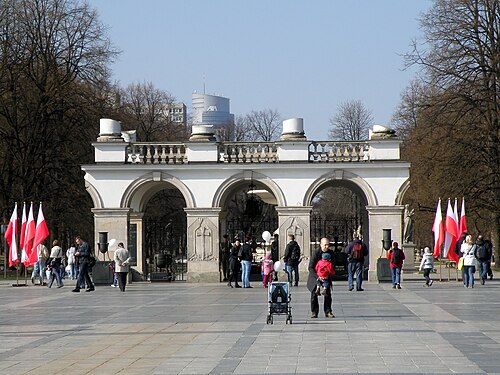
Tomb of the Unknown Soldier, Warsaw
Monument · Warsaw
Palace

The Saxon Palace (Polish: pałac Saski w Warszawie) in Warsaw, Poland, was a historic architectural landmark located on Piłsudski Square in the heart of the Polish capital. Originally built in the 17th century as a noble residence, it was later expanded and transformed into a royal palace under the Saxon House of Wettin in the 18th century. The building underwent several modifications over the centuries, and is most famous for its last, 1838 design in the neoclassical style by the Polish architect Adam Idźkowski, with a distinctive colonnade. The palace played a significant role in Polish history, serving as a military and government headquarters, including housing the Polish General Staff in the interwar period. It was also the site where the German Enigma Cipher was first broken, by Polish cryptologists in 1932. Destroyed by the Germans during the Second World War, only the section of its colonnade which has since 1925 housed the Tomb of the Unknown Soldier, has survived. Plans for the palace’s reconstruction have been discussed since the post-war period, with various proposals put forward over the decades. In 2021, the Polish government launched an official initiative to rebuild the...
A royal residence for the Saxon Kings Augustus II the Strong and his son Augustus III
Originally, the site of the Saxon Palace was occupied by the manor house of Tobiasz Morsztyn [ pl ]. After 1661, his brother and heir, Jan Andrzej Morsztyn, constructed a two-story baroque style palace with four towers on the site of the manor and part of the Sigismund III Embankment, which was known as the Morsztyn Palace ( Polish : Pałac Morsztynów ). In 1713,
In 1713 the Morsztyn Palace was purchased by the first of Poland's two Saxon kings, Augustus II the Strong (reigned in Poland 1697–1706 and 1709–33). The king first had resided in Wilanów Palace, which he had remodeled. The Warsaw Royal Castle, a Renaissance building, seemed too outdated to him. The king expanded and remodeled the palace, now called the Saxon Palace. The works were completed in 1724 and were overseen by Carl Friedrich Pöppelmann and Joachim Daniel von Jauch. The renovated palace became part of the baroque urban development of the Saxon Axis, which extended from Krakowskie Przedmieście to the Mier Barracks.
Starting in 1716, the palace's Theater Hall, along with an amphitheater in the Saxon Garden and the Royal Castle, served as a venue for theatrical performances—Warsaw did not yet have a dedicated theater building at that time. The palace's decorations were designed by Louis de Silvestre.

As part of the expansion of the complex, adjacent noble residences were incorporated. In 1721, the estate of the Sanguszko family, later known as the Brühl Palace, was added. In 1726, the residence of Bishop Teodor Andrzej Potocki was annexed and later transformed into the Blue Palace, intended for Anna Orzelska, the illegitimate daughter of Augustus II the Strong. The reconstruction of the palace and the development of the Saxon Axis took place in three phases: the first from 1713 to the early 1720s, the second until the death of Augustus II in 1733 (when financial and political constraints significantly slowed construction), and the final phase in the 1730s and 1740s, when his son king Augustus III completed the redevelopment of the complex (amongst other works two wings were added in 1748).
The entrance front of the Saxon Palace in the 18th century
The garden front of the Saxon Palace in the 18th century
Second half of the 18th century and early 19th century: Decline
After the death of Augustus III of Saxony in 1763, the palace lost its status as a royal residence and fell into decline. However, it remained in the possession of successive Saxon electors, who rented out its rooms for offices and apartments.

On 17 April 1794, during the Warsaw Uprising, one of the two largest battles in the capital took place in front of the eastern side of the Saxon Palace. The insurgents repelled an attack by a strong column of Russian troops attempting to relieve General Iosif Igelström, the commander-in-chief of the Russian army, who was besieged in a palace on Miodowa Street.
From 1804, the Saxon Palace housed the Warsaw Lyceum. In the autumn of 1810, Nicolas Chopin and his wife Justyna, along with their children Ludwika and Frédéric, moved into the second floor of the palace’s right wing. On 1 October 1810, Frédéric Chopin’s father began working as a French language teacher at the Warsaw Lyceum. The Chopin family lived in the Saxon Palace until 1817.
Between 1808 and 1816, the palace remained the property of the kings of Saxony. However, after the Congress of Vienna forced king Frederick Augustus I to renounce his title as Duke of Warsaw, the palace was sold to the government of the Kingdom of Poland.
In 1817, attempts were made to change the character of the building and its surrounding landscape. Polish architect Piotr Aigner proposed a partial reconstruction of the palace, including the addition of an avenue of one hundred columns along the Saxon Axis. However, this plan was never realized, as the then viceroy, Józef Zajączek, abandoned the project due to its high costs.
A military parade in front of the Saxon Palace

19th century: Reconstruction and Military Use
In 1837, Adam Idźkowski, a master of construction and surveying as well as a graduate of the Fine Arts Department of the University of Warsaw, was commissioned to design the reconstruction of the Saxon Palace by its new owner, merchant Ivan Skwarcov, who had purchased the building from the government for 115,200 złoty. Other architects, including Enrico Marconi and Antonio Corazzi, also participated in the competition for the palace’s redesign. Although Marconi’s project won, viceroy Ivan Paskevich rejected it without justification and approved Idźkowski’s design instead.
Between 1839 and 1842, the palace was rebuilt in a neoclassical style based on Idźkowski’s plans. The central part of the building was demolished and replaced with a Corinthian colonnade. The two side wings were also modified, incorporating pilasters that complemented the style of the colonnade. The reconstructed palace retained the name of the original building.
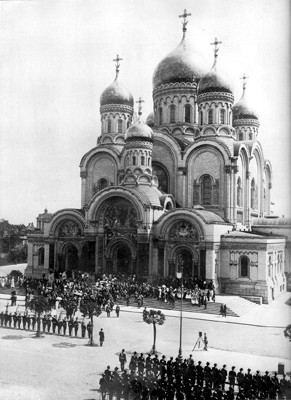
In November 1841, a monument designed by Antonio Corazzi was unveiled in front of the palace, commemorating seven Polish loyalist officers who were killed on 29 November 1830, by insurgents for refusing to join the uprising. Between 1894 and 1912, the monumental Alexander Nevsky Cathedral, featuring a 70-meter-high bell tower facing Królewska Street, was built in the square. Due to the construction of the cathedral, the loyalist officers’ monument was relocated to Zielony Square.
In 1864, Ivan Skwarcov’s heirs sold the palace to the military authorities. Until 1915, the building was occupied by the army of the Russian Empire and served as the headquarters of the Command of the Third Warsaw Military District.
Closest places in our Poland guide.
More places to explore in Poland.