Italy
Roman College
Palazzo · Rome
Church building

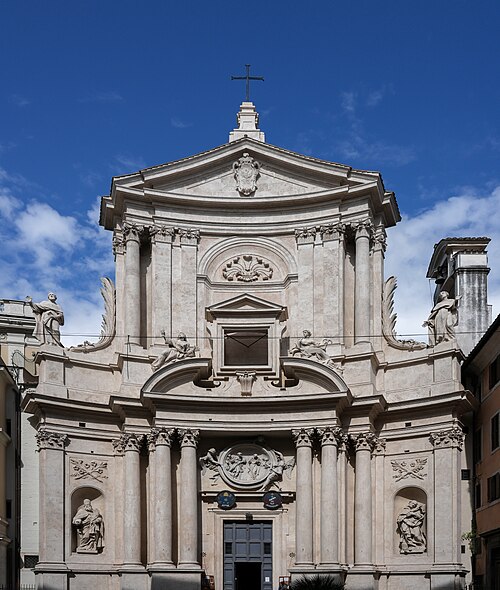
The Oratory of San Francesco Saverio del Caravita (St. Francis Xavier “del Caravita”) is a 17th-century baroque oratory in Rome, near the Church of Sant’Ignazio in rione Pigna. It is home to the Caravita Community, an international English-language Catholic community in Rome.
The current oratory is built over the ruins of the late twelfth century Church of San Nicola de Forbitoribus. The earliest reference to San Nicola is in the Ordo of Cencius Camerarius of 1192.
Forbitoribus apparently refers to the Confraternity of the Forbiciai – the "scissors-makers" and manufacturers of knives. It was a common practice in the 12th century for churches to be sponsored by specific guilds or artisans’ associations, such as Saint Benedict of the Kettle-Makers ( de Caccabis ), Saint Mary of the Blacksmiths ( de Ferraris ), Saint Nicholas of the Lime Burners ( Calcarariorum ), Saint Nicholas of the Rope Makers ( Funariorum ).
The Church of San Nicola is referenced in a bull of Pope Urban V (1362-1370).
On 1 September 1405, the church and bell tower were struck by lightning and suffered considerable damage.
On 14 September 1551, Pope Julius III entrusted the Church to the Camaldolese monks, who established a monastery adjacent to the church dedicated to Saint Anthony of Egypt.
By 1631, the Society of Jesus had established itself next door with the Collegio Romano, and sought to expand nearby to accommodate the active sodalities and lay congregations regularly meeting in the College. The Jesuits acquired the property from the Camaldolese in exchange for a site near Piazza Venezia. The Camaldolese relocated to Saint Romuald, and the Jesuits set about demolishing the older church and monastery in favor of a new oratory.

The current oratory was built by the Jesuit Pietro Gravita, from 1631-1633, with the financial support of a number of noble families who resided in the neighborhood near the Pantheon. Construction was inaugurated on 8 September 1631 with the blessing of Bishop Emilio Altieri, an alumnus of the Collegio Romano and Bishop of Camerino, La Marche, from 1627-1666. Created a cardinal in 1669, Bishop Altieri was elected Pope Clement X in 1670.
The oratory was originally dedicated to Santa Maria della Pietà (Our Lady of Pity) in addition to the great Jesuit missionary Saint Francis Xavier. Under Gravita "it attracted as many os 20,000 communicants a day". It was the first nocturnal oratory in Rome.
Father Gravita was from Terni, and the difference in dialect was apparently enough that the Romans changed the pronunciation of his name to "Caravita". After his death in 1658, the oratory also became known as the oratory “of the Caravita”.
One of the first purpose of the Oratory of St. Francis Xavier was the Missione Urbana, a Jesuit outreach funded by charitable donation, focused on the evangelization and catechesis of farmers and others who came into the Roman markets from the outlying farmlands, which lacked proper pastoral care.
Soon several confraternities, sodalities, and lay congregations began to use the oratory to support their work, including the Mantelloni, a lay penitential confederacy at the Collegio Romano known for its excessive displays of self-mortification.
Another that quickly gained appeal for the students of the Collegio Romano, and which met at the Oratory del Caravita, was the Sodality of the Blessed Virgin, founded in 1563 by a Belgian Jesuit, Jean Leunis.

In 1584, Pope Gregory XIII had ratified the sodality of the Roman College as the prima primeria, or primary unit, to which all other sodalities were to be affiliated, creating a universal structure for these movements. This became a model for the relationship of the other congregations and sodalities, causing the Oratory del Caravita to become the centre of Jesuit-sponsored lay movements known as Congregazione della Santissima Communione Generale, Congregations of General Holy Communion, known for their emphasis on frequent reception of Holy Communion and Eucharistic processions.
In addition, each of these movements emphasized a deep spiritual life of meditation and examination of conscience. Many had a strong charitable orientation, and embraced a broad spectrum of the population: farmers, lawyers, artisans, students, aristocrats, and the guilds.
At the height of their activity, there were nine such organizations housed in the Caravita Oratory, including the first to open membership to women. Each had its own meeting space in the Oratory, but on Friday evenings all would come together for common devotions and formation with the Jesuits who studied or taught at the neighboring Collegio Romano.
Caravita’s mission was consistent with the pastoral strategy of the Jesuits’ founder, Saint Ignatius of Loyola. Whereas monasteries and convents of monks and nuns were in the countryside, Ignatius and the early Jesuits were in the heart of the city where, alongside the elegant palazzi of Rome’s nobility, there was suffering and need. It was here that Ignatius developed a strategic program for Jesuit ministries: hearing confessions, preaching, teaching, but also caring for the poor and victims of the plague, as well as ministering to prostitutes and steering them into houses of reformation.
In 1773, with the suppression of the Society of Jesus, the oratory was under the care of the Fathers of the Holy Faith (later called “Fathers of the Faith of Jesus”), with the help of the Vincentians. These attempted to maintain the Ignatian vision and mission strategy in the absence of the Jesuits. After the restoration of the Society in 1813, the Oratory was used as the center of activity for all Jesuit lay associations in Rome, until falling into disuse in 1925.
The current oratory is built over the ruins of the late twelfth century Church of San Nicola de Forbitoribus. The earliest reference to San Nicola is in the Ordo of Cencius Camerarius of 1192.
Forbitoribus apparently refers to the Confraternity of the Forbiciai – the "scissors-makers" and manufacturers of knives. It was a common practice in the 12th century for churches to be sponsored by specific guilds or artisans’ associations, such as Saint Benedict of the Kettle-Makers ( de Caccabis ), Saint Mary of the Blacksmiths ( de Ferraris ), Saint Nicholas of the Lime Burners ( Calcarariorum ), Saint Nicholas of the Rope Makers ( Funariorum ).
Closest places in our Italy guide.
More places to explore in Italy.