Germany
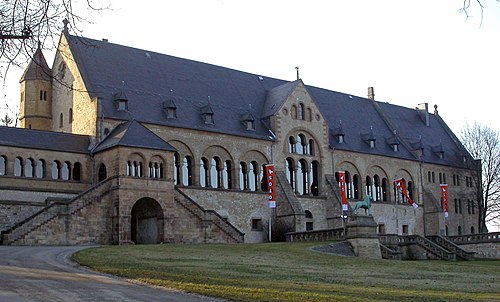
Imperial Palace of Goslar
Kaiserpfalz · Goslar
Mining museum

According to legend, the mountain was named after a knight called "Ramm", who was a henchman of Emperor Otto the Great. In 968, whilst out hunting, the knight tied his horse to a tree, in order to pursue some deer through almost impassable terrain. His charger impatiently pawed the ground with its hooves whilst waiting for his master to return and so exposed a vein of silver ore. According to another explanation, the name may be derived from the widespread ramsons ( Low German : Ramsen ) found on the slopes. It is most probably however, that "ram" is a very old word-explanation for "ore with copper". In Italian today "rame" means "copper".
Unlike the mineral deposits of the Upper Harz, the ore deposits at the Rammelsberg were caused by the escape of hot, metal-bearing, thermal springs on the sea floor in the Devonian period. This formation is referred to as a sedimentary exhalative deposit. At the bottom of the Devonian sea, two large massive sulfide lenses formed that were later caught up in the folding of rocks during the Carboniferous period and so lie overturned at an angle in the mountain.
Ore mining started in the "Old Bed" or "Old Orebody" ( Altes Lager ), exposed on the surface by erosion, during the Bronze Age. The "New Bed" ( Neues Lager ) was only discovered in the 19th century as a result of specific exploration. The mines were exhausted only in the 1980s, and were shut down in 1988. The ore contained an average of 14% of zinc, 6% lead, 2% copper, 1 g/t gold and 140 g/t silver.
The mining history of the Rammelsberg occurred as a continuous process in different phases. Initially the main product was copper ore, then, (much) later lead, and with lead, silver.
The analysis of written sources and archaeological finds of unsmelted pieces of ore and slag found during archaeological excavations between 1981 and 1985 at Düna (near Osterode ) in the South Harz indicates that the earliest mining activity at the Rammelsberg occurred in the late 7th century AD. Anglo-Saxon burial objects made of Harz ore were also excavated in England.
Mining on the Rammelsberg was first mentioned in the records around 968 by the Saxon chronicler, Widukind of Corvey. According to his Res gestae saxonicae, Emperor Otto the Great had silver ore deposits ( Latin : venas argenti ) opened and extracted. The mining settlement of Goslar was not mentioned until 979. In 1005, attracted by the presence of silver, King Henry II of Germany had the Imperial Palace of Goslar ( Kaiserpfalz Goslar ) built at the foot of Mt. Rammelsberg, and held his first Imperial Assembly there in 1009. Extended by his Salian successors Conrad II and Henry III, the palace of Goslar gradually replaced the former Royal palace of Werla.
The profitable mines remained a Reichsgut directly belonging to the Holy Roman Emperor. When in 1175 Emperor Frederick Barbarossa called for support on his campaign against the Italian cities of the Lombard League, the Welf duke Henry the Lion demanded his enfeoffment with the Goslar mines in return, which Frederick denied. Duke Henry laid siege to the town and had the mining installations demolished. Restored after his deposition in 1180, the Rammelberg mines were again contested in 1198/99 during the Welf- Hohenstaufen throne quarrel between his son Otto IV and Frederick's son Philip of Swabia.
After Imperial influence waned, the mines were held in pledge by the council of the Imperial city of Goslar, who officially purchased the entitlement to the rights and royalties from mining ( Bergregal ) in 1359. A mining accident is documented in 1376, when more than 100 miners were buried and killed. The main ores mined at Rammelsberg were lead-zinc ore, copper ore, sulphur ore, mixed ore ( Melierterz ), brown spar ( Braunerz ), barite ore ( Grauerz ), banding ore ( Banderz ) and kniest along with the important minerals of galena, chalcopyrite, sphalerite, baryte and vitriols. The chief metals extracted from these ores included silver, lead, copper and zinc, on which the wealth of Goslar was based. Because of this wealth, Goslar and the Rammelsberg mines were influential in the Hanseatic League throughout the 1440s, but in 1552, control over the mine was transferred from Goslar to the Margraviate of Brandenburg
The Goslar mines for centuries had been a thorn in the side of the Dukes of Brunswick-Wolfenbüttel ruling over the adjacent Harz estates. In 1552 – after decades of legal proceedings, feuds and skirmishing – Duke Henry V took the occasion of the city's weakened position upon the Schmalkaldic War and seized ownership of the mines from the citizens. Mining operations were further promoted by Henry's son and successor Duke Julius of Brunswick-Wolfenbüttel in 1568. During the Thirty Years' War the Goslar citizens once again tried to regain the Rammelsberg mines distinguishing themselves as loyal supporters of the Imperial forces against the Protestant commander Christian the Younger of Brunswick ; however, to no avail as his nephew Duke Augustus the Younger reconciled with Emperor Ferdinand in 1642. Under the Welf dukes, gold was also won from the 18th century onwards.
With Goslar the Rammelsberg mines passed to the Kingdom of Hanover in 1814 and to the Kingdom of Prussia in 1866. Under the 1936/37 Rammelsbergprojekt, the mine was greatly expanded at the behest of the Nazi authorities as part of the Four-year plan. The Nazis saw the Rammelsberg with its metal ores as vital to their war efforts and the difficulty of mineral dressing the ore had been technically solved (using froth flotation ). This led to the construction of the present-day surface installations including the hillside processing plant and Rammelsberg shaft. The architects were Fritz Schupp and Martin Kremmer, who designed other important industrial buildings (including the Zeche Zollverein in the Ruhr area, now also a UNESCO World Heritage Site).
After more than 1000 years during which almost 30 million tonnes of ore were extracted, the mine was finally closed by the Preussag company on 30 June 1988 as the mineral deposits had been largely exhausted. A citizens' association argued forcefully against plans to demolish the surface installations and fill in the historic underground mine workings. Consequently, the disused mine was developed into a museum to preserve its heritage and display the history of the mine and its industrial equipment.
In February 2009, the company, Scandinavian Highlands Holding A/S, published the results of geophysical investigations by its subsidiary, Harz Minerals GmbH, according to which hitherto unknown mineral deposits of the size of those at the Rammelsberg may be present, two kilometres west of the Rammelsberg ore deposits. In autumn 2009 several exploratory bores were sunk in the area of the Hessenkopf and Gosetal to a depth of 500–600 metres. At the end of January 2010, after a news blackout of several months, the company announced that they would soon be drilling to a depth of 800 metres, where they suspected there would be rich mineral deposits.
Mining on the Rammelsberg was first mentioned in the records around 968 by the Saxon chronicler, Widukind of Corvey. According to his Res gestae saxonicae, Emperor Otto the Great had silver ore deposits ( Latin : venas argenti ) opened and extracted. The mining settlement of Goslar was not mentioned until 979. In 1005, attracted by the presence of silver, King Henry II of Germany had the Imperial Palace of Goslar ( Kaiserpfalz Goslar ) built at the foot of Mt. Rammelsberg, and held his first Imperial Assembly there in 1009. Extended by his Salian successors Conrad II and Henry III, the palace of Goslar gradually replaced the former Royal palace of Werla.
The profitable mines remained a Reichsgut directly belonging to the Holy Roman Emperor. When in 1175 Emperor Frederick Barbarossa called for support on his campaign against the Italian cities of the Lombard League, the Welf duke Henry the Lion demanded his enfeoffment with the Goslar mines in return, which Frederick denied. Duke Henry laid siege to the town and had the mining installations demolished. Restored after his deposition in 1180, the Rammelberg mines were again contested in 1198/99 during the Welf- Hohenstaufen throne quarrel between his son Otto IV and Frederick's son Philip of Swabia.
After Imperial influence waned, the mines were held in pledge by the council of the Imperial city of Goslar, who officially purchased the entitlement to the rights and royalties from mining ( Bergregal ) in 1359. A mining accident is documented in 1376, when more than 100 miners were buried and killed. The main ores mined at Rammelsberg were lead-zinc ore, copper ore, sulphur ore, mixed ore ( Melierterz ), brown spar ( Braunerz ), barite ore ( Grauerz ), banding ore ( Banderz ) and kniest along with the important minerals of galena, chalcopyrite, sphalerite, baryte and vitriols. The chief metals extracted from these ores included silver, lead, copper and zinc, on which the wealth of Goslar was based. Because of this wealth, Goslar and the Rammelsberg mines were influential in the Hanseatic League throughout the 1440s, but in 1552, control over the mine was transferred from Goslar to the Margraviate of Brandenburg
The Goslar mines for centuries had been a thorn in the side of the Dukes of Brunswick-Wolfenbüttel ruling over the adjacent Harz estates. In 1552 – after decades of legal proceedings, feuds and skirmishing – Duke Henry V took the occasion of the city's weakened position upon the Schmalkaldic War and seized ownership of the mines from the citizens. Mining operations were further promoted by Henry's son and successor Duke Julius of Brunswick-Wolfenbüttel in 1568. During the Thirty Years' War the Goslar citizens once again tried to regain the Rammelsberg mines distinguishing themselves as loyal supporters of the Imperial forces against the Protestant commander Christian the Younger of Brunswick ; however, to no avail as his nephew Duke Augustus the Younger reconciled with Emperor Ferdinand in 1642. Under the Welf dukes, gold was also won from the 18th century onwards.
With Goslar the Rammelsberg mines passed to the Kingdom of Hanover in 1814 and to the Kingdom of Prussia in 1866. Under the 1936/37 Rammelsbergprojekt, the mine was greatly expanded at the behest of the Nazi authorities as part of the Four-year plan. The Nazis saw the Rammelsberg with its metal ores as vital to their war efforts and the difficulty of mineral dressing the ore had been technically solved (using froth flotation ). This led to the construction of the present-day surface installations including the hillside processing plant and Rammelsberg shaft. The architects were Fritz Schupp and Martin Kremmer, who designed other important industrial buildings (including the Zeche Zollverein in the Ruhr area, now also a UNESCO World Heritage Site).
After more than 1000 years during which almost 30 million tonnes of ore were extracted, the mine was finally closed by the Preussag company on 30 June 1988 as the mineral deposits had been largely exhausted. A citizens' association argued forcefully against plans to demolish the surface installations and fill in the historic underground mine workings. Consequently, the disused mine was developed into a museum to preserve its heritage and display the history of the mine and its industrial equipment.
In February 2009, the company, Scandinavian Highlands Holding A/S, published the results of geophysical investigations by its subsidiary, Harz Minerals GmbH, according to which hitherto unknown mineral deposits of the size of those at the Rammelsberg may be present, two kilometres west of the Rammelsberg ore deposits. In autumn 2009 several exploratory bores were sunk in the area of the Hessenkopf and Gosetal to a depth of 500–600 metres. At the end of January 2010, after a news blackout of several months, the company announced that they would soon be drilling to a depth of 800 metres, where they suspected there would be rich mineral deposits.
In 1992 the museum became a UNESCO World Heritage project together with Goslar's Old Town. In 2010 this World Heritage Site was expanded to include the Upper Harz Water Regale, Walkenried Abbey and the historic Samson Pit. The Rammelsberg Museum and Visitor Mine is an anchor point on the European Route of Industrial Heritage (ERIH).
Closest places in our Germany guide.
More places to explore in Germany.