
Ukraine
Museum of Vera Mukhina
Art museum · Feodosiia
Administrative territorial entity of Ukraine

Feodosia (Ukrainian: Феодосія, Теодосія, Feodosiia, Teodosiia; Russian: Феодосия, tr. Feodosiya), also called in English Theodosia (from Greek: Θεοδοσία), is a city on the Crimean coast of the Black Sea. Feodosia serves as the administrative center of Feodosia Municipality, one of the regions into which Crimea is divided. During much of its history, the city was a significant settlement known as Caffa (Ligurian: Cafà) or Kaffa (Old Crimean Tatar/Ottoman Turkish: کفه; Crimean Tatar/Turkish: Kefe). According to the 2014 census, its population was 69,145.
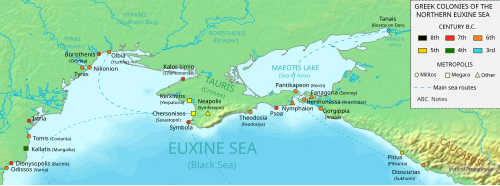
The city was founded as Theodosia (Θεοδοσία) by Greek colonists from Miletos in the 6th century BC. Noted for its rich agricultural lands, on which its trade depended, the city was destroyed by the Huns in the 4th century AD.
Theodosia remained a minor village for much of the next nine hundred years. It was at times part of the sphere of influence of the Khazars (excavations have revealed Khazar artifacts dating back to the 9th century) and of the Byzantine Empire.
Like the rest of Crimea, this place (village) fell under the domination of the Kipchaks and was conquered by the Mongols in the 1230s.
A settlement named Kaphâs (alternate romanized spelling Cafâs, Greek : Καφᾶς ) existed surrounding Theodosia prior to the penetration of Genoese into the Black Sea. The archaeological evidence indicates that during the Middle Ages the population about Theodosia never decreased to zero; several medieval churches are found in the area dating from the times of Late Antiquity / Early Middle Ages. However, the population had become completely agrarian. A small local Greek population must have existed in situ and in the neighboring settlements. Likely, from the 9th century there were Cumans and Goths living alongside the Greeks, and by 1270s, perhaps some Tatars and Armenians as well.

Medieval churches of Kaffa: Armenian Orthodox (top row), Armenian Catholic (middle row) and Greek Orthodox (bottom row) In the late 13th century, traders from the Republic of Genoa arrived and purchased the city from the ruling Golden Horde.
They established a flourishing trading settlement called Kaffa ( also recorded as Caffa), which virtually monopolized trade in the Black Sea region and served as a major port and administrative center for the Genoese settlements around the Sea. The city thrived despite the tenuous politics of the region and Genoa's series of wars with the Mongol successor states.
It came to house one of Europe's biggest slave markets of the Black Sea slave trade, and served as a terminus for the Silk Road. The Great Soviet Encyclopedia also adds that the city of Caffa was established during the times when the area was ruled by the Khan of the Golden Horde Mengu-Timur.
Ibn Battuta visited the city, noting it was a "great city along the sea coast inhabited by Christians, most of them Genoese." He further stated, "We went down to its port, where we saw a wonderful harbor with about two hundred vessels in it, both ships of war and trading vessels, small and large, for it is one of the world's celebrated ports."
In early 1318, Pope John XXII established a Latin Church diocese of Kaffa, as a suffragan of Genoa. The papal bull of appointment of the first bishop attributed to him a vast territory: "a villa de Varna in Bulgaria usque Sarey inclusive in longitudinem et a mari Pontico usque ad terram Ruthenorum in latitudinem" ("from the city of Varna in Bulgaria to Sarey inclusive in longitude, and from the Black Sea to the land of the Ruthenians in latitude"). The first bishop was Fra' Gerolamo, who had already been consecrated seven years before as a missionary bishop ad partes Tartarorum. The diocese ended as a residential bishopric with the capture of the city by the Ottomans in 1475. Accordingly, Kaffa is today listed by the Catholic Church as a titular see. The new diocese effectively broke up the diocese of Khanbaliq, which functioned as one diocese for all Mongol territory from the Balkans to China.

It is believed that the devastating pandemic of the Black Death entered Europe for the first time via Kaffa in 1347. After a protracted siege, the Mongol army under Jani Beg was reportedly withering from the disease and catapulted infected corpses over the city walls, infecting the inhabitants. This is considered one of the first cases of biological warfare. Fleeing inhabitants may have carried the disease back to Italy, causing its spread across Europe. However, the plague appears to have spread in a stepwise fashion, taking over a year to reach Europe from Crimea. Also, there were a number of Crimean ports under Mongol control, so it is unlikely that Kaffa was the only source of plague-infested ships heading to Europe. Additionally, there were overland caravan routes from the East that would have been carrying the disease into Europe as well.
Kaffa eventually recovered. Among visiting merchants in Kaffa at the time were Italians, Poles, Vlachs, Lithuanians, Greeks, Armenians, Persians and Russians. The thriving, culturally diverse city and its thronged slave market have been described by the Spanish traveler Pedro Tafur, who was there in the 1430s. The port was also visited by German traveler Johann Schiltberger in the 15th century.
In addition to trade with Italy, the city developed trade with Poland via the Polish-controlled ports in the Dniester Estuary. Many Polish merchants came to Kaffa and Polish envoys often visited the city, with the Genoese consul of Kaffa stating the Poles and the locals had close and friendly relations. Kaffa had commercial agents in Poland, including one permanently residing in Lwów. Faced with the Ottoman threat, Kaffa sought either to be incorporated into Poland or to form an alliance with Poland. In 1462, Kaffa placed itself under the protectorate of King Casimir IV of Poland. Poland's capacity to provide military assistance was limited, as it was embroiled in the Thirteen Years' War until 1466, however, Polish protectorate prolonged the period of peace and postponed the Ottoman attack. Eventually, Poland did not offer significant help due to reinforcements sent being massacred after a quarrel with locals in Bracław.
Following the fall of Constantinople, Amasra, and lastly Trebizond, the position of Caffa had become untenable and attracted the attention of Ottoman Sultan Mehmed II. He was at no loss for a pretext to extinguish this last Genoese colony on the Black Sea. In 1473, the tudun (or governor) of the Crimean Khanate died and a fight developed over the appointment of his successor. The Genoese involved themselves in the dispute, and the Tatar notables who favored the losing candidate finally asked Mehmed to settle the dispute.
Mehmed dispatched a fleet under the Ottoman commander Gedik Ahmet Pasha, which left Constantinople 19 May 1475. It anchored before the walls of the city on 1 June, started the bombardment the next day, and on 6 June the inhabitants capitulated. Over the next few days the Ottomans proceeded to extract the wealth of the inhabitants, and abduct 1,500 youths for service in the Sultan's palace. [ unbalanced opinion? ] On 8 July, the final blow was struck when all inhabitants of Latin origin were ordered to relocate to Istanbul, where they founded a quarter ( Kefeli Mahalle ) which was named after the town they had been forced to leave. Some of the educated residents fled to Kyiv, where they became employed as lecturers.

Renamed Kefe, Caffa became one of the most important Turkish ports on the Black Sea. It was a major center of the Crimean slave trade until the late 18th-century, referred to by the Lithuanian Michalo Lituanus as: "not a town, but an abyss into which our blood is pouring". The Catholic Diocese of Kaffa was suppressed, although it remained a titular see. From 1493 to 1664, eight Poles were appointed titular bishops of Kaffa.
Following the Turkish conquest, maritime trade between the West and the East via Kaffa was severed. This led to the development of an alternative land trade route, linking Kaffa via Akkerman, Podolia, Lwów, Kraków and Cieszyn to German states. In 1616, Zaporozhian Cossacks under the leadership of Petro Konashevych-Sahaidachny destroyed the Turkish fleet and captured Caffa. Having conquered the city, the Cossacks released the men, women and children who were slaves.
Ottoman control ceased when the expanding Russian Empire took over Crimea between 1774 and 1783. It was renamed Feodosia (Russian Ѳеодосія; reformed spelling Феодосия), after the traditional Russian reading of its ancient Greek name.
As of 1874, the population was mostly Eastern Orthodox, whereas 12.3% were Muslim, 8.2% Karaite, 6.5% Armenian Orthodox, 4.8% Jewish, 3.5% Catholic and 1.1% Protestant. In 1880, there were 427 artisans, and their handcrafted goods provided for local needs only, and there were 11 factories.
In 1894, Feodosia was chosen to replace Sevastopol as the chief commercial port of Crimea, which fueled its development. In 1900, Zibold constructed the first air well (dew condenser) on mount Tepe-Oba near Feodosia. [ citation needed ] The city had several churches, including Eastern Orthodox, Armenian Orthodox and Armenian Catholic (also hosting Polish Catholic services), and Tatar mosques, a synagogue and a Karaite kenesa.
Closest places in our Ukraine guide.
More places to explore in Ukraine.



_1.jpg?width=1200)


