Greece
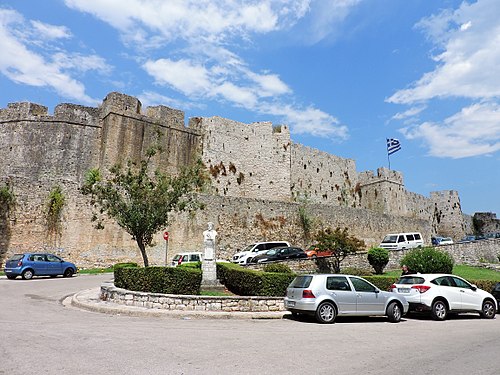
Arta Castle
Archaeological site · Artaion Municipality
Church building

The Panagia Vlacherna (Greek: Παναγία της Βλαχέρνας) is an imposing Byzantine church of the 10th-13th century, with later interventions, in the village of Vlacherna outside Arta. Originally built as a monastery catholicon in the type of three-aisled basilica and decorated with frescoes, sculptures, marble inlays and mosaics, Panagia Vlacherna functioned as a burial temple for the Comnenos-Doukas family, rulers of the Despotate of Epirus. The original, mid-Byzantine church of the end of the 9th or the beginning of the 10th century.
it had the form of a three-aisled, wooden-roofed basilica with a tripartite sanctuary and a semicircular arch protruding from the eastern wall. From that architectural phase, various architectural members built into the later masonry survive, as well as the central arch of the sanctuary and part of an adjacent wall that were incorporated into the chancel of the southeast corner of the later temple. The difference in masonry, shape and height of the arches of the two phases is evident on the east side Archived 2016-03-10 at the Wayback Machine.
of the temple. The church that survives today is late Byzantine (see plan). It was rebuilt in the early 13th century...
Closest places in our Greece guide.
More places to explore in Greece.