
Portugal
Electricity Museum
Technology museum · Belém
Art museum
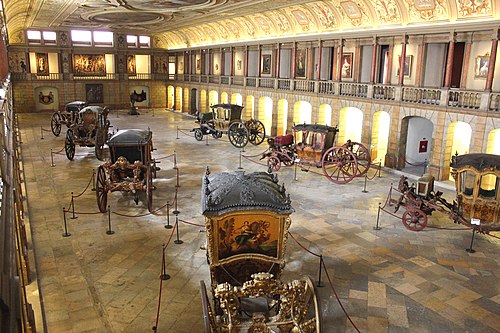
The National Coach Museum (Museu Nacional dos Coches) is located in Lisbon, Portugal. First established in 1905 as the Royal Coaches Museum (Coaches Reaes Museum), the museum houses historic horse-drawn coaches and carriages that belonged to the royal houses of Portugal from the 16th to the 19th century. The collection is housed across two buildings: the 1787 Royal Riding School of the Belém Palace in Afonso de Albuquerque Square, and a 2015 modern building opposite on Avenida da Índia. The collection comprises around 9,000 objects including ceremonial and gala vehicles and equestrian accessories. It has been the most visited national museum in Portugal, with 382,593 visitors in 2016. The new building, which houses the majority of the collections, is a project by Paulo Mendes da Rocha in partnership with the Ricardo Bak Gordon studio and engineer Rui Furtado. Since 1 February 2025, Dr Rita Dargent has served as the director of the National Coach Museum.
The "National Coach Museum" was created on 23 May 1905, at the initiative of Queen Amélia of Orléans and Braganza, the wife of King Carlos I (1889–1908), with the aim of gathering, safeguarding, and presenting to the public an important collection of carriages belonging to the Royal House. The chosen location for the first coach museum in the world was the site of the former Royal Riding School, adapted for this purpose by the court architect, Rosendo Carvalheira, with the collaboration of painters José Malhoa and Conceição Silva. The success was significant, but the lack of space was immediately felt, which led the Queen herself to commission a new project the following year to expand the museum and display the remaining carriages of the Royal House stored in the stables of various palaces. After the establishment of the Republic on 5 October 1910, the museum's collection increased with the arrival of a set of coaches and landaus from the defunct Royal House and vehicles from church assets.
In 1911, the museum was renamed the National Coach Museum. Years later, in 1944, a new hall designed by architect Raul Lino was inaugurated by the then President of the Republic, Marshal Carmona. The tourist development and the consequent increase in visitors in the 1960s led to the creation of new services and support spaces, such as the Educational Service, the Temporary Exhibition Room, the Library, and the Shop. In 1983, the then Portuguese Institute of Cultural Heritage and the Braganza House Foundation established an agreement that granted the Museum an annex integrated into the Ducal Palace of Vila Viçosa for the exhibition of vehicles stored in the Palaces of Ajuda and Necessidades. In 1994, the Ministry of Culture acquired the former General Workshops of the Army in Belém for the construction of a new building for the Museum. In 2008, the Council of Ministers decided to proceed with the project to construct this building to bring together the entire collection of vehicles, and Brazilian architect Paulo Mendes da Rocha, Pritzker Prize winner in 2006, was invited to carry out the project. The foundation stone was laid on 1 February 2010.
On 23 May 2015, the majority of the collection was transferred to the newly built building, becoming an additional reason to visit this extraordinary collection. In memory of the first museum, a visitable exhibition core remains in the space of the Old Riding School, featuring coaches and landaus, the painting gallery of the royal family, as well as cavalry accessories. The National Coach Museum is currently divided between the new building in Belém and the old Riding School of the Royal Palace, both located in Praça Afonso de Albuquerque, Lisbon.
The Museum houses a unique collection of ceremonial and state vehicles, as well as some travel and leisure carriages from the 16th to the 19th centuries, most of which come from the Portuguese Royal House. After the establishment of the Republic in 1910, vehicles from church properties and private collections were added. This excellent set of vehicles allows visitors to understand the technical and artistic evolution of animal-drawn transport used by European courts until the advent of the automobile. The collection includes coaches, landaus, carriages, sedans, baby carriages, litters, and chairs. Additionally, it features harnesses, vehicle accessories, uniforms, musical instruments, a collection of arms, and oil portraits of the monarchs of the House of Braganza.
When the Royal Coach Museum opened its doors in 1905, its collection consisted solely of pieces belonging to the Crown Jewels, gathered from various deposits, stables, and coach houses of the royal palaces of Belém, Ajuda, and Necessidades. Later, members of the Royal Family enriched the collection with objects related to the museum's theme, which were deposited indefinitely. Among these are some exotic harnesses, such as a Mexican hunting harness (in silver), two Algerian harnesses—gifted to Queen Amélia by Colonel Ben-Daoud—a gaucho saddle (Brazilian), a harness with silver applications given to King Carlos by the President of the State of Rio Grande do Sul, an Indian harness ( Goa ) offered in 1872 by the Hindu Chief of the Dempó family to Infante D. Augusto, son of D. Maria II, as well as Moroccan harness pieces gifted by Sultan Muley Hassam of Morocco to King D. Luís, along with Arab horses, in 1878.
In 1911, under the law of the Separation of Church and State, pieces from former convents and religious houses began to enter the Museum. Later, thanks to a policy of acquisitions and personal gifts, under the direction of Luciano Freire, the Museum gained a significant collection of drawings, engravings, and graphic materials, predominantly featuring studies and designs for vehicles. Simultaneously, in 1912, the first oil portraits of the Portuguese royal family were incorporated into the museum's collection— D. Catarina de Bragança, who married King Charles II of England, D. João V, D. Maria Ana of Austria, Prince D. José, and D. Maria I —originating from the Patriarchal Palace of S. Vicente de Fora, along with eight coaches and landaus from the former Patriarchs. In just two years, the royal series experienced significant growth, giving rise to the current portrait gallery of the Braganza dynasty, owners of some of the luxurious of the Marquis of Marialva, 18th Century.
An important section consists of uniforms and clothing accessories of high-ranking officials of the Court, the Royal Guard, and servants of the Royal House who participated in royal processions and ceremonies, most of which came from the Palace of Necessidades in 1913. This includes six tabards of the Kings of Arms and their respective collars bearing the arms of D. José, six solid silver maces of the Mace Bearers, twenty-two trumpets of the Royal Charamela, some with corresponding banners, sixteen halberds from the reigns of D. José, D. Maria I, and D. João VI, an ivory staff (a symbol of royal power) known as Negrinha, four skirts for timbales, a royal pavilion, and a covering with golden stars, as well as various accessories for heralding the horsemen.
Many other pieces have been added to the collection over the years through donations, acquisitions, or exchanges carried out by various directors. Moreover, policies for integrating museum institutions aimed at maintaining the uniformity and coherence of their collections led to the deposit of vehicles at the National Coach Museum that completed the collection with various types or vehicles with extraordinary histories, such as the Landau from the Regicide at the National Palace of Ajuda, field or hunting carriages from the Museum of Évora, or the Charabanc from the Ducal Palace of Vila Viçosa, as well as the Mail Coach from the Portuguese Communications Foundation, among others.
The collection of horse-drawn vehicles includes coaches, landaus, sedans, carriages, baby carriages, litters, chairs, phaetons, milords, victorias, child carriages, charabancs, hunting carriages, landaus, and urban vehicles such as clarences, broughams, coupes, dormeuses (bedlandas), breaks, caleches, and mail coaches.

- Older Carriages from the 16th to 17th Centuries – The museum houses some of the oldest coaches in the world. The term originates from the Hungarian city of Kocs, where the first models were manufactured and later exported to Italy, being adopted by all European courts. Among this period's exhibits at the National Coach Museum is the Coach of Philip II, which belonged to King Philip II (Philip III of Spain) and was used during his visit to Portugal in 1619. It is the oldest vehicle in the museum's collection.
- Symbols of Power – 18th Century – During the reign of D. João V, royal power reached its zenith. This ostentation is reflected in the decorations of the magnificent coaches used in grand ceremonies that impressed the public. The ceremonial vehicle commissioned by King D. João V for the Portuguese Royal House is a prime example from this period.
- Triumphal Carriages – 18th Century – Unique examples of Italian Baroque include three main coaches from the embassy of the Marquis of Fontes sent to Rome by D. João V to Pope Clement XI in 1716.
- Portuguese Baroque – 18th Century – In the vehicles from this period, the gilded carving and the paintings of the boxes reveal harmonious compositions of sacred and profane themes. The decoration of D. José's Coach exemplifies the exuberance of the Baroque style in Portugal.
- Marriage Exchange – 18th Century – The ceremony of the double wedding held at the Caia border between a prince of Portugal and a Spanish Infanta and between a prince of Spain and a Portuguese Infanta marked the restoration of good diplomatic relations between the two countries since the Restoration of independence in 1640. Evidence of this grand event includes the coaches and landaus that participated in this journey.
- Landaulets of the 18th and 19th Centuries – This model of vehicle originated in Berlin in the second half of the 17th century. It is distinguished from the coach by its type of suspension. The body is no longer suspended and rests on two strong leather straps, providing greater stability and making journeys more comfortable.
- Ecclesiastical Vehicles – Members of the high clergy held a status equivalent to that of the nobility and had their own vehicles identified by prelatical coats of arms. In certain ceremonies, religious images were transported in processional landaulets.
- Sedges of the 18th Century – Sedges were vehicles pulled by one or two horses, very discreet and practical for daily use. They could be driven by the passenger themselves or by a coachman, a man riding alongside the sedge holding the reins. They were the first rental cars in Lisbon. An example is the "Sedge dos Óculos" (Portuguese).
- Pleasure Carriages of the 18th Century – Built during the time of D. Maria I, these light cars, decorated in rocaille style, were pulled by a single horse and used by the Royal Family for outings in the gardens and parks of the palaces.
- Litters and Chairs – Litters were used in Europe from Roman times until the 19th century, as they were easy to maneuver on paths where other vehicles could not travel. Chairs were used mainly in the narrow streets of cities for transporting noblewomen, the sick, or clergy members.
Closest places in our Portugal guide.
More places to explore in Portugal.


