Germany
Baptismal font in Hildesheim Cathedral
Baptismal font · Hildesheim
Catholic cathedral
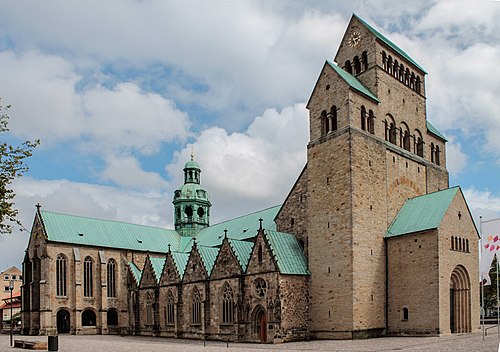
Hildesheim Cathedral (German: Hildesheimer Dom), officially the Cathedral of the Assumption of Mary (German: Hohe Domkirche St. Mariä Himmelfahrt) or simply St. Mary's Cathedral (German: Mariendom), is a medieval Roman Catholic cathedral in the city centre of Hildesheim in Lower Saxony, Germany, that serves as the seat of the Diocese of Hildesheim. The cathedral has been on the UNESCO World Cultural Heritage list since 1985, together with the nearby St. Michael's Church because of its unique art and outstanding Romanesque architecture. The cathedral church was built between 1010 and 1020 in the Romanesque style. It follows a symmetrical plan with two apses, that is characteristic of Ottonian Romanesque architecture in Old Saxony. The cathedral's treasures include world-famous artworks, bronze works from the time of Bishop Bernward, Bernward Doors and Bernward Column, as well as two of the four notable Romanesque wheel chandeliers: the Hezilo chandelier and the Azelin chandelier. After renovations and extensions in the 11th, 12th and 14th centuries, the cathedral was completely destroyed during an air raid on 22 March 1945 and rebuilt from 1950 to 1960. A thorough renovation of the...
After the establishment of the Diocese of Hildesheim in 815 by Louis the Pious, a Chapel of St. Mary was built on the locations of the modern apse. Bishop Gunthar of Hildesheim, who was in office from 815 to 834, had a small basilica with two round towers built immediately to the south of the chapel, which he dedicated to Saint Cecilia. This served as the original cathedral and Stift church. The first four bishops were buried there. Only traces of the foundations of these two buildings remain. An older Hildesheim parish church probably once stood on the site of the Chapel of Saint Stephen next to the gatehouse at the eastern entrance to the chapel of St. Hellweg, which might date back to Hildegrim of Châlons and his expedition to East Saxony.
The cathedral was built in 872 under Bishop Altfrid as a cruciform three-aisled basilica with a two-story westwork. It is an example of Ottonian architecture, with alternating column support and semi circular apses completing the naves. The building suffered severe fire damage in 1046. Bishop Azelin planned to erect a new, larger building further to the west and to extend the nave. His successor, Hezilo of Hildesheim, abandoned this plan and instead built on the old foundations, incorporating the surviving walls into the new building. Further important renovations occurred up to the end of the fourteenth century but did not deviate from the ground plan of Bishop Altfrid's basilica. The northern paradise and the north and south side chapels date from the gothic period and the tower above the crossing from the baroque period. In the nineteenth century, the original westwork was replaced by a Neo-Romanesque two-tower facade, which stood until 1945.
Hildesheim Cathedral School [ de ] ( Hildesheimer Domschule ), which had rooms in the cloisters, was one of the most significant educational institutions of the Ottonian and Salian periods. Its library has served as the cathedral's library ( German : Dombibliothek Hildesheim ) since 815; it is the oldest library in Northern Germany.
Foundation of the first cathedral under the crypt dating from 815
Cloister with St. Anne's Chapel, c. 1845
During the aerial bombardment of Hildesheim by the RAF and RCAF in World War II, the main building was almost entirely destroyed; only the westwork and the outer walls survived. Of the ancillary buildings, only the Gothic Anne's chapel ( Annenkapelle ), erected in 1321 in the middle of the cathedral's courtyard, was mostly undamaged. It was the only cathedral in Germany that had to be newly consecrated after its reconstruction, on 27 March 1960 by Bishop Heinrich Maria Janssen.
The building was rebuilt between 1950 and 1960 in a simplified form. The baroque elements were abandoned in favour of a form which took its cue from the early Romanesque style. The most visible aspect of this on the exterior was that upper stories, and side towers added to the westwork in 1840, were not restored. The westwork was reconstructed closer to its earlier state based on the model of the westwork of Minden Cathedral, which had also been severely damaged by wartime bombing. In addition, the gatehouse in front of the westwork was reduced by about half. Otherwise, the exterior appeared as it had done before the destruction – in particular, the baroque crossing-tower was rebuilt.
The reconstruction was carried out under tight constraints. Because of the lack of sandstone tiles, the floor was relaid in marble. The roofs of the nave, transept, and cloisters were cast in concrete and covered with wooden boards on the inside to recall the appearance of ceiling beams. The interior walls, as well as the walls of the nave, were rebuilt in brick and limestone, hidden from view by a dimension stone coating on the outside and by a coat of smooth plaster on the inside. The ground level was raised by 60 cm, which resulted in the rooms having a squat appearance, especially in the transepts. The columns of the nave were cast in concrete, and the pilasters were coated in sandstone.
The reconsecration took until 1960 to complete because of various problems, chiefly the "Hildesheim Cathedral construction dispute" ( Hildesheimer Dombaustreit ), an argument between the Diocese of Hildesheim and the Land of Lower Saxony about the cost of the reconstruction and particularly about whether Lower Saxony was one of the legal successors of the Free State of Prussia which had undertaken to cover the cathedral's building expenses in 1803 (when it was still the Kingdom of Prussia ) during the process of German mediatization. The parties reached a settlement in 1957.
After many years of planning, a thorough renovation of the cathedral began in January 2010, the first since 1960. Along with technical and conservation measures, there were alterations to the design. The floor was lowered to the original level, the Hezilo and Azelin chandeliers were restored to their places in the nave and the high choir, and Bernward Doors were again mounted facing outwards, behind an antechamber, as originally intended. In addition, a bishop's crypt was created.
On 10 January 2010, the cathedral was closed for the work to begin. During the reconstruction, the basilica of St. Godehard served as the bishop's church ( cathedra ), as it had in the postwar years. The cathedral renovation was the largest church construction project in Germany. The solemn reopening of the cathedral was on 15 August 2014, coinciding with the beginning of the Diocese's 1200 year jubilee.
The cathedral building is widely known for the " Thousand-year Rose " ( Tausendjähriger Rosenstock ) which grows outside the building on the outer wall of the apse in the courtyard of the cloisters. The exact age of the rose is no longer precisely known, but the legend of the rose bush claims that it dates to 815. It is an important symbol of Hildesheim – according to folklore, as long as the bush flourishes, Hildesheim will prosper.
According to the story, Emperor Louis the Pious had to hold a Mass while out hunting in the middle of the forest. For this purpose, a reliquary of St. Mary which he had with him was hung from the branch of a wild rose. After the mass, the reliquary could not be removed from the branch. The Emperor considered this a sign that the new bishopric should be established here (not in Elze as he had planned) and he should dedicate it to St. Mary, whose symbol is the rose.
The existence of the rose bush has been attested for at least four hundred years. The aerial bombardment of 22 March 1945 which damaged the cathedral and the apse also killed the main growth of the rose bush above the ground; under the rubble, only the charred stump of the rose remained. It was thought that the end of the famous rose had come, but the roots were largely intact, and in the spring of 1945 it put out 25 new shoots. The first sparse flowers bloomed in 1947, and by 1948 there were 122 flowers. Since then, the new branches of the "Thousand-year Rose" (as it was already known before the bombing) have been marked with little metal signs with the year in which they first appeared. It is believed to be the oldest living rose in the world.
After the establishment of the Diocese of Hildesheim in 815 by Louis the Pious, a Chapel of St. Mary was built on the locations of the modern apse. Bishop Gunthar of Hildesheim, who was in office from 815 to 834, had a small basilica with two round towers built immediately to the south of the chapel, which he dedicated to Saint Cecilia. This served as the original cathedral and Stift church. The first four bishops were buried there. Only traces of the foundations of these two buildings remain. An older Hildesheim parish church probably once stood on the site of the Chapel of Saint Stephen next to the gatehouse at the eastern entrance to the chapel of St. Hellweg, which might date back to Hildegrim of Châlons and his expedition to East Saxony.
The cathedral was built in 872 under Bishop Altfrid as a cruciform three-aisled basilica with a two-story westwork. It is an example of Ottonian architecture, with alternating column support and semi circular apses completing the naves. The building suffered severe fire damage in 1046. Bishop Azelin planned to erect a new, larger building further to the west and to extend the nave. His successor, Hezilo of Hildesheim, abandoned this plan and instead built on the old foundations, incorporating the surviving walls into the new building. Further important renovations occurred up to the end of the fourteenth century but did not deviate from the ground plan of Bishop Altfrid's basilica. The northern paradise and the north and south side chapels date from the gothic period and the tower above the crossing from the baroque period. In the nineteenth century, the original westwork was replaced by a Neo-Romanesque two-tower facade, which stood until 1945.
Hildesheim Cathedral School [ de ] ( Hildesheimer Domschule ), which had rooms in the cloisters, was one of the most significant educational institutions of the Ottonian and Salian periods. Its library has served as the cathedral's library ( German : Dombibliothek Hildesheim ) since 815; it is the oldest library in Northern Germany.
Foundation of the first cathedral under the crypt dating from 815
Cloister with St. Anne's Chapel, c. 1845
Closest places in our Germany guide.
More places to explore in Germany.