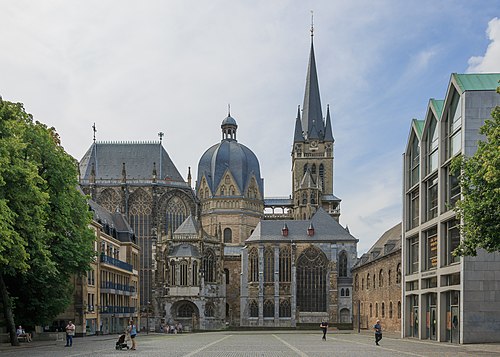
Germany
Marktkirche
Church building · Mitte
Big city

Wiesbaden (German pronunciation: [ˈviːsˌbaːdn̩] ; lit. 'meadow baths') is the capital of the German state of Hesse, and the second-largest Hessian city after Frankfurt am Main. With around 283,000 inhabitants, it is Germany's 24th-largest city. Wiesbaden forms a conurbation with a population of around 500,000 with the neighbouring city of Mainz. This conurbation is in turn embedded in the Rhine-Main Metropolitan Region—Germany's second-largest metropolitan region after Rhine-Ruhr—which also includes the nearby cities of Frankfurt am Main, Darmstadt, Offenbach am Main, and Hanau, and has a combined population exceeding 5.8 million. The city is located on the Rhine (Upper Rhine), at the foothills of the Taunus, opposite the Rhineland-Palatine capital of Mainz, and the city centre is located in the wide valley of the small Salzbach stream. Wiesbaden lies in the Rheingau wine-growing region, one of Germany's 13 wine regions. Three of Wiesbaden's boroughs were part of the city of Mainz until 1945, and still bear the designation "Mainz" in their names—the so-called AKK-boroughs of Mainz-Amöneburg, Mainz-Kastel, and Mainz-Kostheim. This so-called AKK-Konflikt (de:AKK-Konflikt) is the main...
Wiesbaden is situated on the right (northern) bank of the Rhine, above the confluence of the Main, where the Rhine's main direction changes from north to west. The city is across the Rhine from Mainz, the capital of the state of Rhineland-Palatinate. Frankfurt am Main is located about 38 kilometres (23.6 mi) east. To the north of the city are the Taunus Mountains, which trend in a northeasterly direction.
The city center, the Stadtmitte, is located in the north-easternmost part of the Upper Rhine Valley at the spurs of the Taunus mountains, about 5 kilometres (3.1 mi) from the Rhine. The landscape is formed by a wide lowland between the Taunus heights in the north, the Bierstadter Höhe and the Hainerberg in the east, the Mosbacher Mountain in the south, and the Schiersteiner Mountain in the west, an offshoot of the Taunus range.
The downtown is drained only by the narrow valley of the Salzbach, a tributary of the Rhine, on the eastern flanks of the Mosbacher Mountain. The city's main railway line and the Mainz road ( Mainzer Straße ) follow this valley. Several other streams drain into the Salzbach within the city center: the Wellritzbach, the Kesselbach, the Schwarzbach, the Dambach, and the Tennelbach, as well as the outflow of many thermal and mineral springs in the Kurhaus (spa) district. Above the city center, the Salzbach is better known as the Rambach.
The highest point of the Wiesbaden municipality is located northwest of the city center near the summit of the Hohe Wurzel, with an elevation of 608 metres (1,995 ft) above sea level. The lowest point is the harbour entrance of Schierstein at 83 metres (272 ft) above sea level. The central square (the Schlossplatz, or palace square) is at an elevation of 115 metres (377 ft).
Wiesbaden covers an area of 204 km 2 (79 sq mi). It is 17.6 kilometres (10.9 mi) from north to south and 19.7 kilometres (12.2 mi) from west to east. In the north are vast forest areas, which cover 27.4% of the urban area. In the west and east are vineyards and agricultural land, which cover 31.1% of the area. Of the municipality's 79-kilometre-long (49.1 mi) border, the Rhine makes up 10.3 kilometres (6.4 mi).
Wiesbaden has a temperate - oceanic climate ( Köppen : Cfb ; Trewartha : Dobk ) with relatively cold winters and warm summers. Its average annual temperature is 9.8 °C (49.6 °F), with monthly mean temperatures ranging from 1.2 °C (34.2 °F) in January to 18.9 °C (66.0 °F) in July.
The Wiesbaden weather station has recorded the following extreme values:
Wiesbaden has a temperate - oceanic climate ( Köppen : Cfb ; Trewartha : Dobk ) with relatively cold winters and warm summers. Its average annual temperature is 9.8 °C (49.6 °F), with monthly mean temperatures ranging from 1.2 °C (34.2 °F) in January to 18.9 °C (66.0 °F) in July.
The Wiesbaden weather station has recorded the following extreme values:
While evidence of settlement at present-day Wiesbaden dates back to the Neolithic era, historical records document continuous occupancy after the erection of a Roman fort in 6 AD which housed an auxiliary cavalry unit. The thermal springs of Wiesbaden are first mentioned in Pliny the Elder 's Naturalis Historia. They were famous for their recreation pools for Roman army horses and possibly as the source of a mineral used for red hair dye (which was very fashionable around the turn of BC/AD among women in Rome).
The Roman settlement is first mentioned using the name Aquae Mattiacorum ( Latin for "Waters of the Mattiaci") in 121. The Mattiaci were a Germanic tribe, possibly a branch of the neighboring Chatti, who lived in the vicinity at that time. The town also appears as Mattiacum in Ptolemy 's Geographia (2.10). The Roman Empire built the Limes Germanicus, which was a line of Roman frontier fortifications in the Taunus. Wiesbaden is just south of the Taunus.
The capital of the province of Germania Superior, Mogontiacum (present-day Mainz ), base of 2 (at times 3) Roman legions, was just over the Rhine and connected by a bridge at the present-day borough of Mainz-Kastel (Roman " castellum "), a strongly fortified bridgehead.
The Alamanni, a coalition of Germanic tribes from beyond the Limes, captured the fort around 260. Later, in the 370s, when the Romans and Alamanni were allied, the Alemanni gained control of the Wiesbaden area and were in charge of its defense against other Germanic tribes.
After the Franks under Clovis I defeated the Alamanni in the Battle of Tolbiac in 496, the Franks eventually displaced the Alamanni in the Wiesbaden area over the course of the 6th century. In the 8th century, Wiesbaden became the site of a royal palace of the Frankish kingdom. The first documented use of the name Wiesbaden is by Einhard, the biographer of Charlemagne, whose writings mention "Wisabada" sometime between 828 and 830.
When the Frankish Carolingian Empire broke up in 888, Wiesbaden was in the eastern half, called East Francia (which would evolve into the Holy Roman Empire ). The town was part of Franconia, the heartland of East Francia. In the 1170s, the Count of Nassau, Walram I, received the area around Wiesbaden as a fiefdom. When Franconia fragmented in the early 13th century, Nassau emerged as an independent state as part of the Holy Roman Empire.
In 1232 Wiesbaden became a Reichsstadt, an imperial city, of the Holy Roman Empire. However, in 1242, during the war of Emperor Frederick II against the Pope, the Archbishop of Mainz, Siegfried III, ordered the city's destruction.
Wiesbaden returned to the control of the House of Nassau in 1270 under Count Walram II, Count of Nassau. However, Wiesbaden and the castle at Sonnenberg were again destroyed in 1283 in conflict with Eppstein.
Walram's son and successor Adolf would later become king of Germany from 1292 until 1298. In 1329, under Adolf's son Gerlach I of Nassau-Weilburg the House of Nassau and thereby, Wiesbaden, received the right of coinage from Holy Roman Emperor Louis the Bavarian.
In 1355, the County of Nassau-Weilburg was divided among the sons of Gerlach. The County of Nassau's holdings would be subdivided many times among heirs, with the parts being brought together again whenever a line died out. Wiesbaden became the seat of the County of Nassau-Wiesbaden under Count Adolf I (1307–1370), eldest son of Gerlach. It would eventually fall back to Nassau-Weilburg in 1605.
Closest places in our Germany guide.
More places to explore in Germany.