Greece
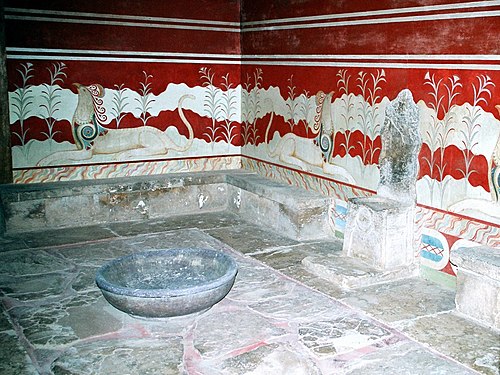
Throne Room, Knossos
Historic site · Heraklion
Tourist attraction

Knossos (; Ancient Greek: Κνωσσός, romanized: Knōssós; Greek: Κνωσός, romanized: Knōsós; Linear B: 𐀒𐀜𐀰 Ko-no-so) is an archaeological site and ancient urban centre in Crete, Greece. It is located within the southern periphery of Heraklion, about 5 km (3.1 mi) south of the city's historic centre. The site was occupied from the Neolithic period into the first millennium AD and became the largest and best-known centre of the Minoan civilisation. Knossos is often described as the oldest city in Europe. The claim is based on the combination of its early Neolithic foundation, its central role in the Minoan civilisation, widely regarded as the earliest advanced civilisation in Europe, and the long continuity of occupation in the Knossos valley, which is now part of the urban area of Heraklion. It was also one of the earliest known Neolithic settlements on Crete. The site is dominated by the monumental Palace of Minos. Like other Minoan palaces, the complex is generally interpreted as an administrative, economic, religious and ceremonial centre. Its role as a royal residence is debated. The first palace was built around 1900 BC on a hill that had already been occupied for several millennia...
The ancient name of the city is attested in Greek as Κνωσσός and in Linear B as 𐀒𐀜𐀰, transliterated as Ko-no-so. The Latinised form Cnossus was also used in antiquity and in older scholarship. The modern Greek form is usually written Κνωσός, although the classical spelling Κνωσσός remains common in archaeological and historical writing.
Knossos lies on Kephala hill, in the valley of the Kairatos river, within the modern municipality of Heraklion. It is not a separate modern city outside Heraklion, but lies within the southern periphery of the present urban area, about 5 km (3.1 mi) from the historic centre. The location gave the ancient settlement access to the north coast of Crete, the harbour area of ancient Knossos and routes leading into the island's interior.
The archaeological landscape extends beyond the palace itself. It includes remains of the surrounding Minoan town, later Greek and Roman occupation, cemeteries, roads, villas, sanctuaries and ritual buildings. The Knossos Urban Landscape Project, a collaboration involving the British School at Athens and the Greek Archaeological Service, surveyed approximately 11 km 2 (4.2 sq mi) around Knossos. It documented occupation from about 7000 BC into the modern period and identified an urban centre of about 1.5 km 2 (0.58 sq mi) together with surrounding cemeteries and archaeological features.
The chronology of Knossos extends from the Neolithic period to late antiquity. The dates below are approximate and reflect broad archaeological phases rather than fixed historical boundaries.
The earliest known settlement at Knossos dates to about 7000 BC, during the early Neolithic period. This makes Knossos one of the earliest permanent settlements on Crete and one of the earliest long-lived settlements in the Aegean. The first community occupied the summit of Kephala hill, the later site of the palace. Archaeological evidence indicates a small but stable settlement based on farming, animal husbandry and domestic craft production.
Over the following millennia, the settlement expanded and accumulated deep archaeological deposits. Pottery, stone tools, figurines and building remains show long continuity through the Early, Middle, Late and Final Neolithic phases. By the end of the Neolithic period, Knossos had become one of the most important settlements in the Aegean.
During the Early Bronze Age, usually dated to about 3000 to 1900 BC, Knossos grew in size and complexity. This period is often called the Prepalatial period because it preceded the construction of the first palace. The settlement developed stronger craft specialisation, wider exchange networks and greater social differentiation. These developments prepared the ground for the emergence of palatial organisation in the early second millennium BC.
The end of the Prepalatial period saw major architectural changes on Kephala hill. Earlier structures were levelled or reorganised, creating the platform on which the first palace was built.
The first palace at Knossos was constructed around 1900 BC. It marked a major shift in the organisation of the settlement and the surrounding region. The palace appears to have functioned as a centre for administration, storage, redistribution, ritual activity and craft production. The use of writing systems, sealings and specialised storage areas points to a complex bureaucracy.
The first palace was destroyed around 1700 BC, probably by an earthquake or a series of seismic events. The destruction did not end the importance of Knossos. Instead, the site was rebuilt on a larger and more elaborate scale.
The Second Palace period, from about 1700 to 1450 BC, was the height of Minoan Knossos. The palace was reconstructed with its central court, monumental entrances, staircases, magazines, reception rooms, ritual spaces, light wells, drainage systems and richly decorated wall paintings. The surrounding town also expanded, making Knossos the largest known Minoan centre.
During this period, Knossos maintained strong links with other parts of Crete and the wider eastern Mediterranean. Evidence from pottery, frescoes, administrative documents and luxury objects suggests extensive economic, artistic and cultural exchange.
Knossos is also represented in external evidence from the eastern Mediterranean. Aegean place-name lists from Egypt have been interpreted as including Knossos, indicating the site's wider diplomatic or commercial significance during the Late Bronze Age.
The palace was partially destroyed around 1450 BC, during a wider period of disruption affecting many Minoan sites. After this event, Knossos continued to function, but with stronger Mycenaean Greek influence.
After about 1450 BC, Knossos became an important Mycenaean administrative center. The Linear B tablets discovered at the site record an early form of Greek and provide evidence for administrative control over land, labor, livestock, textiles, offerings and other resources. These tablets are among the most important documents for the study of Late Bronze Age Crete and Mycenaean administration.
The palace was finally destroyed by fire around 1350 BC. This destruction ended the palatial phase of Knossos, although occupation of the wider site continued. Postpalatial occupation did not reproduce the scale or administrative structure of the Minoan and Mycenaean palace, but the settlement retained local importance.
Knossos remained occupied after the collapse of the Bronze Age palace system. During the Early Iron Age, it was one of the most significant communities on Crete. Cemeteries such as the North Cemetery, Fortetsa and Teke provide evidence for continued prosperity, social organisation and overseas contacts. Grave goods show connections with other parts of the Aegean and the eastern Mediterranean.
Although the palace was no longer functioning, the memory and prestige of Knossos remained important. The settlement continued to develop as a Greek city. Burial evidence from the Early Iron Age is particularly important because it preserves traces of social organisation, external contact and elite display that are less visible in the settlement remains.
Archaic, Classical and Hellenistic periods
Closest places in our Greece guide.
More places to explore in Greece.


