Spain
Terrassa Museum
Museum · Terrassa
Park

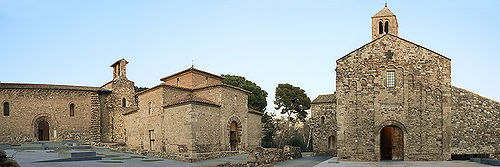
Vallparadís Park (in Catalan and officially Parc de Vallparadís) is a natural urban space located in the municipality of Terrassa, in the province of Barcelona, Spain. Its construction began in 1991, from several previous approaches during the 19th and 20th centuries, which culminated in the final drafting of the project by Manuel Ribas i Piera. The park was declared an Bien de Interés Cultural by the Government of Spain. From north to south it is about 3.5 km long, and averages about 100 m (330 ft) wide. The first fossil findings in the area date back a million years; samples of Pleistocene flora and fauna have been discovered at the Cal Guardiola site, while the first evidence of human presence dates back to the Iberian period, found at the Egosa settlement. This site would eventually become Egara, now Terrassa. The park has a "Y" shape due to the Vallparadís torrent and the Monner torrent, which converge in the Monumental church complex of Sant Pere de Terrassa, a historical heritage made up of a patrimonial, archaeological and artistic ensemble, a fundamental piece of Romanesque art in Catalonia. It houses the Textile Museum and Documentation Centre, one of the main textile museum...
Since the Neogene, the park has been naturally shaped by the fluvial erosion of the waters of the Monner and Vallparadís torrents, forming part of the Catalan pre-coastal depression.
The sediments found in the area correspond to the Neogene and later Quaternary, and come mainly from the erosion of metamorphic, volcanic and plutonic rocks from the Paleozoic, and also from terrigenous and carbonate rocks, both from the Mesozoic and Paleogene.
In 1997, through a series of archaeological excavations that lasted more than two years at the Cal Guardiola site, some 26,000 fossils were found, of which approximately 3,000 remains corresponded to mammals. Among them, the presence of hippopotamuses, damas, equus and hyenas are noteworthy. Other animal species found include various types of proboscideans, bears, rhinoceroses, jaguars, deer, macaques, megaloceroses, bovidae and a suidae, the only one found in Western Europe with an age of one million years.
Plant remains have also been found in the excavations, of which two large specimens with dimensions exceeding 3 m (9.8 ft) are worth mentioning.
Main article: Parks and gardens of Barcelona The Vallparadís park has gone through several stages until it became what it is today, since 1346, when the first settlers arrived in the area known as Vallis Paradisi. The torrents that occupied the park were inhabited by several agricultural settlements until the end of the 19th century, when the city of Terrassa was affected by the transformations of the municipality due to the arrival of the railroad in 1856 —in the northernmost part of the park— and the first urban planning project by Miquel Curet in 1878.
Thus, in 1895 the construction of the Pont del Passeig was adjudicated, considered the first modern structure in the park, and in 1915 the first urban planning project was carried out by Josep Maria Coll i Bacardí [ ca ; es ].
18 years later, in 1933, a second, more modest urban development plan called Pla Viñals was drawn up, but it was not until 1951 that the Plan General de Ordenación Urbana was drawn up by the Provincial Urban Planning Committee of Barcelona. Meanwhile, in 1942 a request was made for the Carthusian castle of Vallparadís to be declared a Historic-Artistic monument.
However, the Plan General de Ordenación underwent a series of modifications and it was not until 1965 that a new Plan was presented, revised in 1970, which incorporated special attention to green areas. Finally, in 1972, the park Nuevo Plan de Ordenación was approved with a detailed delimitation and management.
With the definitive Plan, in 1985 the drafting of the Plan Especial de Vallparadís was assigned to Manuel Ribas i Piera [ ca ; es ], a project that was executed between 1991 and 1997 in three construction phases.
In 1999, with the park already formed, a master plan was drawn up that set the autonomous organizational guidelines for Vallparadís.
Since the Neogene, the park has been naturally shaped by the fluvial erosion of the waters of the Monner and Vallparadís torrents, forming part of the Catalan pre-coastal depression.
The sediments found in the area correspond to the Neogene and later Quaternary, and come mainly from the erosion of metamorphic, volcanic and plutonic rocks from the Paleozoic, and also from terrigenous and carbonate rocks, both from the Mesozoic and Paleogene.
In 1997, through a series of archaeological excavations that lasted more than two years at the Cal Guardiola site, some 26,000 fossils were found, of which approximately 3,000 remains corresponded to mammals. Among them, the presence of hippopotamuses, damas, equus and hyenas are noteworthy. Other animal species found include various types of proboscideans, bears, rhinoceroses, jaguars, deer, macaques, megaloceroses, bovidae and a suidae, the only one found in Western Europe with an age of one million years.
Plant remains have also been found in the excavations, of which two large specimens with dimensions exceeding 3 m (9.8 ft) are worth mentioning.
Main article: Parks and gardens of Barcelona The Vallparadís park has gone through several stages until it became what it is today, since 1346, when the first settlers arrived in the area known as Vallis Paradisi. The torrents that occupied the park were inhabited by several agricultural settlements until the end of the 19th century, when the city of Terrassa was affected by the transformations of the municipality due to the arrival of the railroad in 1856 —in the northernmost part of the park— and the first urban planning project by Miquel Curet in 1878.
Thus, in 1895 the construction of the Pont del Passeig was adjudicated, considered the first modern structure in the park, and in 1915 the first urban planning project was carried out by Josep Maria Coll i Bacardí [ ca ; es ].
18 years later, in 1933, a second, more modest urban development plan called Pla Viñals was drawn up, but it was not until 1951 that the Plan General de Ordenación Urbana was drawn up by the Provincial Urban Planning Committee of Barcelona. Meanwhile, in 1942 a request was made for the Carthusian castle of Vallparadís to be declared a Historic-Artistic monument.
However, the Plan General de Ordenación underwent a series of modifications and it was not until 1965 that a new Plan was presented, revised in 1970, which incorporated special attention to green areas. Finally, in 1972, the park Nuevo Plan de Ordenación was approved with a detailed delimitation and management.
With the definitive Plan, in 1985 the drafting of the Plan Especial de Vallparadís was assigned to Manuel Ribas i Piera [ ca ; es ], a project that was executed between 1991 and 1997 in three construction phases.
Closest places in our Spain guide.
More places to explore in Spain.