Italy
Lacus Curtius
Archaeological site · Rome
Archaeological site

The Roman Forum (Italian: Foro Romano), also known by its Latin name Forum Romanum, is a rectangular forum (plaza) surrounded by the ruins of several important ancient government buildings at the centre of the city of Rome. Citizens of the ancient city referred to this space, originally a marketplace, as the Forum Magnum, or simply the Forum. For centuries, the Forum was the centre of day-to-day life in Rome: the site of triumphal processions and elections; the venue for public speeches, criminal trials and gladiatorial matches; and the nucleus of commercial and legal affairs. Here statues and monuments commemorated the city's leaders. The heart of ancient Rome, it has been called the most celebrated meeting place in the world, and in all history. Located in the small valley between the Palatine and Capitoline Hills, the Forum today is a sprawling ruin of architectural fragments and intermittent archaeological excavations attracting 4.5 million or more sightseers yearly. Many of the oldest and most important structures of the ancient city were located on or near the Forum. The Roman Kingdom's earliest shrines and temples were located on the southeastern edge. These included the ancient...
Unlike the later imperial fora in Rome—which were self-consciously modelled on the ancient Greek plateia (πλατεῖα) public plaza or town square —the Roman Forum developed gradually, organically, and piecemeal over many centuries. This is the case despite attempts, with some success, to impose some order there, by Sulla, Julius Caesar, Augustus and others. By the Imperial period, the large public buildings that crowded around the central square had reduced the open area to a rectangle of about 130 by 50 meters.
Its long dimension was oriented northwest to southeast and extended from the foot of the Capitoline Hill to that of the Velian Hill. The Forum's basilicas during the Imperial period—the Basilica Aemilia on the north and the Basilica Julia on the south—defined its long sides and its final form. The Forum proper included this square, the buildings facing it and, sometimes, an additional area (the Forum Adjectum ) extending southeast as far as the Arch of Titus.
Originally, the site of the Forum had been a marshy lake where waters from the surrounding hills drained. This was drained by the Tarquins with the Cloaca Maxima. Because of its location, sediments from both the flooding of the Tiber and the erosion of the surrounding hills have been raising the level of the Forum floor for centuries. Excavated sequences of remains of paving show that sediment eroded from the surrounding hills was already raising the level in early Republican times.
As the ground around buildings rose, residents simply paved over the debris that was too much to remove. Its final travertine paving, still visible, dates from the reign of Augustus. Excavations in the 19th century revealed one layer on top of another. The deepest level excavated was 3.60 meters above sea level. Archaeological finds show human activity at that level with the discovery of carbonized wood. [ citation needed ]
An important function of the Forum, during both Republican and Imperial times, was to serve as the culminating venue for the celebratory military processions known as Triumphs. Victorious generals entered the city by the western Triumphal Gate ( Porta Triumphalis ) and circumnavigated the Palatine Hill (counterclockwise) before proceeding from the Velian Hill down the Via Sacra and into the Forum.
From here, they would mount the Capitoline Rise ( Clivus Capitolinus ) up to the Temple of Jupiter Optimus Maximus on the summit of the Capitol. Lavish public banquets ensued back down on the Forum. (In addition to the Via Sacra, the Forum was accessed by several storied roads and streets, including the Vicus Jugarius, Vicus Tuscus, Argiletum, and Via Nova.)
The Forum Romanum : view facing north east from above the Portico Dii Consentes
Pottery deposits discovered in the Forum, Palatine and Capitoline demonstrated that humans occupied these areas in the Final Bronze Age (1200–975 BC). In the early Iron Age an area of the future Forum, close to the site of Temple of Antoninus and Faustina, was used as a cemetery (10th century BC), possibly by the communities based on the Palatine and Capitoline hills. Most of the burials were cremations of the same type which is also found in the other sites in Latium. The urn containing the ashes of the deceased was placed inside a large earthenware jar, along with grave goods, and then buried in a cavity cut into the ground and covered with a capstone. There were also a small number of inhumation burials. On current evidence, it is likely that burials in the Forum ceased in the late 9th century BC and that the Esquiline Necropolis replaced them.
The first archaeological finds on the sites of the key public buildings point to a transformation of the Forum from a cemetery to a public site in the 8th century BC. Part of the Forum was paved over. The earliest finds in the sites of the Comitium and Vulcanal were votive offerings. They indicate that the area was dedicated to a celebration of religious cults.
According to Roman historical tradition, the Forum's beginnings are connected with the alliance between Romulus, the first king of Rome controlling the Palatine Hill, and his rival, Titus Tatius, who occupied the Capitoline Hill. An alliance formed after combat had been halted by the prayers and cries of the Sabine women. Because the valley lay between the two settlements, it was the designated place for the two peoples to meet. Since the early Forum area included pools of stagnant water, the most easily accessible area was the northern part of the valley which was designated as the Comitium. It was here at the Vulcanal that, according to the story, the two parties laid down their weapons and formed an alliance.
The Forum was outside the walls of the original Sabine fortress, which was entered through the Porta Saturni. These walls were mostly destroyed when the two hills were joined. The original Forum functioned as an open-air market abutting on the Comitium, but eventually outgrew its day-to-day shopping and marketplace role. As political speeches, civil trials, and other public affairs began to take up more and more space in the Forum, additional fora throughout the city began to emerge to expand on specific needs of the growing population. Fora for cattle, pork, vegetables and wine specialised in their niche products and the associated deities. [ citation needed ]
Rome's second king, Numa Pompilius (r. 715–673 BC), is said to have begun the cult of Vesta, building its house and temple as well as the Regia as the city's first royal palace. Later Tullus Hostilius (r. 673–642 BC) enclosed the Comitium around the old Etruscan temple where the Senate would meet at the site of the Sabine conflict. He is said to have converted that temple into the Curia Hostilia close to where the Senate originally met in an old Etruscan hut. In 600 BC Tarquinius Priscus had the area paved for the first time.
Originally a low-lying, grassy wetland, the Forum was drained in the 7th century BC with the building of the first structures of Cloaca Maxima, a large covered sewer system that emptied into the Tiber, as more people began to settle between the two hills. Archaeological evidence shows that by the end of the 7th century BC, the ground level of the Forum was raised significantly in some places to overcome the problems of poor drainage and provide a foundation for a pebble-paved area. In the middle of the 7th century BC thatch-and-timber huts were demolished on the route of the Via Sacra and rectangular stone buildings began to replace them.
The earliest structures in the Forum were discovered in two separate locations: the site of the Comitium and the group of sanctuaries of Regia (House of the kings), House of the Vestals and Domus Publica. Around 650–630 BC the area of the Comitium was excavated into a deep triangular depression. The area was paved with a beaten earth pavement and later replaced with a more substantial gravel one. Nearby was located an archaic sanctuary dedicated to Vulcan known as Vulcanal (also Volcanal ): a small rectangular pit and elliptical basin carved out of an outcrop of tuff. It has been suggested that the earliest ancient materials collected in the area of the Vulcanal are from the second half of the 8th century BC. It appears that the Romans were aware of the sites’ archaic origins: the foundation of the Comitium and Vulcanal were attributed to Romulus himself while the first Curia (senate house), which was located nearby, to Tullus Hostilius.
At the western end of the Forum, excavations near the House of the Vestals and the sanctuary of Vesta have revealed an important group of 7th-century-BC buildings. The archaeologists have identified them as the early phases of the Regia (House of the kings), House of the Vestals, and Domus Publica (official residence of the pontifex maximus ). There seems to have been something of a surge in development of the Forum in the last quarter of the 7th century BC, as many of the changes date from 625 to 600 BC. Archaeologically, there is substantial evidence for development of the Forum in the 6th century BC: parts of the paving have been found and a large number of fragments of terracotta decorations from this area suggests that structures around the Forum were becoming more elaborate and highly decorated.
During the Republican period, the Comitium continued to be the central location for all judicial and political life in the city. However, to create a larger gathering place, the Senate began expanding the open area between the Comitium and the Temple of Vesta by purchasing existing private homes and removing them for public use. Building projects of several consuls repaved and built onto both the Comitium and the adjacent central plaza that was becoming the Forum.
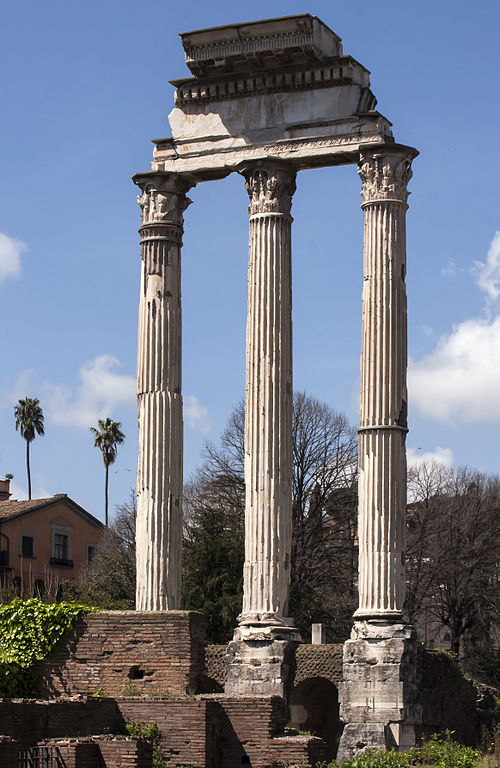
The 5th century BC witnessed the earliest Forum temples with known dates of construction: the Temple of Saturn (497 BC) and the Temple of Castor and Pollux (484 BC). The Temple of Concord was added in the following century, possibly by the soldier and statesman Marcus Furius Camillus. A long-held tradition of speaking from the elevated speakers' Rostra —originally facing north towards the Senate House to the assembled politicians and elites—put the orator's back to the people assembled in the Forum. A tribune known as Caius Licinius (consul in 361 BC) is said to have been the first to turn away from the elite towards the Forum, an act symbolically repeated two centuries later by Gaius Gracchus.
This began the tradition of locus popularis, in which even young nobles were expected to speak to the people from the Rostra. Gracchus was thus credited with (or accused of) disturbing the mos maiorum ("custom of the fathers/ancestors") in ancient Rome. When Censor in 318 BC, Gaius Maenius provided buildings in the Forum neighborhood with balconies, which were called after him maeniana, so that the spectators might better view the games put on within the temporary wooden arenas set up there.
The Tribune benches were placed on the Forum Romanum, as well. First, they stood next to the senate house; during the late Roman Republic, they were placed in front of the Basilica Porcia.
Closest places in our Italy guide.
More places to explore in Italy.