
Italy
Augustinianum College
Palace · Milan
Church building
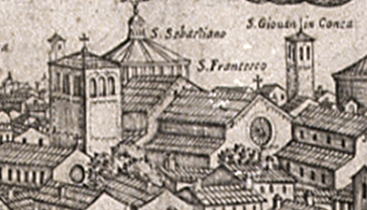
The Church of San Francesco Grande (in Italian: Chiesa di San Francesco Grande) was an ancient church in Milan built in the 4th century and demolished in 1806. It was originally called Basilica di San Nabore after the saint whose remains it houses, but from the 13th century onwards, as the adjoining Franciscan monastery took possession of the monument, it took its new name from Francis of Assisi, founder of the order. Before the end of the 17th century, the church adopted a rectangular plan. At first, in the part corresponding to the Basilica of Saint Nero, it had a mixture of Lombard Romanesque and Gothic architecture, to which was added a larger part due to the Franciscans. Later, the church continued to grow with the creation of numerous chapels by wealthy donors, who in exchange obtained the right to be buried in sepulchres created by renowned artists. After a first destruction at the end of the 17th century and a reconstruction some ten years later, in 1697, the architectural style of the church became baroque, but its plan remained very close to that of the original building, although it lost ground area. The church of San Francesco Grande is known for having housed many works...
At the time of its destruction in 1806, the church of San Francesco Grande was located within the walls of the city of Milan in Piazza San Ambrose, named after the basilica that borders it.
The present-day Nirone and Santa Valeria streets ran alongside it. In its place, the Garibaldi police barracks now stand.
Situation on the map of Milan in 1573 by Antoine Lafréry: 1)Saint Francesco Grande Church; 2) Basilica of Sant'Ambrogio ; 3) Milan cathedral ; 4) Sforza Castle.
Place Saint Ambroise in the 1950s: the barracks are on the left and the Catholic University of the Sacred Heart opposite.
The history of the church of San Francesco Grande can be described in three main phases between its creation in the first centuries of the Christian era and its destruction in 1806. This history benefits from the archaeological research carried out during several excavation campaigns: a first one in 1939-1940 under the management of Aristide Calderini, then a second one in two phases conducted in 2006-2008 and a third one in 2011–2012 on the occasion of the creation of a car park on the Place Saint Ambrose.
In ancient times, the site to be occupied by the church of San Francesco Grande was located outside the city walls, a short distance from a gateway to the circus area and the imperial palace.
From the 1st century of the Christian era onwards, this place was part of a vast space that developed as a necropolis made up of several funerary nuclei that were still commonly used until the 3rd century of the Common Era and then more sporadically afterwards. These nuclei are organised around dwellings serving as churches, each with its own cemetery. The complex thus houses the remains of ancient Christian martyrs, constituting the first Christian cemetery in Milan. Saint Ambrose called it the "Cemetery of the Saints" (in Italian: Cimiterio de' santi ) or the "Cemetery of the Martyrs" (in Latin: ad martyres ) in his memoirs. Excavations show that, despite the construction of churches, the area was used as a burial ground at a later date, with tombs dating from the 5th century.
Amongst these houses, there is in particular that of Filippo de 'Oldani, a Roman consul of the time of Nero who secretly converted to Christianity and buried the remains of St. Gervais and St. Protais here. This is where the church was built. During this time, what is now the primitive church is called, according to hagiographic writings, " Polyandrion Caius et Filippo" (in Latin: Polyandrion Caij et Philippi ) from the names of Filippo and Saint Caius, the third bishop of Milan.
In the second century, it was consecrated as a basilica by the bishop of Milan, Saint Castriziano. Then, in the following century, the remains of St. Nabor and St. Felix, who died during the reign of the co-emperor Maximian Hercules, were transferred there from Lodi by Bishop Materne of Milan (episcopate after 314 and before 342). In fact, it is called the "Naborian Basilica" or "Basilica of Saint Nabore" (" San Nabore " in Italian). The transfer is the occasion of festivities that take place in the presence of one of the reigning co-emperors of the Tetrarchy.
All these saints were buried there before being transferred in June 386 by Saint Ambrose to the basilica he founded on the site where Saint Victor had been buried, in the "house of Fausta", named after the daughter of Filippo.
The building of the first real church in place of the domus Philippi is difficult to date, but an inscription on its walls several centuries later assures that it took place at the beginning of the tenth century. The Italian priest and historian Paolo Rota (1832 - 1911), however, dates it slightly earlier, to the 7th century.
From the arrival of the Franciscan friars to the first destruction
In the 13th century, the Franciscans - whose order had just been created - settled in Milan. In 1222, they obtained a plot of land behind the Basilica of San Nabore, on which they built a convent and, in 1233, a chapel that they attached to the apse. In 1256, by papal bull of Alexander IV, they received permission to build a church dedicated to the founder of the order, Saint Francis of Assisi. On 14 March 1263 the Pope allowed them to take possession of the church of San Nabore. They then restructured the two buildings to form a single one and named it the "Church of Saint Francis". The first occurrence of this name dates back to 1387 in a calendar of the order, thus confirming the fusion of the basilica and the chapel. The promoters of the construction soon received rich donations from the faithful, who in exchange obtained the right to make it their burial place.
In 1272 a bell tower was erected, but in 1551 it was lowered by a third of its height by the city governor - along with all the city's tallest bell towers - to prevent it from providing a sightline on the newly created city walls. This reduction corresponds to "40 fathoms" or 24 metres, which suggests that it was originally over 70 metres high. Finally, the church was extended and modified between 1570 and 1571.
The chapel and the brotherhood of the Immaculate Conception
- The panels of the Angel musicians framing the Virgin of the Rocks on the altarpiece in the chapel (proportions not respected).
Angel musician playing the fiddle attributed to Francesco Napoletano (Between 1495 and 1499, London, National Gallery ).
The Virgin of the Rocks by Leonardo da Vinci (Between 1491 and 1499, then between 1506 and 1508, London, National Gallery ).
Angel musician playing a lute painted by Giovanni Ambrogio de Predis (Between 1495 and 1499, London, National Gallery ).
Closest places in our Italy guide.
More places to explore in Italy.


