Italy
Istituto nazionale per la grafica
Art museum · Rome
Tourist attraction

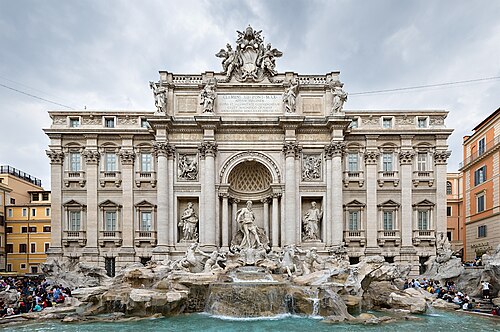
The Trevi Fountain (Italian: Fontana di Trevi) is an 18th-century fountain in the Trevi district in Rome, Italy, designed by Italian architect Nicola Salvi and completed by Giuseppe Pannini in 1762. Standing 26.3 metres (86 ft) high and 49.15 metres (161.3 ft) wide, it is the largest Baroque fountain in the city and one of the most famous fountains in the world.
The fountain, at the junction of three roads ( tre vie ), marks the terminal point of the "modern" Acqua Vergine —the revived Aqua Virgo, one of the aqueducts that supplied water to ancient Rome. In 19 BC, supposedly with the help of a virgin, Roman technicians located a source of pure water some 13 km (8.1 mi) from the city. (This scene is presented on the present fountain's façade.) However, the eventual indirect route of the aqueduct made its length some 22 km (14 mi). This Aqua Virgo led the water into the Baths of Agrippa. It served Rome for more than 400 years.
During the 6th century AD, the aqueducts were not well maintained and the 14 functioning ones were damaged during the invasion of the Ostrogoths. Although compromised and greatly reduced in scope after the damage caused by the siege of the Goths of Vitiges in 537, the Acqua Vergine remained in use throughout the Middle Ages, with restorations attested as early as the 8th century, then again by the Municipality in the 12th century, on the occasion of which the conduit was also connected to other sources closer to the city, located in a place then called "Trebium". [ citation needed ]
The Acqua Vergine water aqueduct carries the water to the Trevi Fountain, after having collected it 10 km (6.2 mi) from the Italian capital. [ citation needed ] The aqueduct is still in use today, despite some interventions during which the fountain remained empty. Calcium-free water is thought to be one of the causes [ further explanation needed ].
In 1629, Pope Urban VIII, finding the earlier fountain insufficiently dramatic, asked Gian Lorenzo Bernini to sketch possible renovations, but the project was abandoned when the Pope died. Though Bernini's project was never constructed, there are many Bernini touches in the fountain as it exists today. An early influential model by Pietro da Cortona, preserved in the Albertina, Vienna, also exists, as do various early 18th century sketches, most unsigned, as well as a project attributed to Nicola Michetti one attributed to Ferdinando Fuga and a French design by Edmé Bouchardon.
Competitions had become popular during the Baroque era to design buildings, fountains, as well as the Spanish Steps. In 1730, Pope Clement XII organized a contest in which Nicola Salvi initially lost to Alessandro Galilei – but due to the outcry in Rome over a Florentine having won, Salvi was awarded the commission anyway. Work began in 1732.
When Salvi designed the fountain, a palace (now the Palazzo Poli ) was on the site so he incorporated the fountain into the rear of the building.
Salvi died in 1751 with his work half finished, but he had made sure a barber's unsightly sign would not spoil the ensemble, hiding it behind a sculpted vase, called by Romans the asso di coppe, the " Ace of Cups ", because of its resemblance to a Tarot card. Four different sculptors were hired to complete the fountain's decorations: Pietro Bracci (whose statue of Oceanus sits in the central niche), Filippo della Valle, Giovanni Grossi, and Andrea Bergondi. Giuseppe Pannini (1718-1805), son of Giovanni Paolo Panini, was hired as architect.
The Trevi Fountain was finished in 1762 by Pannini, who substituted the present allegories for planned sculptures of Agrippa and Trivia, the Roman virgin. It was officially opened and inaugurated on 22 May by Pope Clement XIII. The majority of the piece is made from Travertine stone, quarried near Tivoli, about 35 kilometres (22 miles) east of Rome.
The name of the fountain derives from the Latin word trivium, meaning "intersection of three streets". The statue is located right in the center of Via De' Crocicchi, Via Poli and Via Delle Muratte.
The fountain was refurbished once in 1988 to remove discoloration caused by smog, and again in 1998; the stonework was scrubbed and all cracks and other areas of deterioration were repaired by skilled artisans, and the fountain was equipped with recirculating pumps. In January 2013, it was announced that the Italian fashion company Fendi would sponsor a 20-month, 2.2-million-euro restoration of the fountain, the most thorough in the fountain's history. Restoration work began in June 2014 and was completed in November 2015. The fountain was reopened with an official ceremony on the evening of 3 November 2015. The restoration included the installation of more than 100 LED lights to improve the nighttime illumination of the fountain.
On 21 May 2023, activists of the climate group Ultima Generazione (Last Generation) climate protest group vandalized the fountain by dyeing the water with charcoal. Rome Mayor Roberto Gualtieri criticized the attacks on heritage sites. As the fountain recirculates the water, cleaning of the fountain would need the 300,000 litres of polluted water to be emptied and replaced resulting in significant costs. Ryan Maue, the former chief scientist for the National Oceanic and Atmospheric Administration, stated the attack was done by "climate eco-anarchists".
On 2 February 2026, the City Council of Rome introduced a ticketing system where non-residents will need to buy a 2-euro ticket to approach the fountain and throw coins into its waters. This is part of its latest effort to manage crowds at one of the capital’s most overwhelmed landmarks. Tickets are required from 11 a.m. to 10 p.m. on Mondays and Fridays, and from 9 a.m. to 10 p.m. the rest of the week. After 10 p.m., the barriers are opened and access is free for all.
As stated by Rome's city councillor responsible for tourism Alessandro Onorato, the city hall estimates that the ticketing system in place has the potential to earn over six million euros in revenue a year. These funds would, apart from fund restoration, also pay for around 25 stewards hired within the ticketing office and also to usher people through the restricted area reserved for ticket holders. The funds raised would also permit free access for locals to a series of museums across the Italian capital, Onorato also said.
The fountain, at the junction of three roads ( tre vie ), marks the terminal point of the "modern" Acqua Vergine —the revived Aqua Virgo, one of the aqueducts that supplied water to ancient Rome. In 19 BC, supposedly with the help of a virgin, Roman technicians located a source of pure water some 13 km (8.1 mi) from the city. (This scene is presented on the present fountain's façade.) However, the eventual indirect route of the aqueduct made its length some 22 km (14 mi). This Aqua Virgo led the water into the Baths of Agrippa. It served Rome for more than 400 years.
During the 6th century AD, the aqueducts were not well maintained and the 14 functioning ones were damaged during the invasion of the Ostrogoths. Although compromised and greatly reduced in scope after the damage caused by the siege of the Goths of Vitiges in 537, the Acqua Vergine remained in use throughout the Middle Ages, with restorations attested as early as the 8th century, then again by the Municipality in the 12th century, on the occasion of which the conduit was also connected to other sources closer to the city, located in a place then called "Trebium". [ citation needed ]
The Acqua Vergine water aqueduct carries the water to the Trevi Fountain, after having collected it 10 km (6.2 mi) from the Italian capital. [ citation needed ] The aqueduct is still in use today, despite some interventions during which the fountain remained empty. Calcium-free water is thought to be one of the causes [ further explanation needed ].
In 1629, Pope Urban VIII, finding the earlier fountain insufficiently dramatic, asked Gian Lorenzo Bernini to sketch possible renovations, but the project was abandoned when the Pope died. Though Bernini's project was never constructed, there are many Bernini touches in the fountain as it exists today. An early influential model by Pietro da Cortona, preserved in the Albertina, Vienna, also exists, as do various early 18th century sketches, most unsigned, as well as a project attributed to Nicola Michetti one attributed to Ferdinando Fuga and a French design by Edmé Bouchardon.
Competitions had become popular during the Baroque era to design buildings, fountains, as well as the Spanish Steps. In 1730, Pope Clement XII organized a contest in which Nicola Salvi initially lost to Alessandro Galilei – but due to the outcry in Rome over a Florentine having won, Salvi was awarded the commission anyway. Work began in 1732.
When Salvi designed the fountain, a palace (now the Palazzo Poli ) was on the site so he incorporated the fountain into the rear of the building.
Closest places in our Italy guide.
More places to explore in Italy.