Germany
Museum of Modern Electronic Music
Museum · Frankfurt
Church building
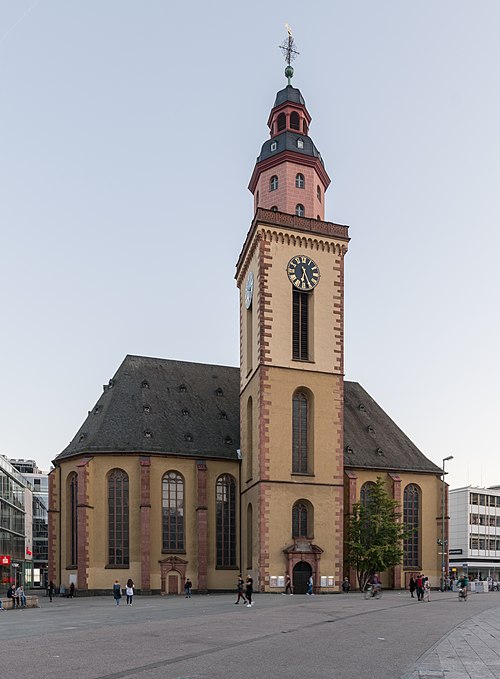
St. Catherine's Church (German: Katharinenkirche) is the largest Protestant church in Frankfurt am Main, Germany. It is a parish church in the old city centre near one of the most famous city squares, the Hauptwache. The church is dedicated to the martyred early Christian saint Catherine of Alexandria. The building was completed in 1681 in a Baroque style. After being heavily damaged in 1944 during allied air raids in World War II, the church was rebuilt in the 1950s in a simpler style. More detailed restorations of the exterior and interior, including original baroque paintings that survived the war, were completed between 1978 and 2005. The steeple and roof were fully restored in 2011. St. Catherine's has a long tradition as a centre of church music, starting from the days when Georg Philipp Telemann was director of the city's music. It hosts a regular concert series around the Rieger organ, installed in 1990.
In 1343, Wicker Frosch [ de ], cantor of Frankfurt Cathedral, received land in front of the Bockenheimer Tor of the Staufenmauer to build a hospice centre for the sick and poor. Two years later Frosch secured a foundation that guaranteed the financing of the hospital, and expanded it in 1354 with a patrician convent dedicated to Saints Catherine and Barbara, organized on the Rule of the Teutonic Knights for Women.
Frankfurt adopted the Reformation in 1533 and unilaterally appropriated all religious buildings within its old city centre. In 1526 the medieval convents were secularized, but the White Ladies Convent (Weißfrauenklosters) continued to operate as a shelter for windows, orphans and other dependents. On 8 March 1554 the convents were given to the Reformed French community in Frankfurt, officially founding that community in the city. [ citation needed ] Saint Catherine's Church had had protestant preachers beginning in 1522, as it was a pulpit for Hartmann Ibach [ de ] in 1522, whose preaching there sparked controversy in Frankfurt, for Dietrich Sartorius [ de ] and finally for Johannes Cellarius [ de ] of Wittenberg.
The church was built by Melchior Heßler between 1678 and 1681 in the Baroque style and stands 54 metres (177 ft) in height. While the exterior of the building was kept modest, the interior was a lavish Baroque installation. Three sides (west, north and east) had a double gallery. A cycle of paintings on the galleries dominated the space. On the lower level were 41 paintings which depicted biblical scenes, one for each book from the Old Testament, and for several books from the New Testament. The upper level held 42 paintings with matching topics from the bible or allegories. The altar was installed in the East, as usual, but the pulpit was in the south wall. The wooden construction of the ceiling was reminiscent of a late-Gothic rib vault. It held a painting of biblical scenes which was not restored after World War II. [ citation needed ]
The German writer, artist, and politician Johann Wolfgang von Goethe (1749–1832) was baptized in this church in 1749. The church's status was fixed in 1830 by the deeds of dotation contracts, which made the church one of the city's nine dotation churches left for eternal usage by a Protestant congregation.
On 22 March 1944, an air raid destroyed much of the Altstadt, including St. Catherine's, whose clock froze at 09:43 local time. The city of Frankfurt decided to rebuild the church, keeping the interior simple.
The rebuilding began at Pentecost 1950 and was completed in October 1954. The architects were Theo Kellner and Wilhelm Massing [ de ]. The exterior was restored similar to the previous appearance. The interior was the subject of long debates. The wooden ceiling was reconstructed, while the ceiling of the nearby church Liebfrauen was not restored to its Gothic vaults. The multiple Baroque galleries on three sides were not restored, but replaced by a single simple gallery in the west which became the place for the organ. Below the gallery, a hall for meetings and one for weddings were installed. The main entrance was changed from the north to the west. The walls were kept plain white, and furnishing such as altar, benches and lighting were kept intentionally simple, in keeping with the mood of the 1950s. The main decoration of the church are 17 stained windows created by Charles Crodel.
After restoration, the church was reopened with a service on 24 October 1954. When a U-Bahn was built in the 1960s, it was difficult to enter the church. Exterior restoration was completed in 1978. Several paintings that had decorated the Baroque galleries survived the war. They were restored, and eight of them installed at the new gallery in 1990, including Die Predigt des Hosea ( Hosea's Sermon ).
Another interior restoration began in 2001 and was completed in 2005. The complete set of more than 80 Baroque paintings was shown in 2005 in an exhibition in memory of the 300th anniversary of the death of Spener, in the Franckesche Stiftungen in Halle (Saale). 22 of the paintings were shown in the Katharinenkirche, in addition to the eight permanently there, from 10 October to 31 December 2006.
The steeple was restored again in 2011, with a new roof and a colour of the walls matching historic models. The cross on top was also restored.
The Protestant congregation enjoys usufruct of the building. It is a member of the Protestant Church in Hesse and Nassau.
In 1343, Wicker Frosch [ de ], cantor of Frankfurt Cathedral, received land in front of the Bockenheimer Tor of the Staufenmauer to build a hospice centre for the sick and poor. Two years later Frosch secured a foundation that guaranteed the financing of the hospital, and expanded it in 1354 with a patrician convent dedicated to Saints Catherine and Barbara, organized on the Rule of the Teutonic Knights for Women.
Frankfurt adopted the Reformation in 1533 and unilaterally appropriated all religious buildings within its old city centre. In 1526 the medieval convents were secularized, but the White Ladies Convent (Weißfrauenklosters) continued to operate as a shelter for windows, orphans and other dependents. On 8 March 1554 the convents were given to the Reformed French community in Frankfurt, officially founding that community in the city. [ citation needed ] Saint Catherine's Church had had protestant preachers beginning in 1522, as it was a pulpit for Hartmann Ibach [ de ] in 1522, whose preaching there sparked controversy in Frankfurt, for Dietrich Sartorius [ de ] and finally for Johannes Cellarius [ de ] of Wittenberg.
The church was built by Melchior Heßler between 1678 and 1681 in the Baroque style and stands 54 metres (177 ft) in height. While the exterior of the building was kept modest, the interior was a lavish Baroque installation. Three sides (west, north and east) had a double gallery. A cycle of paintings on the galleries dominated the space. On the lower level were 41 paintings which depicted biblical scenes, one for each book from the Old Testament, and for several books from the New Testament. The upper level held 42 paintings with matching topics from the bible or allegories. The altar was installed in the East, as usual, but the pulpit was in the south wall. The wooden construction of the ceiling was reminiscent of a late-Gothic rib vault. It held a painting of biblical scenes which was not restored after World War II. [ citation needed ]
The German writer, artist, and politician Johann Wolfgang von Goethe (1749–1832) was baptized in this church in 1749. The church's status was fixed in 1830 by the deeds of dotation contracts, which made the church one of the city's nine dotation churches left for eternal usage by a Protestant congregation.
On 22 March 1944, an air raid destroyed much of the Altstadt, including St. Catherine's, whose clock froze at 09:43 local time. The city of Frankfurt decided to rebuild the church, keeping the interior simple.
The rebuilding began at Pentecost 1950 and was completed in October 1954. The architects were Theo Kellner and Wilhelm Massing [ de ]. The exterior was restored similar to the previous appearance. The interior was the subject of long debates. The wooden ceiling was reconstructed, while the ceiling of the nearby church Liebfrauen was not restored to its Gothic vaults. The multiple Baroque galleries on three sides were not restored, but replaced by a single simple gallery in the west which became the place for the organ. Below the gallery, a hall for meetings and one for weddings were installed. The main entrance was changed from the north to the west. The walls were kept plain white, and furnishing such as altar, benches and lighting were kept intentionally simple, in keeping with the mood of the 1950s. The main decoration of the church are 17 stained windows created by Charles Crodel.
After restoration, the church was reopened with a service on 24 October 1954. When a U-Bahn was built in the 1960s, it was difficult to enter the church. Exterior restoration was completed in 1978. Several paintings that had decorated the Baroque galleries survived the war. They were restored, and eight of them installed at the new gallery in 1990, including Die Predigt des Hosea ( Hosea's Sermon ).
Another interior restoration began in 2001 and was completed in 2005. The complete set of more than 80 Baroque paintings was shown in 2005 in an exhibition in memory of the 300th anniversary of the death of Spener, in the Franckesche Stiftungen in Halle (Saale). 22 of the paintings were shown in the Katharinenkirche, in addition to the eight permanently there, from 10 October to 31 December 2006.
The steeple was restored again in 2011, with a new roof and a colour of the walls matching historic models. The cross on top was also restored.
Closest places in our Germany guide.
More places to explore in Germany.