
Spain
Glory's Portico
Portico · Santiago de Compostela
Church building
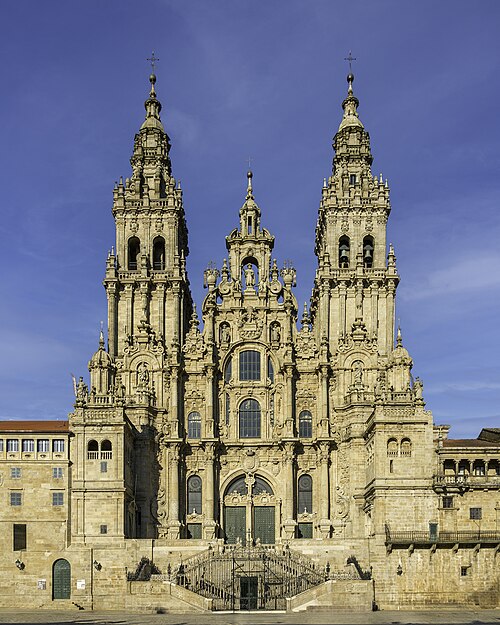
The Santiago de Compostela Archcathedral Basilica (Spanish and Galician: Catedral Basílica de Santiago de Compostela) is part of the Metropolitan Archdiocese of Santiago de Compostela and is an integral component of the Santiago de Compostela World Heritage Site in Galicia, Spain. The cathedral is the reputed burial place of Saint James the Great, one of the apostles of Jesus Christ. It is also among the remaining churches in the world built over the tomb of an apostle, the other ones being St Peter's Basilica in Vatican City, St Thomas Cathedral Basilica in Chennai, India, and Basilica of St. John in İzmir, Turkey. The archcathedral basilica has historically been a place of Christian pilgrimage on the Way of St James since the Early Middle Ages and marks the traditional end of the pilgrimage route. The building is a Romanesque structure, with later Gothic and Baroque additions.
According to legend, the tomb in Santiago was rediscovered in AD 814 by Pelagius the Hermit, after he witnessed strange lights in the night sky above the Libredon forest. Bishop Theodomirus of Iria recognized this as a miracle and informed king Alfonso II of Asturias and Galicia (791–842). The king ordered the construction of a chapel on the site. Legend has it that the king was the first pilgrim to this shrine. This was followed by the first church in AD 829 and then in AD 899 by a pre-Romanesque church, ordered by king Alfonso III of León, which caused the gradual development of this major place of pilgrimage.
In 997 the early church was reduced to ashes by Al-Mansur Ibn Abi Aamir (938–1002), army commander of the caliph of Córdoba. St James's tomb and relics were left undisturbed. The gates and the bells, carried by local Christian captives to Córdoba, were added to the Aljama Mosque. When Córdoba was taken by king Ferdinand III of Castile in 1236, these same gates and bells were then transported by Muslim captives to Toledo, to be inserted in the Cathedral of Saint Mary of Toledo.
Construction of the present cathedral began in 1075 under the reign of Alfonso VI of Castile (1040–1109) and the patronage of bishop Diego Peláez. It was built according to the same plan as the monastic brick church of Saint Sernin in Toulouse, probably the greatest Romanesque edifice in France. [ according to whom? ] It was built mostly in granite. Construction was halted several times and, according to the Liber Sancti Iacobi, the last stone was laid in 1122. But by then, the construction of the cathedral was certainly not finished. The cathedral was consecrated in 1211 in the presence of king Alfonso IX of Leon.
According to the Codex Calixtinus the architects were "Bernard the elder, a wonderful master", his assistants Robertus Galperinus and, later possibly, "Esteban, master of the cathedral works". In the last stage "Bernard, the younger" was finishing the building, while Galperinus was in charge of the coordination. He also constructed a monumental fountain in front of the north portal in 1122.

The city became an episcopal see in 1075 and the church its cathedral. Due to its growing importance as a place of pilgrimage, it was raised to an archiepiscopal see by Pope Callixtus II in 1120. A university was added in 1495. [ citation needed ]
It has been proposed that the peculiar lantern towers of several churches in the Duero valley ( Zamora, Plasencia, Toro, Évora ) were inspired by the Romanesque dome of Santiago, substituted by a Gothic one in the 15th century. The cathedral was expanded and embellished with additions in the 16th, 17th and 18th centuries.
Each of the façades along with their adjoining squares constitute a large urban square. The Baroque façade of the Praza do Obradoiro square was completed by Fernando de Casas Novoa in 1740. Also in baroque style is the Acibecharía façade by Ferro Caaveiro and Fernández Sarela, later modified by Ventura Rodríguez. The Pratarías façade, built by the Master Esteban in 1103, and most importantly the Pórtico da Gloria, an early work of Romanesque sculpture, were completed by Master Mateo in 1188.
The Obradoiro square in front of the façade alludes to the workshop ( Galician : obradoiro ) of stonemasons who worked on the square during the construction of the cathedral. In order to protect the Pórtico da Gloria from deterioration caused by weather, this façade and towers have had several reforms since the 16th century. In the 18th century it was decided to build the current Baroque façade, designed by Fernando de Casas Novoa. It has large glazed windows that illuminate the ancient Romanesque façade, located between the towers of the Bells and of the Ratchet. In the middle of the central body is St. James and one level below his two disciples Athanasius and Theodore, all dressed as pilgrims. In between, the urn (representing the found tomb) and the star (representing the lights Hermit Pelagius saw) between angels and clouds. The tower on the right depicts Mary Salome, mother of St. James, and the tower on the left depicts his father Zebedee. The balustrade on the left side depicts St. Susanna and St. John and the one on the right depicts St. Barbara and James the Less.
The Maximilian Staircase allows entrance to the façade. The stair was made in the 17th century by Ginés Martínez and it is of Renaissance style inspired by Giacomo Vignola of Palazzo Farnese. It is diamond-shaped with two ramps that surround the entrance to the old 12th century Romanesque crypt of the Master Mateo, popularly called the "Old Cathedral". According to Manuel Gago Mariño, the sculptures at the base of the Maximilian Staircase of the cathedral, built by Maximilian of Austria are also related to the Battle of Clavijo.

Between the existing plane of the façade of the Obradoiro and the old Romanesque portal (Pórtico da Gloria) there is a covered narthex.
This façade has become a symbol of the cathedral and the city of Santiago de Compostela. As such, it is the engraving on the back of the Spanish euro coins of 1, 2 and 5 cents.
The façade of the Silverware (Pratarías in Galician) is the southern façade of the transept of the cathedral of Santiago de Compostela; it is the only Romanesque façade that is preserved in the cathedral. It was built between 1103 and 1117 and elements from other parts of the cathedral have been added in subsequent years. The square is bound by the cathedral and cloister on two sides. Next to the cathedral is the Casa do Cabido.
It has two entrance doors in degradation with archivolts and historical tympanums. The archivolts are attached over eleven columns, three are of white marble (middle and corners) and the rest of granite. In the center are the figures of twelve prophets and the Apostles on the sideline. On the tympanums is a large frieze separated from the upper body by a strip supported by grotesque corbels; on this floor are two windows decorated with Romanesque archivolts.
In the central frieze is Christ, with various characters and scenes. On the right six figures belong to the Stone choir of Master Mateo [ es ] that were placed in the late 19th century. The original provision of the iconographic elements was invalidated since in the 18th century numerous images were introduced recovered from the dismantled Acibecharía façade. A central medallion shows the Eternal Father (or Transfiguration ) with open hands and on the top surface there are four angels with trumpets heralding the Final Judgment.

In the tympanum of the left door is Christ tempted by a group of demons. To the right is a half-dressed woman with a skull in her hands, which could be Eve or the adulterous woman. This figure is not praying on her knees but is sitting on two lions. The jambs are Saint Andrew and Moses. In the left abutment, the Biblical King David seated on his throne with his legs crossed, translucent through the thin fabric of his clothes, and playing what appears to be a rebec, personifies the triumph over evil and is an outstanding Romanesque work, sculpted by Master Esteban. The creation of Adam and Christ's blessing is also shown. Many of these figures come from the Romanesque façade of the north or do Paraíso (current façade of the Acibecharía) and were placed on this façade in the 18th century.
In the tympanum of the right door there are several scenes from the Passion of Christ and the Adoration of the Magi. In one of the jambs is the inscription commemorating the laying of the stone:
ERA / IC / XVI / V IDUS / JULLII Registration follows the Roman calendar, according to the computation of the Spanish era, corresponding to July 11, 1078. An image, unidentified, of a fox eating a rabbit and, against this, a badly dressed woman with an animal in her lap. Supported on the wall of the tower Berenguela appear other images representing the creation of Eve, Christ on a throne, and the Binding of Isaac.
The façade "da Acibecharía" (Galician name derived from the jet gemstone) is in the Praza da Inmaculada or Acibecharía, draining the last section of urban roads: French, Primitive, Northern and English through the old gate Franxígena or Paradise door. The Romanesque portal was built in 1122 by Bernardo, treasurer of the temple. This portal was demolished after suffering a fire in 1758; some sculptural pieces that were saved were placed on the façade das Pratarías. The new façade was designed in Baroque style by Lucas Ferro Caaveiro and finished by Domingo Lois Monteagudo and Clemente Fernández Sarela in the neoclassical style in 1769, although it retained some traces of the baroque.
At the top of the façade is an 18th-century statue of St. James, with two kings in prayer at his feet: Alfonso III of Asturias and Ordoño II of León. In the centre is the statue of Faith.
Closest places in our Spain guide.
More places to explore in Spain.


