Germany
Feuerland
Cultural heritage ensemble · Büsum
Coastal spa
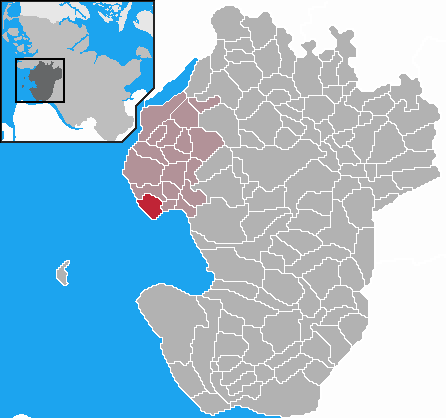
Büsum (German pronunciation: [ˈbyːzʊm] ) is a fishing and tourist town in the district of Dithmarschen, in Schleswig-Holstein, Germany. It is situated on the North Sea coast, approx. 18 km (12 miles) southwest of Heide. Büsum is also the administrative seat of the Amt ("collective municipality") Büsum-Wesselburen.
The first documented mention of Büsum (as an island) dates from the year 1140. The island's name on medieval documents changed several times from the original Bivsne (1140) to Busin (1208), Busen (1281), and Buzen (1447). Büsum's medieval history has been documented through the chronicles of Neocorus (Johannes Adolph Köster), a pastor and teacher in Büsum during the 16th century.
During medieval times, Büsum was an island with three villages, Süderdorp, Middeldorp and Norddorp. Devastating floods in 1362 ( Grote Mandrenke ), 1436, and 1570 ( All Saint's Flood ) drowned most of the island and destroyed the two settlements Süderdorp and Middeldorp. The former Norddorp with the St. Clemens church nowadays forms the old core of the town Büsum.
In 1585, the island was connected with the mainland through the building of a dam. Subsequent deposits of sediment by the sea created new land, which was further secured through dikes. Storm floods continued to take their toll as documented in the St. Clemens church with a tabloid commemorating the Burchardi flood of 1634 flood, which killed 168 people and destroyed 102 homes in Büsum. During the devastating Christmas flood of 1717, the village Werven near Büsum sank completely. The last great flood happened during February 1825. Since then, the improved dikes have been able to protect the town from storm tides.
The island of Büsum was originally beholden to the bishopric of Hamburg and Bremen before Dithmarschen became a confederated peasant's republic. From 1559 until 1867, Büsum (and Dithmarschen) were Danish territory and subsequently became part of Prussia. After World War II, Büsum was part of the British Zone until 1955.
During medieval times, Büsum was frequently visited by traders of the Hanseatic League. The Hansa was the main ally of Dithmarschen, but the peasants' republic never became part of the Hanseatic League itself. The people of the comparatively poor island Büsum often resorted to piracy to better their lives, resulting in repeated conflicts. In 1420, Rackler Kersten and his men from Büsum sailed into the harbor of Hamburg to scuttle and loot Hanseatic trading ships. In retaliation, the Hamburgers pillaged and burned the island's church in Middeldorp. The new church was built in Norddorp and furnished with several items looted from the island Pellworm by the pirate Cord Widderich.
During World War II, the shipyard and harbor in Büsum were used by the Kriegsmarine, making it a target for an air raid. Büsum was bombed on May 4, 1945, the day German troops surrendered in northern Germany and thus the last day of war in the region. Nine people lost their lives, 19 were injured, and five houses were completely destroyed.
During medieval times, Büsum was an island with three villages, Süderdorp, Middeldorp and Norddorp. Devastating floods in 1362 ( Grote Mandrenke ), 1436, and 1570 ( All Saint's Flood ) drowned most of the island and destroyed the two settlements Süderdorp and Middeldorp. The former Norddorp with the St. Clemens church nowadays forms the old core of the town Büsum.
In 1585, the island was connected with the mainland through the building of a dam. Subsequent deposits of sediment by the sea created new land, which was further secured through dikes. Storm floods continued to take their toll as documented in the St. Clemens church with a tabloid commemorating the Burchardi flood of 1634 flood, which killed 168 people and destroyed 102 homes in Büsum. During the devastating Christmas flood of 1717, the village Werven near Büsum sank completely. The last great flood happened during February 1825. Since then, the improved dikes have been able to protect the town from storm tides.
The island of Büsum was originally beholden to the bishopric of Hamburg and Bremen before Dithmarschen became a confederated peasant's republic. From 1559 until 1867, Büsum (and Dithmarschen) were Danish territory and subsequently became part of Prussia. After World War II, Büsum was part of the British Zone until 1955.
During medieval times, Büsum was frequently visited by traders of the Hanseatic League. The Hansa was the main ally of Dithmarschen, but the peasants' republic never became part of the Hanseatic League itself. The people of the comparatively poor island Büsum often resorted to piracy to better their lives, resulting in repeated conflicts. In 1420, Rackler Kersten and his men from Büsum sailed into the harbor of Hamburg to scuttle and loot Hanseatic trading ships. In retaliation, the Hamburgers pillaged and burned the island's church in Middeldorp. The new church was built in Norddorp and furnished with several items looted from the island Pellworm by the pirate Cord Widderich.
During World War II, the shipyard and harbor in Büsum were used by the Kriegsmarine, making it a target for an air raid. Büsum was bombed on May 4, 1945, the day German troops surrendered in northern Germany and thus the last day of war in the region. Nine people lost their lives, 19 were injured, and five houses were completely destroyed.
During medieval times, Büsum was frequently visited by traders of the Hanseatic League. The Hansa was the main ally of Dithmarschen, but the peasants' republic never became part of the Hanseatic League itself. The people of the comparatively poor island Büsum often resorted to piracy to better their lives, resulting in repeated conflicts. In 1420, Rackler Kersten and his men from Büsum sailed into the harbor of Hamburg to scuttle and loot Hanseatic trading ships. In retaliation, the Hamburgers pillaged and burned the island's church in Middeldorp. The new church was built in Norddorp and furnished with several items looted from the island Pellworm by the pirate Cord Widderich.
During World War II, the shipyard and harbor in Büsum were used by the Kriegsmarine, making it a target for an air raid. Büsum was bombed on May 4, 1945, the day German troops surrendered in northern Germany and thus the last day of war in the region. Nine people lost their lives, 19 were injured, and five houses were completely destroyed.
Neocorus reported that the main source of living for the people of Büsum during his times were fishing and farming. Büsum as a fisher town is primarily known for its specialty Büsumer Krabben (North Sea shrimp, Crangon crangon ), which are processed and canned for sale. The first records of shrimping in Büsum date from 1624. During this time, shrimp fishing was mostly done by women with nets in the tidal gullies of the Wadden Sea. At the end of the 19th century, fishing on the high seas became popular and added the need for seafaring fishing boats. Before World War II, Büsum's fishing fleet counted 132 vessels. Since then, the number of fishing vessels has continuously decreased. In 1998, Büsum's fishing fleet consisted of 35 fishing boats, with the harbor hosting 20 additional fishing vessels, mainly from the Netherlands.
Büsum had an active shipyard which started as a fishing boat repair service in 1902 and was expanded to build increasingly larger ships over the decades. During World War II, the shipyard in Büsum manufactured submarine parts. It finally closed in 1986, rendered unprofitable by overseas competition.
Since 1818, Büsum has been used as a spa town visited for the healing effects of the seawater and the mudflats of the Wadden Sea. It gained official Nordseebad (North Sea spa) status in 1837. To accommodate spa guests, Büsum was connected to the railway network by the Heide–Büsum railway in 1883.
During the Nazi regime, Büsum was a destination for Kraft durch Freude ("strength through joy") tourists, a recreational program organized by the NSDAP.
In 1949, Büsum was officially named a Nordseeheilbad (North Sea health spa). Nowadays, Büsum is a popular summer vacation spot for families and day trips from Hamburg. in 2002, Büsum accommodated 658,723 overnight stays by 83,295 guests. Nearly all (99.5%) of Büsum's tourists are Germans.
One of the landmarks of the town is Büsum Lighthouse. Built in 1912/13 from 55 tons of cast iron plates, it was originally painted black until it received its characteristic red and white daymark in 1952. It has been operated automatically since 1976 and is managed by the Water and Shipping Authority Tönning. From the harbor of Büsum, tourists can take trips to sea, either for pleasure or fishing, as nature trips along the Wadden Sea National Parks, or to the island Helgoland.
Closest places in our Germany guide.
More places to explore in Germany.