Denmark
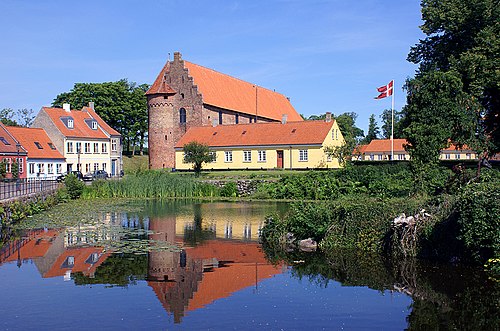
Nyborg Castle
Fortress · Nyborg Municipality
Bridge–tunnel

The Great Belt Bridge (Danish: Storebæltsbroen) or Great Belt fixed link (Danish: Storebæltsforbindelsen) is a multi-element fixed link crossing the Great Belt strait between the Danish islands of Zealand and Funen. It consists of a road suspension bridge and a railway tunnel between Zealand and the small island Sprogø in the middle of the Great Belt, and a box-girder bridge for both road and rail traffic between Sprogø and Funen. The total length is 18 kilometres (11 mi). The term Great Belt Bridge commonly refers to the suspension bridge, although it may also be used to mean the box-girder bridge, especially when discussing the railway, or the link in its entirety. Together with the New Little Belt Bridge, the Great Belt link provides a continuous road and rail connection between Copenhagen and the Danish mainland (the Jutland Peninsula of the European continent). It has the world's seventh-longest main span (1.6 km (1 mi)). Operation and maintenance of the bridge are performed by A/S Storebælt under Sund & Bælt. Maintenance and the original construction are financed by tolls on vehicles and trains making use of the bridge. Officially named the East Bridge, the suspension bridge was...
See also: Great Belt § International waterway The Great Belt ferries entered service between the coastal towns of Korsør and Nyborg in 1883, connecting the railway lines on either side of the Belt. In 1957, road traffic was moved to the Halsskov–Knudshoved route, about 1.5 kilometres to the north and close to the fixed link.
Construction drafts for a fixed link were presented as early as the 1850s, with several suggestions appearing in the following decades. The Danish State Railways, responsible for the ferry service, presented plans for a bridge in 1934. The concepts of bridges over Øresund (152 million DKK) and Storebælt (257 million DKK) were calculated around 1936. In 1948, the Ministry for Public Works (now the Ministry of Transport ) established a commission to investigate the implications of a fixed link.
The first law concerning a fixed link was enacted in 1973, but the project was put on hold in 1978 as the Venstre (Liberal) party demanded postponing public spending. Political agreement to restart work was reached in 1986, with a construction law ( Danish : anlægslov ) being passed in 1987.
The design was carried out by the engineering firms COWI and Ramboll together with Dissing+Weitling architecture practice.

Construction of the link commenced in 1988. In 1991, Finland sued Denmark at the International Court of Justice, on the grounds that Finnish-built mobile offshore drilling units would be unable to pass beneath the bridge. The two countries negotiated a financial compensation of 90 million Danish kroner, and Finland withdrew the lawsuit in 1992.
A European Court of Justice ruling in 1993 found that a contractual condition requiring use of local labour and local materials in constructing the bridge was incompatible with the principles of the EEC Treaty.
The link is estimated to have created a value of 379 billion DKK after 50 years of use.
In 2022, the bridge was crossed as part of the route of Stage 2 of the 2022 Tour de France.
The construction of the fixed link became the biggest building project in the history of Denmark. In order to connect Halsskov on Zealand with Knudshoved on Funen, 18 kilometres (11 mi) to its west, a two-track railway and a four-lane motorway had to be built, via the small island of Sprogø in the middle of the Great Belt. The project comprised three different tasks: the East Bridge for road transport, the East Tunnel for rail transport and the West Bridge for road and rail transport combined. The construction work was carried out by Sundlink Contractors, a consortium of Skanska, Hochtief, Højgaard & Schultz (which built the West Bridge) and Monberg & Thorsen (which built the eight-kilometre (5.0 mi) section under the Great Belt). The work of lifting and placing the elements was carried out by Ballast Nedam using a floating crane.

Built between 1991 and 1998 at a cost of US$950 million, the East Bridge ( Østbroen ) is a suspension bridge between Halsskov and Sprogø. It is 6,790 metres (4.219 mi) long with a free span of 1,624 metres (5,328 ft). The East Bridge had been planned to be completed in time to be the longest bridge in the world, but there were delays in construction. In the end,the Akashi-Kaikyo Bridge opened two months earlier than the East Bridge.
The vertical clearance for ships is 65 metres (213 ft), meaning the world's largest cruise ship, an Oasis -class cruise ship, just fits under with its smokestack folded. At 254 metres (833 ft) above sea level, the two pylons of the East Bridge are the highest points on self-supporting structures in Denmark. Some radio masts, such as Tommerup transmitter, are taller.
Panoramic picture of the East Bridge To keep the main cables tensioned, an anchorage structure on each side of the span is placed below the road deck. After 15 years, the cables have no rust. They were scheduled for a 15 million DKK paint job, but due to corroding cables on other bridges, the decision was made to instead install a 70 million DKK sealed de-humidifying system in the cables. This was carried out by UK engineering firm Spencer Group, with help from Danish subcontractors Davai who provided the manpower, and Belvent A/S who provided the dehumidification system. Nineteen concrete pillars (12 on the Zealand side, seven by Sprogø), 193 metres (633 ft) apart, carry the road deck outside the span.
The West Bridge ( Vestbroen ) is a box girder bridge between Sprogø and Knudshoved. It is 6,611 metres (4.108 mi) long, and has a vertical clearance for ships of 18 metres (59 ft). It is actually two separate, adjacent bridges: the northern one carries rail traffic and the southern one road traffic. The pillars of the two bridges rest on common foundations below sea level. The West Bridge was built between 1988 and 1994; its road/rail deck comprises 63 sections, supported by 62 pillars.
The twin bored tunnel tubes of the East Tunnel ( Østtunnelen ) are each 8,024 m (4.986 miles) long. There are 31 connecting tunnels between the two main tunnels, at 250 metres (820 ft) intervals. The equipment that is necessary for train operation in the tunnels [ clarification needed ] is installed in the connecting tunnels, which also serve as emergency escape routes.

There were delays and cost overruns in the tunnel construction. The plan was to open it in 1993, giving the trains a head start of three years over road traffic, but train traffic started in 1997 and road traffic in 1998. During construction the sea bed gave way and one of the tunnels was flooded. The water continued to rise and reached the end at Sprogø, where it continued into the (still dry) other tunnel. The water damaged two of the four tunnel boring machines, but no workers were injured. Only by placing a clay blanket on the sea bed was it possible to dry out the tunnels. The two damaged machines were repaired and the majority of the tunnelling was undertaken from the Sprogø side. The machines on the Zealand side tunnelled through difficult ground and made little progress. A major fire on one of the Zealand machines in June 1994 stopped these drives and the tunnels were completed by the two Sprogø machines.
A total of 320 compressed air workers were involved in 9,018 pressure exposures in the four tunnel-boring machines. The project had a decompression sickness incidence of 0.14% with two workers having long-term residual symptoms.
Built between 1991 and 1998 at a cost of US$950 million, the East Bridge ( Østbroen ) is a suspension bridge between Halsskov and Sprogø. It is 6,790 metres (4.219 mi) long with a free span of 1,624 metres (5,328 ft). The East Bridge had been planned to be completed in time to be the longest bridge in the world, but there were delays in construction. In the end,the Akashi-Kaikyo Bridge opened two months earlier than the East Bridge.
The vertical clearance for ships is 65 metres (213 ft), meaning the world's largest cruise ship, an Oasis -class cruise ship, just fits under with its smokestack folded. At 254 metres (833 ft) above sea level, the two pylons of the East Bridge are the highest points on self-supporting structures in Denmark. Some radio masts, such as Tommerup transmitter, are taller.
Panoramic picture of the East Bridge To keep the main cables tensioned, an anchorage structure on each side of the span is placed below the road deck. After 15 years, the cables have no rust. They were scheduled for a 15 million DKK paint job, but due to corroding cables on other bridges, the decision was made to instead install a 70 million DKK sealed de-humidifying system in the cables. This was carried out by UK engineering firm Spencer Group, with help from Danish subcontractors Davai who provided the manpower, and Belvent A/S who provided the dehumidification system. Nineteen concrete pillars (12 on the Zealand side, seven by Sprogø), 193 metres (633 ft) apart, carry the road deck outside the span.
Closest places in our Denmark guide.
More places to explore in Denmark.