Germany
Historical Museum of the Palatinate
History museum · Speyer
Catholic cathedral

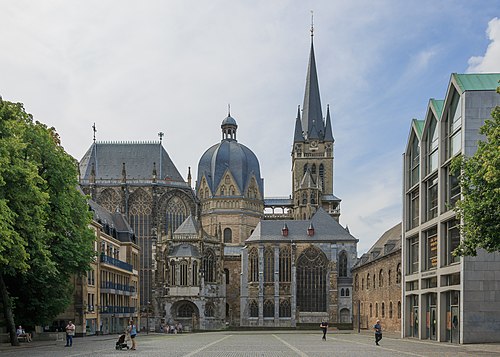
Speyer Cathedral, officially the Imperial Cathedral Basilica of the Assumption and St Stephen, in Latin: Domus sanctae Mariae Spirae (German: Dom zu Unserer lieben Frau in Speyer) is a historical religious building in Speyer, Germany. It is the seat of the Roman Catholic Bishop of Speyer and is suffragan to the Roman Catholic Archdiocese of Bamberg. The cathedral, which is dedicated to St. Mary, patron saint of Speyer ("Patrona Spirensis") and St. Stephen is generally known as the Kaiserdom zu Speyer (Imperial Cathedral of Speyer). Pope Pius XI raised Speyer Cathedral to the rank of a minor basilica of the Roman Catholic Church in 1925. Begun in 1030 under Conrad II, with the east end and high vault of 1090–1103, the imposing triple-aisled vaulted basilica of red sandstone is the "culmination of a design which was extremely influential in the subsequent development of Romanesque architecture during the 11th and 12th centuries". As the burial site for Salian, Staufer and Habsburg emperors and kings the cathedral is regarded as a symbol of imperial power. With the Abbey of Cluny in ruins, it is the largest remaining Romanesque church and building. It is considered to be "a turning point...
Plan and interior Plan in the 19th century revealing the "double-bay" system of vaulting Interior looking east In 1025, Conrad II ordered the construction of the Christian Western world's largest church in Speyer which was also supposed to be his last resting place. Construction began in 1030 on the site of a former basilica which stood on an elevated plateau right by the Rhine but safe from high water. Along with Santiago de Compostela (begun 1075), Cluny Abbey (Cluny III, begun 1085), and Durham Cathedral (begun 1093), it was the most ambitious project of the time. The red sandstone for the building came from the mountains of the Palatine Forest and is thought to have been shipped down the channelled Speyerbach, a stream running from the mountains into the Rhine at Speyer. Neither Conrad II, nor his son Henry III, were to see the cathedral completed. Conrad II died in 1039 and was buried in the cathedral while it was still under construction; Henry III was laid next to him in 1056. The graves were placed in the central aisle in front of the altar.
Nearly completed, the cathedral was consecrated in 1061. This phase of construction, called Speyer I, consists of a Westwerk, a nave with two aisles and an adjoining transept. The choir was flanked by two towers. The original apse was round inside but rectangular on the outside. The nave was covered with a flat wooden ceiling but the aisles were vaulted, making the cathedral the second largest vaulted building north of the Alps (after Aachen Cathedral ). It is considered to be the most stunning outcome of early Salian architecture and the "culmination of a design which was extremely influential in the subsequent development of Romanesque architecture during the 11th and 12th centuries".
Around 1090, Conrad's grandson, Emperor Henry IV, conducted an ambitious reconstruction in order to enlarge the cathedral. He had the eastern sections demolished and the foundations reinforced to a depth of up to eight metres. Only the lower floors and the crypt of Speyer I remained intact. The nave was elevated by five metres and the flat wooden ceiling was replaced with a groin vault of square bays, one of the outstanding achievements of Romanesque architecture. Each vault extends over two bays of elevation. Every second pier was enlarged by adding a broad pilaster or dosseret, which formed a system of interior buttressing. Engaged shafts had appeared around 1030 in buildings along the Loire ( Saint-Benoît-sur-Loire, Auxerre, Loches ) from where the technique spread to Normandy and the Rhineland.
The only other contemporary example of such a bay system is in the Church of Sant Vicenç in Cardona, Spain. The " double-bay system " of Speyer functioning as a support for the stone vaults was copied in many monuments along the Rhine. The addition of groin vaults made the incorporation of clerestory windows possible without weakening the structure. "The result is an interior of monumental power, albeit stark and prismatic when compared with contemporary French buildings, but one which conveys an impression of Roman gravitas, an impression singularly appropriate for a ruler with the political pretensions of Henry IV."
In the course of these modifications the cathedral was equipped with an external dwarf gallery, an arcaded gallery recessed into the thickness of the walls, and which is a natural development of the blind arcade. Such blind arcades were used extensively as decorations, lining internal and external walls of many Romanesque churches. At the east end of Speyer Cathedral the dwarf gallery and the blind arcades were composed into "one of the most memorable pieces of Romanesque design". The dwarf gallery encircles the top of the apse, underlining its rounded form, and runs all around the structure below the roofline. This feature soon became a fundamental element in Romanesque churches; it was adopted at Worms Cathedral and Mainz Cathedral, and on the façades of many churches in Italy (see detail in gallery below). "The cathedral re-emerged in a more sculptural style typical of the prime of the Romanesque period." "The transept, the square of the choir, the apse, the central tower and the flanking towers were combined in a manner and size surpassing anything done before. All surfaces and edges rise without stages. The major elements within the combination remain independent.... Speyer became a model for many other church buildings but was unsurpassed in its magnificence."
The expanded cathedral, Speyer II, was completed in 1106, the year of Henry's IV death. With a length of 444 Roman feet (134 metres) and a width of 111 Roman feet (43 metres) it was one of the largest buildings of its time. The building became a political issue: the enlargement of the cathedral in the small village of Speyer with only around 500 inhabitants was a blunt provocation for the papacy. The emperor not only laid claim to secular but also to ecclesiastical power, and with the magnificence and splendour of this cathedral he underlined this bold demand. The purpose of the building, already a strong motive for Conrad, was the emperor's "claim to a representative imperial Roman architecture" in light of the continuing struggle with Pope Gregory VII. Thus, Speyer Cathedral is also seen as a symbol of the Investiture Controversy. It was only five years after his death that Henry IV's excommunication was revoked and his body was put to rest in his cathedral in 1111.
In the following centuries the cathedral remained relatively unchanged. In a drawing of 1610 a Gothic chapel has been added to the northern aisle, and in a drawing of around 1650 there is another Gothic window in the northern side of the Westwerk. In a drawing of 1750 depicting the cathedral with the destroyed middle section the latter window is absent.
- View from south west View showing the original westwork in 1606 The new westwork by Heinrich Hübsch, 1854–1858 The last ruler was put to rest in the cathedral in 1308, completing a list of eight emperors and kings and a number of their wives:
- Conrad II (died 1039) and his wife Gisela (died 1043)
- Henry IV (died 1106), son of Henry III, and his wife Bertha (died 1087)
- Beatrice I (died 1184), second wife of Frederick Barbarossa and their daughter Agnes
- King Philipp of Swabia (died 1208), son of Frederick Barbarossa
- King Albert I of Germany (died 1308), son of Rudolph of Habsburg (Note: all eight of these rulers were kings of Germany. However, to receive the title of Holy Roman Emperor, they had to be crowned by the pope. When relations between the pope and German king were good, they were crowned "Imperator Romanum" or Holy Roman Emperor. When relations were strained, the popes refused to crown the king as emperor. So essentially these were all eight Holy Roman Emperors, but four of them were "uncrowned".)
In addition to these rulers the cathedral is the resting place of several of the ruler's wives and many of Speyer's bishops.
Although repeatedly occupied and ransacked, town and cathedral survived the Thirty Years' War (1618–1648) with little damage. During the Nine Years' War (Palatinate War of Succession 1688–97), the people of Speyer brought furniture and possessions into the cathedral, stacking everything several metres high hoping to save them from the French troops of Louis XIV marauding the town. But on 31 May 1689 the soldiers broke in, pillaged the imperial graves and set everything alight. On that day almost the whole town of Speyer was burned down. In the heat of the fire, the western part of the nave collapsed and the late Gothic elements were destroyed.
In the great fire, the Prince-Bishops of Speyer lost their residence, and a plan was considered to build a new one in the style of a Baroque château in place of the cathedral. Because of the hostility of the people of Speyer towards the bishop, it was decided to build a palace in Bruchsal.
For almost a century, only the eastern part of the cathedral was secured and used for services. Under the direction of Franz Ignaz M. Neumann, the son of renowned Baroque architect Balthasar Neumann, the building was restored from 1748 to 1772. The Romanesque nave was reconstructed, but the westwork rebuilt in the Baroque style on its remaining lower section. The funds were not sufficient to rebuild the whole cathedral in the style of the time.
In 1792, Speyer was again occupied, this time by French revolutionary troops, and once more the cathedral was pillaged. During the Napoleonic Wars (1803 to 1815) the cathedral was used as a stable and storage facility for fodder and other material. In 1806 the French planned to tear the building down and use it as a quarry, but this was solely prevented by the bishop of Mainz, Joseph Ludwig Colmar. After Napoleon 's victories over the Prussian and Russian armies in the Battles of Grossgörschen and Lützen in 1813, around 4,000 wounded soldiers came to Speyer. After the battle of Leipzig there were even more and the cathedral was needed as an army hospital.
As a result of the Congress of Vienna (1815), Speyer and the Palatinate passed to Bavaria. At the behest of King Ludwig I of Bavaria, Johann von Schraudolph and Joseph Schwarzmann decorated the interior walls of the cathedral with Nazarene style frescoes (1846–1853). In 1854 to 1858, Ludwig's successor, King Maximilian II, had the Baroque westwork replaced by a Neo-Romanesque one, with the two tall towers and the octagonal dome resembling those that were lost, thus restoring the cathedral's overall Romanesque appearance. The roofs were lowered and covered with copper. Only the Gothic sacristy kept its slate roof. Eduard Rottmanner was organist at the church from 1839 to 1843.
Closest places in our Germany guide.
More places to explore in Germany.