Germany
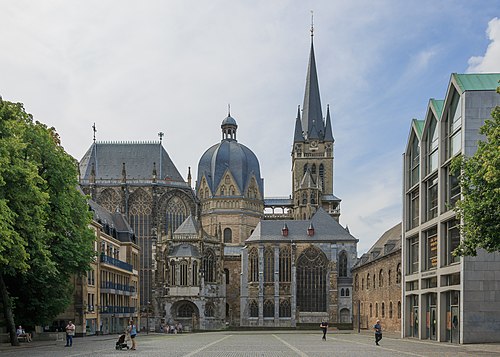
St. Peter's Cathedral
Cathedral · Osnabrück
Church building

St. Marien (St. Mary's Church) is a Lutheran parish and market church in Osnabrück, Germany. It is one of the most artistically and historically significant buildings in the North German city. A previous Romanesque church was mentioned in records as early as 1177. However, the history of the church's construction began some time before it was first mentioned in writing. Archaeological traces suggest the existence of a predecessor building in the 10th century. Construction of the Gothic hall church which exists today started in the 13th century and was completed between 1430 and 1440. The St. Marien church has a complex architectural history. Over time, extensive restorations have enabled archaeological excavations which have contributed considerably to a reconstruction of the building's history. The existence of at least three predecessor buildings has thereby been established. As Osnabrück's oldest town church, it has a central location in the city. The Marienkirche is located directly on the market place, next to the Stadtwaage (city weighing house) and the town hall. Along with the cathedral, St. Katharinen (St. Catherine's) and St. Johann (St. John's), it is one of the four medieval...
Before reconstruction of the Marienkirche started from 1950 onwards following severe damage caused by incendiary bombs during World War II, a series of excavations took place to investigate the building's earlier architectural history. With the modernisation of the building's heating systems in 1958 as well as internal and external renovation work from 1987 to 1992, there arose further opportunities to conduct research into the architectural history of St. Marien.
The excavations were carried out by the federal curator of Lower Saxony under the scientific supervision of the then-curators Dr. Roswitha Poppe and Dr. –Ing (Doctor of Engineering) Hans Roggenkamp. The research work received support from the municipal office for the preservation of historical monuments, the Amt für Bau- und Kunstpflege ( office for the maintenance of art and buildings ) of the Evangelical Church in Osnabrück, and ultimately from master sculptor Werner Paetzke.
The extensive excavations managed to establish the existence of at least three predecessor buildings.
From the predecessor buildings to today’s Marienkirche

The oldest predecessor church was a hall building, constructed on a sandy island-like knoll during the 10th century. This is the oldest predecessor building of St. Marien and is regarded as its architectural origin. As the construction project was linked to the establishment of a market, it can be assumed that the initial purpose of the building was for it to be a market church for the city of Osnabrück. The single-nave long building, without a transept but with an almost semicircular apsis, was positioned before an open, two-storied vestibule to the west. A salient feature is the robust stonework of the roofed hall with a width of 2.3 m, suggesting it functioned as part of a fortified church. The form of the ground plan along with the highly retracted interior of the chancel point to late Carolingian or early Saxon-era designs.
The second predecessor building of Osnabrück's Marienkirche was constructed on the foundations of the first church in the 11th century. Once again there featured a single-nave roofed hall with a semicircular apsis. However, this time a 14-metre-high (46 ft) tower with a vaulted upper floor and basement was also constructed on the west side of the church. Materials from the previous church were used to construct the rectangular western tower.
The most recent of the three predecessor churches was built during the 12th century. The single-nave roofed hall was expanded to include two narrow side aisles. A three-aisled basilica with three semicircular altar apses and no transept was built. The core masonry of the western tower and the tower building are the only parts of this building which remain today.
During the 13th and 14th centuries the three-aisled basilica was transformed into a Gothic hall church. Four more stories were added to the western tower and the chancel took on a rectangular shape. The subsequent conversion of the rectangular chancel into a basilica chancel around 1430-40 brought work on the Marienkirche to a temporary end.
The damage caused during World War II was repaired concurrently alongside the archaeological excavations; the repair work was finished by 1950. The reconstruction work, led by local architect Max H. Berling, also led to changes in the features of the church as well as the colouration, most of which was done during a renovation in 1901.

Before reconstruction of the Marienkirche started from 1950 onwards following severe damage caused by incendiary bombs during World War II, a series of excavations took place to investigate the building's earlier architectural history. With the modernisation of the building's heating systems in 1958 as well as internal and external renovation work from 1987 to 1992, there arose further opportunities to conduct research into the architectural history of St. Marien.
The excavations were carried out by the federal curator of Lower Saxony under the scientific supervision of the then-curators Dr. Roswitha Poppe and Dr. –Ing (Doctor of Engineering) Hans Roggenkamp. The research work received support from the municipal office for the preservation of historical monuments, the Amt für Bau- und Kunstpflege ( office for the maintenance of art and buildings ) of the Evangelical Church in Osnabrück, and ultimately from master sculptor Werner Paetzke.
The extensive excavations managed to establish the existence of at least three predecessor buildings.
The oldest predecessor church was a hall building, constructed on a sandy island-like knoll during the 10th century. This is the oldest predecessor building of St. Marien and is regarded as its architectural origin. As the construction project was linked to the establishment of a market, it can be assumed that the initial purpose of the building was for it to be a market church for the city of Osnabrück. The single-nave long building, without a transept but with an almost semicircular apsis, was positioned before an open, two-storied vestibule to the west. A salient feature is the robust stonework of the roofed hall with a width of 2.3 m, suggesting it functioned as part of a fortified church. The form of the ground plan along with the highly retracted interior of the chancel point to late Carolingian or early Saxon-era designs.
The second predecessor building of Osnabrück's Marienkirche was constructed on the foundations of the first church in the 11th century. Once again there featured a single-nave roofed hall with a semicircular apsis. However, this time a 14-metre-high (46 ft) tower with a vaulted upper floor and basement was also constructed on the west side of the church. Materials from the previous church were used to construct the rectangular western tower.

The most recent of the three predecessor churches was built during the 12th century. The single-nave roofed hall was expanded to include two narrow side aisles. A three-aisled basilica with three semicircular altar apses and no transept was built. The core masonry of the western tower and the tower building are the only parts of this building which remain today.
During the 13th and 14th centuries the three-aisled basilica was transformed into a Gothic hall church. Four more stories were added to the western tower and the chancel took on a rectangular shape. The subsequent conversion of the rectangular chancel into a basilica chancel around 1430-40 brought work on the Marienkirche to a temporary end.
The damage caused during World War II was repaired concurrently alongside the archaeological excavations; the repair work was finished by 1950. The reconstruction work, led by local architect Max H. Berling, also led to changes in the features of the church as well as the colouration, most of which was done during a renovation in 1901.
St. Marien is a three-aisled hall church without a transept. The main aisle is three bays long. The bays in the central nave are slightly rectangular. Both side aisles are four bays deep, these having a slight oblong shape. The central nave is separated from the side aisles by archways consisting of large compound piers. The extension of the side aisles by one bay each enables the inclusion of the western tower in the interior architecture. On the eastern side, the nearly-quadratic hall is appended by the polygon-shaped basilican chancel. Attached to the chancel on the north side is the quadratic sacristy, covering four bays. This has four arches, all buttressed by one central compound pier. The Gothic hall is overlaid by ribbed vaults. The nave is 20.56 metres long in total, which represents only a slight difference from the length and width measurements (roughly 25.5 and 24.5 metres respectively). This gives the nave an almost-cubical shape. The central nave is only slightly wider than the side aisles. This results in merely a weak accentuation of the longitudinal axis of the church. The bays of the side aisles counteract this slight longitudinal alignment by opening up their broadsides to the central nave, thus emphasising the lateral alignment. This gives the impression of undirected space. St. Marien is thus characterised by the overall appearance of its nave.
The western tower stands imposingly over the roof of St. Marien, representing the old market church. The design of the north and south sides of the Marienkirche is symmetrical. A total of four portals enable entry into St. Marien, two each on the north and south sides. The market place is characterised by the visible side of the church, featuring four gables crested with tracery and narrow elevated lancet windows. Sandstone figures are positioned on the gables. The buttresses – typical elements of Gothic architecture - help divide the visible side of the church into four vertical zones. The buttresses run in pinnacles with waterspouts between the four gables. There are two portals on this side. One side portal and the Brautportal, the main entrance to the Marienkirche. Buttresses (along with flying buttresses) and balustrades characterise the image of the chancel. The exterior of the chancel underlies a bisection emerging from the ambulatory and the clerestory.
Closest places in our Germany guide.
More places to explore in Germany.