Germany
Hardtwaldstadion
Association football venue · Sandhausen
Open-air museum
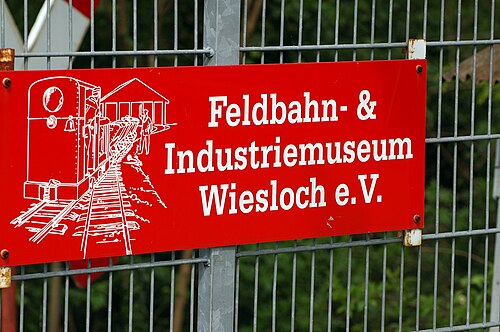
The Wiesloch Feldbahn and Industrial Museum (German: Feldbahn- und Industriemuseum Wiesloch, FIW) is a narrow-gauge railway and industrial heritage open-air museum established in 2001, at Wiesloch, Germany. The museum is centred around the former locomotive shed of the Tonwaren-Industrie Wiesloch (TIW) brickworks, and houses industrial equipment from large excavators to small machine tools, plus large and small locomotives. It is 650 metres (0.4 mi) north of Wiesloch-Walldorf station, lying between the River Leimbach and mainline Mannheim–Karlsruhe–Basel railway to the west, and the Bundesstraße 3 and REWE supermarket Group's south-west central warehouses to the east.
The museum is based partly on the site of the former Tonwaren-Industrie Wiesloch brickworks which closed in 1989 and had been served by a 600-millimetre narrow-gauge railway network. During the 1960s the brickworks employed approximately 320 people and the narrow-gauge trains were used for transporting raw material from the Dämmel clay pit to the brickworks. Following the completion of clay mining the area was backfilled, burying the narrow-gauge locomotive shed and raising the area of the surrounding landscape. Further heavy development on the subsequent site of the museum would have required twelve-metre deep foundations, which would have been uneconomical, ultimately leading to the preservation of the site.
The museum area covers two hectares, and is covered with mature trees, and this woodland area is kept for shade and enjoyment. The land is home to wild animals, including lizards, hares and occasionally deer. Two ex- Deutsche Bahn railway wagons serve as a workshop and club house, on their own length of standard gauge track.
A plan for restoration of the locomotive shed and operation of narrow-gauge passenger trains were presented to the City of Wiesloch in 2000. The estimated costs for the plan were 100,000 DM (€50,000). Narrow gauge trains were additionally seen as an attraction for a planned garden festival ( Landesgartenschau ) proposed in Wiesloch/Walldorf at the time.
The museum is operated by the Feldbahn- und Industriemuseum Wiesloch e.V registered association ( eingetragener Verein ), with the management board ( Vorstand ) elected by the members of the organisation. The museum society was founded on 7 September 2001. A new management board was elected in March 2012, March 2015, and adjusted in early 2019. Approximately fifty volunteer members maintain the museum, of which fifteen were actively involved in 2014. In 2005 the Locomotive shed had its 100th birthday and in 2006 the museum society had its fifth birthday.
The narrow gauge locomotive workshop ( Lokschuppen ) was built from brick ( Klinkerbauweise ) in 1905 to house stream locomotives, and later diesel locomotives. The locomotive shed retains two chimney flues originally used to enable lighting up of steam locomotives undercover. It is a listed historic industrial monument ( industriegeschichtliches Denkmal ) and unique in southern Germany.
Text stating " TIW 1905 " is embossed in the roof tiles. The shed was extended after World War II and this remains visible in the brickwork. In its later operational years it housed seven narrow-gauge diesel locomotives that operated between the clay pit and the brickworks. Commercial operation of the narrow gauge locomotives ended in 1979.
The locomotive shed is at the lowest level of the site, representing the original land level of the whole area. During the 1990s the area covered by the brickworks was transformed into a new industrial area, with the locomotive shed one of four original TIW buildings to survive. The building was left empty and started to decay. By 2000 the locomotive shed had been buried under the ground with its windows broken.
Firstly the locomotive shed had to be excavated by the members of the museum. The rest of the museum site was then constructed on a gradual basis. As of 2016 [update] the building had been refitted out with traditional machinery used for milling metal, pillar drills, and metal lathes.
Also in 2016 there were plans to construct a new locomotive shed to store all of the museum's locomotives, and to allow the original historic shed to be more easily viewed by visitors. The new shed was planned to have two tracks for storing locomotives, and had been awaiting planning permission since 2014 with construction occurring during 2017.
As of 2012 [update] the museum collection included half-a-dozen cranes, diggers, and excavators, including an Orenstein & Koppel L 051 power shovel that arrived in May 2012. In 2014 a crawler excavator rescued by Walter Ofenloch was added to the collection. By 2017 there were ten construction machines with eight restored and working.
At the highest point of the museum there is a working bucket chain excavator built in 1948 and previously used by a mine in Wasserberg, Bavaria until 1976. The bucket chain excavator arrived at the museum in October 2010, allowing the opening of a clay pit exhibition area in 2012, and is now operated by a three-phase electric motor. These machines can be used to demonstrate traditional clay, sand and gravel mining techniques.
In 2015 Weiland Crane and Transport Group brought a Pekazett [ de ] TK 5 crane owned by the Rattelsdorf Crane and Construction Museum to the site.
The museum site has a 600-millimetre (2 ft) narrow-gauge railway ( Feldbahn ) network, one of several 600 mm gauge railways in Germany. This connects the original 1905 locomotive shed to the rest of the site.
Part of the museum railway track extends 400 metres (0.25 mi) southwards through the old brickworks to the Landratsamt district offices opposite Leimbach Park. This section uses the former standard gauge railway siding linking the REWE central warehouse to Wiesloch-Walldorf station and so track gauge conversion to narrow gauge was necessary. An earlier plan had been for conversion of the REWE siding to dual gauge using a three- or four-rail arrangement. By late-2002, the gauge conversion to 600 millimetre, and connection to the tracks around the locomotive shed allowed a significant expansion of the railway activities.
Beginning in 2011 a second route was opened, running through woodland to the museum's bucket chain excavator. On 30 September 2013 this was inspected by the TÜV Rheinland technical inspection agency to certify it for passenger use. During 2015–2016 additional track was laid increasing the drivable distance to 1.4 kilometres (0.9 miles). In September 2016 the circular Waldstrecke (Woodland route) was opened by Mayor of Wiesloch Ludwig Sauer, with politicians Karl Klein [ de ] and Claudia Martin [ de ] attending.
The museum has a large collection of Gmeinder diesel locomotives, including the last locomotive delivered by the Gmeinder company—Gmeinder #5366—a 4.5-tonne diesel locomotive manufactured in the nearby town of Mosbach in 1965 and rescued from Spain. A Gmeinder locomotive and associated passengers wagons originally used for the 1990 Landesgartenschau garden festival were obtained on permanent loan from the City of Würzburg. Another Gmeinder locomotive was rescued from the Vatter stone quarry in Dossenheim, along with some tipper wagons.
As of 2012 [update] the museum had a Henschel & Son locomotive awaiting restoration of a type that originally worked at the Tonwaren-Industrie Wiesloch brickworks, as well as a six-tonne Diema locomotive matching a type originally used at the TIW brickworks. As of 2014 [update] the Diema was awaiting repairs to its suspension.
In early-2014 a Deutz AG Diesel locomotive made in 1938 arrived from Belgium.
In November 2016 the museum received an original Diema locomotive that had been delivered to the TIW brickworks in 1956. Up until the end of the 1970s the Diema DS40 locomotive had for many decades transported wagons between the Dämmelwald clay pit and the TIW brickworks. The museum planned to restore and repaint the seven-tonne locomotive in its original green colour for 2017. After being withdrawn in the 1980s, the Diema locomotive had travelled around Germany and ended up at a museum in Klütz.
Closest places in our Germany guide.
More places to explore in Germany.