Croatia
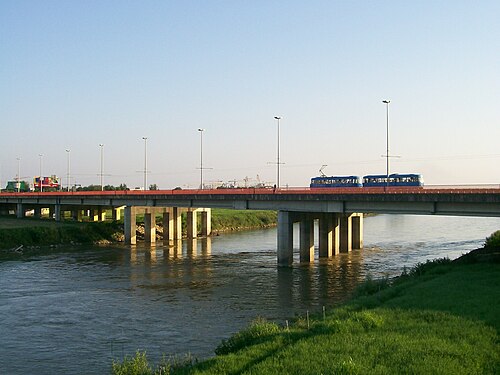
Adriatic Bridge
Bridge
Baptismal font
baptismal font of Prince Višeslav

The Baptismal font of Duke Višeslav is an early medieval baptismal font the inscription of which mentions for the first time a South Slavic duke, Višeslav of Croatia. It is believed to date to the 9th century, and has generally carried historical and cultural significance for Croatia. Its origin and dating are a matter of scientific debate.
In 1853 the font came to public prominence when the Capuchin monastery of Il Redentore in Venice gifted it to the Museo Correr. Immediately the Italian historian Giuseppe Valentinelli informed Croatian historian Ivan Kukuljević Sakcinski, who first introduced it to the Croatian scientific public.
In early 1940s, Archbishop of Zagreb Aloysius Stepinac wrote to Patriarch of Venice Adeodato Giovanni Piazza, but couldn't be gifted without state Kingdom of Italy approval, so wrote to Independent State of Croatia minister Mile Budak, and in July 1941 Stepinac was informed that was accepted exchange with two paintings of Vittore Carpaccio from the Strossmayer Gallery of Old Masters, and font arrived in May 1942 to Zagreb. From then on and long after the World War II, the font stood in the atrium of the Palace of Croatian Academy of Sciences and Arts in the state's capital, Zagreb. Since 1958 the font can be seen in the harbor city of Split, in the Museum of Croatian Archaeological Monuments.
In Croatian studies the font has been considered an important historical and cultural significance for Christianity in Croatia and an example of application of Croatian interlace.
The Catholic Church in Croatia has described the inscription as a "shining monument and symbol of the baptism of our Croatian ancestors".
The baptismal font petrografic analysis from the University of Venice showed it was made of Proconnesus marble. It was cut in the form of hexagon. In one of the side faces, there is an irregular opening (now closed), which was probable used to supply water to the font. The bottom has a round opening for water outflow. There are a few holes at the rim of the top opening that contain iron scraps. Possibly these are the remains of a fastening for a lid or a railing. They probably do not come from the time the font was created.
The font is 90 cm (35 in) high, the diameter of the opening is 136 cm (54 in), the inside depth is 76 cm (30 in), width of each side is approximately 70 cm (28 in), and weights 1,194 kg (2,632 lb).
Each of the six sides, except the bottom one, is decorated on the left and on the right with tilted furrows, like a relief column wrapped in a cord with a simple base and a capital with two side volutes. These pillars have a simply profiled architrave, decorated only with plain molding.
On the front central side there is a relief cross styled like a processional cross. The top and both side arms of the cross each have two volutes, but the bottom arm does not. The body of the cross arms is filled with Croatian interlace. The bottom, longer arm of the cross stands on a leg, also filled with tilted furrows, as if wrapped in a cord, which tapers off.
The architrave, which also forms the hem of the opening, has the Latin inscription:
+ HEC FONS NEMPE SVMIT INFIRMOS VT REDDAT
ILLVMINATOS · HIC EXPIANT SCELERA SVA QVOD
DE PRIMO SVMPSERVNT PARENTE · VT EFFICIANTV
R XPISTICOLE SALVBRITER CONFITENDO TRINVM PER
HENNE · HOC IOHANNES PRESBITER SVB TEMPORE VVISSAS
CLAVO DVCI OPVS BENE COMPOSVIT DEVOTE On the fifth side of the font, i.e. under the fifth line of the above, one can read:
IN HONORE VIDELICET SANCTI The sixth side bears the end of the inscription with two lines:
CLIENTVLOQVE SVO The inscription can be translated as follows:
This source of water/font receives the weak in order to enlighten them. Here they are cleansed of their sins, which they have inherited from their first parent, to be Christians soberly confessing the eternal Trinity. This work of piety was created by John the Priest at the time of Duke Višeslav, and in honour of St. John the Baptist, to intercede on behalf of him and his flock.
The inscription is done with regular rustic capitals and the height of the letters varies between 6.0 and 6.5 cm (2.4 and 2.6 in). The stonemason used many ligatures, contractions, suspensions, and abbreviation characters for TRINVM ("Trinity") and special characters for word part PER in the word PERHENNE ("eternal"). It possibly has substantial Carolingian -Northern Italian influences.
More places to explore in Croatia.


