
Australia
Reef HQ
Public aquarium · Queensland
Church building

St John's Anglican Church Precinct is a heritage-listed churchyard at 30–34 Macrossan Street, South Townsville, City of Townsville, Queensland, Australia. It was built from c. 1907 to c. 1911. It was added to the Queensland Heritage Register on 21 October 1992.
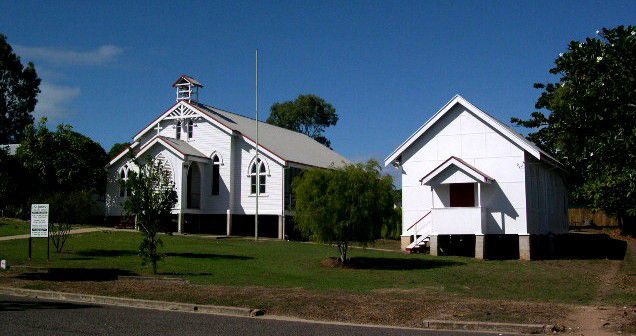
St John's Anglican Precinct at South Townsville comprises a small timber church constructed in 1907; a timber rectory constructed c. 1907 ; and a small timber and fibrous-cement sheeted church hall. St John's Church is the third church erected on this site, replacing an 1898 church destroyed in 1903 by Cyclone Leonta, which in turn had replaced an 1884 church destroyed by Cyclone Sigma in 1896. The rectory also is the third residence on the site, replacing vicarages destroyed in the 1896 and 1903 cyclones. These buildings remain amongst the earliest surviving Anglican church buildings in the Diocese of North Queensland.
Townsville was established in the mid-1860s as a port to service new pastoral runs being taken up in the Kennedy District. The town centre developed along the north west bank of Ross Creek, while suburban settlement spread to the north along the beach front, to the west along what later became known as Ingham Road and south across the creek to Ross Island. The discovery of gold at Cape River in 1867 and the boom in the pastoral industry consolidated Townsville's position as a port and administrative and commercial centre during the 1870s. The port expanded and rail facilities were established in 1881 with the construction of the Great Northern Railway from Townsville to Charters Towers and later to Hughenden further west.
The Church of England early established a presence in Townsville and opened St James' Church in 1871. At this time the district was part of the Diocese of Sydney. The Diocese of North Queensland was formed in 1878, when North Queensland 's mineral fields and grazing industry were flourishing. The Rev. George Henry Stanton was consecrated the first Bishop of the new Diocese, arriving in Townsville in May 1879 and establishing his seat at St James' Church (which became the pro-Cathedral). Stanton proved very popular and was adept at attracting overseas funding for the new Diocese. As Townsville expanded during the early 1880s, he assisted his parishioners to establish new churches at West End in 1883 (opened as St James' Mission Church and renamed St Peter's in 1884) and at Ross Island (St John's) in 1884.
Ross Island was a focus for settlement as early as 1868 when the first Townsville hospital was constructed on the island. By the mid-1870s a thriving suburb had been established, with Palmer Street the commercial centre. In 1883 the island was officially surveyed, excised from Thuringowa Division and incorporated into the Municipality of Townsville as South Townsville. To serve the burgeoning population, the South Townsville State School was opened in February 1884.
Prior to the construction of St John's, occasional Anglican services had been conducted at the immigration depot on Ross Island. At the first sale of Ross Island subdivisions in May 1883 Bishop Stanton acquired two adjacent allotments in Macrossan Street for church purposes (allotments 6 & 7, section 161, comprising half an acre in total and directly opposite the school reserve). In June 1884 title to the land was transferred from Bishop Stanton to The Corporation of the Diocesan Synod of North Queensland, which had been established in June 1883 for the purpose of acquiring and managing church property for the Diocese.
In August 1884 the first St John's Church was dedicated on this site. At this period the new church was part of the parish of Townsville and was administered from St James' pro-Cathedral. The Townsville Herald of 24 December 1887 described the building as "a pretty little church" and "well patronised".
Ross Creek boomed during the second half of the 1880s. In 1885–86 the Great Northern Railway was extended east into South Townsville and the Ross Island jetty was extended into deeper water to facilitate the shipment of station produce from the far west of Queensland. The Victoria Bridge opened in July 1889, was constructed across Ross Creek, linking the island to Townsville's central business district along Flinders Street. Wharves, railway yards, a meat works and foundries at Ross Island became major employers and the surrounding district developed as a working class residential suburb. By the late 1880s it was the fastest growing area in Townsville.
In 1889 Ross Island was declared a parochial district within the Diocese of North Queensland, with the Rev. L Ketchlee as the priest-in-charge. It is likely that the first St John's vicarage was erected at this time.
In January 1896 Cyclone Sigma destroyed St John's Church and Vicarage at Ross Island. A contemporary report estimated the loss at about £600. A second St John's Church was opened in 1898, constructed at a cost of £450.
In May 1901 the Diocesan Synod acquired title to an adjacent allotment in Macrossan Street (allotment 5, section 161). This is the site of the later church hall. It may have contained an existing residence acquired for use as a vicarage.
On 9 March 1903 Cyclone Leonta destroyed the second St John's Church of England and Vicarage at Ross Island. Photographs of the site taken shortly afterwards show a pile of tangled timbers and iron roofing. The local press reported that the church furniture had been saved through the efforts of the incumbent priest, the Rev. Goodchild.
Cyclone Leonta had struck at a time when the Diocese of North Queensland was in severe financial difficulty, arising from the impact of the early 1890s economic depression and the closure of many Queensland banks, closures of many gold and tin mines and a fall in world copper prices in the 1890s, and a severe drought 1898–1902. Diocesan architects and civil engineers Tunbridge and Tunbridge of Townsville, engaged to report on the cyclone devastation, estimated that £2,600 worth of damage to Diocesan property had been sustained in Townsville alone and £6,250 throughout the Diocese. Bishop George Frodsham, then Bishop of North Queensland, travelled overseas to raise funds to save his Diocese and by May 1905 over £6,000 had been subscribed from various diocese in Britain, New Zealand, Australia, Japan and Hong Kong; from British church societies; and from individuals.

Ross Island was a working class district and had suffered substantially during Cyclone Leonta, with many homes reportedly destroyed or unroofed. It took the parish nearly four years to replace their church, with the third and present St John's Church of England dedicated on 17 February 1907. The third St John's Church was designed by architect Charles Dalton Lynch, the Townsville partner in the architectural firm of Tunbridge, Tunbridge and Lynch from 1907 to 1910 and in partnership with Walter Hunt from 1911 to 1921. Lynch was a noted and influential architect, who designed many buildings in North Queensland, including several of Cairns ' most prominent buildings: Cairns School of Arts and Harbour Board Offices (1907), new Court House Hotel (1908) and Central Hotel ( Central Court ) (1909). Works by Lunch & Hunt include Agora House in Townsville for Howard Smith & Co. Ltd (1910–11), Mulgrave Shire Council Chambers in Cairns (1912–13) and St Josephs Church, North Ward, (1920–21).
Lynch addressed the problem of cross ventilation in a tropical climate by providing St John's with large sliding doors along each side of the nave, which were sheltered by open verandahs and when opened allowed air to circulate freely through the building. The use of banks of side doors was a popular ventilation device of the period employed in large auditoria such as public halls and theatres, but was less commonly used in church buildings.
The third St John's vicarage may have been erected around this time, and evidently by 1911. St John's Church Hall is suspected to date to this period.
Ross Island (South Townsville) remained a vibrant working class community until port facilities began to move closer to the harbour mouth in the second half of the 20th century. By 1958 the population in the parish of South Townsville had reached 4,000.
St John's Church and Rectory were entered in the Register of the National Trust of Queensland in May 1980 for their historical and architectural interest. Regular Sunday services are still held at the church.
St John's Church, Church Hall and Rectory are located on the southeast side of Macrossan Street, South Townsville, between Allen and Cannan streets, opposite the South Townsville State School. The district is suburban residential in character.
St John's Church is located in the centre of the church property in Macrossan Street, flanked by the rectory to the northeast and the church hall to the southwest. It is a simple but aesthetically pleasing timber building which employs Gothic stylistic detailing along with accommodation for Townsville's warm sub-tropical climate.
Closest places in our Australia guide.
More places to explore in Australia.
_cropped.jpg?width=1200)


.jpg?width=1200)
.jpg?width=1200)
.jpg?width=1200)


