Italy
Grotta di Cocceio
Roman tunnel · Pozzuoli
Archaeological site
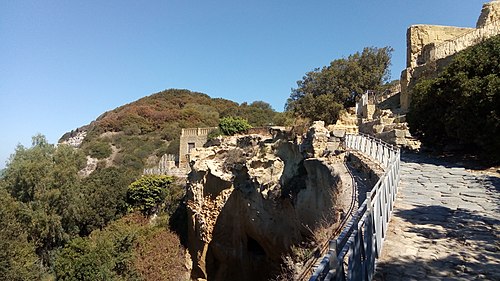
Cumae (Ancient Greek: Κύμη, romanized: (Kumē) or Κύμαι (Kumai) or Κύμα (Kuma); Italian: Cuma) was the first ancient Greek colony of Magna Graecia on the mainland of Italy and was founded by settlers from Euboea in the 8th century BCE. It became a rich Roman city, the remains of which lie near the modern village of Cuma, a frazione of the comune Bacoli and Pozzuoli in the Metropolitan City of Naples, Campania, Italy. The archaeological museum of the Campi Flegrei in the Aragonese castle contains many finds from Cumae.
The oldest archaeological finds by Emilio Stevens in 1896 date to 900–850 BC and more recent excavations have revealed a Bronze Age settlement of the ‘ pit-culture ’ people, and later dwellings of Iron Age Italic peoples whom the Greeks referred to by the names Ausones and Opici (whose land was called Opicia ).
The Greek settlement was founded in the 8th century BCE by emigrants from cities of Eretria and Chalcis in Euboea, next to an Opician settlement. The Greeks were already established at nearby Pithecusae (modern Ischia ) and were led to Cumae by the joint oecists (founders): Megasthenes of Chalcis and Hippocles of Cyme.
The site chosen was on the hill and later acropolis of Monte di Cuma surrounded on one side by the sea, and on the other by particularly fertile ground on the edge of the Campanian plain. While continuing their maritime and commercial traditions, the settlers of Cumae strengthened their political and economic power by exploitation of the land and extended their territory at the expense of neighbouring peoples.
The colony thrived and in the 8th century BCE it was already strong enough to send Perieres to found Zancle in Sicily, and another group to found Tritaea in Achaea, Pausanias was told. Cuma established its dominance over almost the entire Campanian coast up to Punta Campanella over the 7th and 6th centuries BCE, gaining sway over Puteoli and Misenum.
The colony spread Greek culture in Italy and introduced a dialect of Greek, and the Euboean alphabet, a variant of which was adapted and modified by the Etruscans and then re‑adapted by the Romans and became the Latin alphabet, still used worldwide today.
According to Dionysius of Halicarnassus,
Cumae was at that time celebrated throughout all Italy for its riches, power, and all the other advantages, as it possessed the most fertile part of the Campanian plain and was mistress of the most convenient havens round about Misenum.
The growing power of the Cumaean Greeks led many indigenous tribes of the region to organise against them, notably the Dauni and Aurunci with the leadership of the Capuan Etruscans. This coalition was defeated by the Cumaeans in 524 BCE at the first Battle of Cumae under the direction of Aristodemus. The glorious victories of the colony increased its prestige, so much so that according to Diodorus Siculus, it was usual to associate the whole region of the Phlegraean Fields with Cumaean territory.
At this time the Roman senate sent agents to Cumae to purchase grain in anticipation of a siege of Rome. Then in 505 BCE Aristodemus led a Cumaean contingent to assist the Latin city of Aricia in defeating the Etruscan forces of Clusium (see also War between Clusium and Aricia ) and having attained the people's favour he overthrew the aristocratic faction and became a tyrant himself. It was probably at this point that Cumae founded Neapolis (“new city”) in the late 6th century BCE.
Further contact between the Romans and the Cumaeans occurred during the reign of Aristodemus. Tarquinius, the last of the legendary Kings of Rome, lived his life in exile with Aristodemus at Cumae after the Battle of Lake Regillus and died there in 495 BCE. Livy records that Aristodemus became the heir of Tarquinius, and in 492 BCE when Roman envoys travelled to Cumae to purchase grain, Aristodemus seized the envoys' vessels on account of the property of Tarquinius which had been seized at the time of Tarquinius' exile.
Eventually, the dispossessed nobles and their sons were able to take over Cumae in 490 BCE, and executed Aristodemus.
The combined fleets of Cumae and Syracuse (on Sicily) defeated the Etruscans at the Battle of Cumae in 474 BCE.
The temple of Apollo sent the revered Sibylline Books to Rome in the 5th c. BCE. Also Rome obtained its priestesses who administered the important cult of Ceres from the temple of Demeter in Cumae.
The Greek period at Cumae came to an end in 421 BC, when the Oscans allied to the Samnites broke down the walls and took the city, ravaging the countryside. Some survivors fled to Neapolis.
The walls on the acropolis were rebuilt from 343 BCE. Cumae came under Roman rule with Capua and in 338 BCE was granted partial citizenship, a civitas sine suffragio. In the Second Punic War, in spite of temptations to revolt from Roman authority, Cumae withstood Hannibal 's siege, under the leadership of Tib. Sempronius Gracchus.
The city prospered in the Roman period from the 1st c. BCE along with all the cities of Campania and especially the bay of Naples as it became a desirable area for wealthy Romans who built large villas along the coast. The "central baths" and the amphitheatre are built.
During the civil wars Cumae was one of the strongholds that Octavian used to defend against Sextus Pompey. Under Augustus extensive public building works and roads were begun and in or near Cumae several road tunnels were dug: one through the Monte di Cumae linking the forum with the port, the Grotta di Cocceio 1 km long to Lake Avernus and a third, the "Crypta Romana", 180m long between Lake Lucrino and Lake Averno. The temples of Apollo and Demeter were restored.
The proximity to Puteoli, the commercial port of Rome and to Misenum, the naval fleet base, also helped the region to prosper.
Another very important innovation was the construction of the great Serino aqueduct, the Aqua Augusta supplying many of the cities in the area from about 20 BC. Domitian 's via Domitiana provided an important highway to the via Appia and thence to Rome from 95 AD.
Closest places in our Italy guide.
More places to explore in Italy.