Belgium
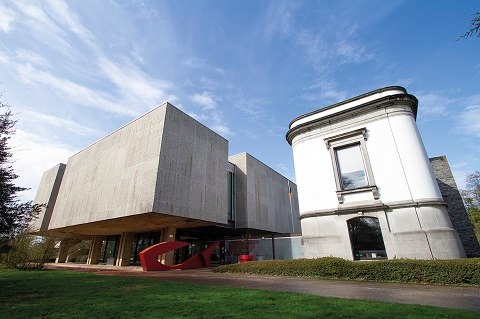
Musee de Mariemont
Museum · Morlanwelz
Castle park
domein van Mariemont

Construction of the Hunting Pavilion (1546–47)
The Château of Mariemont owes its name (literally, "Mary-Mount") to its commissioner Queen Mary of Hungary, the sister of Emperor Charles V. After she lost her husband, King Louis II of Hungary, at a fairly young age, in 1531, she was commissioned by her brother to govern the Habsburg Netherlands as governor. To compensate her, in April 1545, he granted her the lifelong benefit of the city and land of Binche. While she had reconstructed the palace in Binche, as a hunting enthusiast, she also ordered a hunting pavilion to be built in the woods of Morlanwelz. The two residences were both designed in 1545–46 by the Mons architect-sculptor Jacques Du Brœucq.
Like many artists of the time, Dubroeucq had travelled to Italy. On his way back, he had visited the Châteaux of the Loire Valley. This double influence, Italian and French, can be found in the Renaissance palace of Binche, but much less so in Mariemont. As the location for the hunting lodge, Maria chose the edge of the forest of Morlanwelz, on a hill overlooking the Haine. Dubrœucq drew the plans and supervised the work, which was almost finished in 1547. The building, 19 meters by 7 meters, was surrounded by a wide moat and only accessible via a drawbridge. It was in the form of a two-storey rectangular tower flanked by a turret and capped by a parapet terrace. Mullion windows broke the seriousness of the façades.
The Château of Mariemont, with its rustic and almost medieval appearance, did not pretend to compete with Binche Palace. Nevertheless, it included a number of luxurious rooms on the ground and first floors. Wood panelling, frescoes and works by renowned artists decorated the apartments of the governor and those of her sister Eleonora, widow of King Francis I of France. Dubrœucq made various models of fireplaces, an alabaster painting for the chapel and, with Luc Lange, thirteen sculptures for the gallery on the first floor. The upper floor, less formal, was intended to be decorated at a later date.
In 1549, Mary organized the "Triumph of Binche" for her brother Charles V and her nephew, the future Philip II. The year before, the aging emperor had decided to have his son recognized as successor by the various principalities that made up his realm. On 22 August 1549, the Imperial procession arrived in Binche. The governor was aware of the importance of the event and organized a grand reception, intended to move the public. Parties, balls and tournaments followed each other for six days. On 28 August, the masquerade ball was in full swing in the great hall of the palace, when gentlemen disguised as "savages" suddenly kidnapped four ladies in medieval dress to Mariemont. The next day, in front of the whole court and with some 20,000 spectators from the surrounding area, a thousand men commanded by the prince of Piedmont and count of Ligne surrounded the palace, stormed it and freed the prisoners. When asked "who kidnapped them this way, they said they did not recognize them at first, but eventually found out they were their husbands".
Shortly after these festivities, the old conflict between Spain and France flared up again. In the spring of 1554, the Imperial army entered Picardy under the command of Adriaan van Croÿ, 1st Count of Roeulx, and ravaged the country up to 70 km from Paris. They destroyed the palace of Folembray, the love nest of Henry II of France and Diana de Poitiers. However, the French troops counterattacked. On 21 July, they raided Binche and Mariemont, whose palaces were set on fire in retaliation. Henry lit the fire himself and had a placard affixed to the ruins: "Queen of folly, remember Folembray!"
But Maria did not hang her head. On her behalf, Dubrœucq started rebuilding the hunting lodge that same year. The governoress retired to Spain in 1556 and died two years later. The château would not be completed until 1560. For about forty years, Mariemont was in a semi-abandoned state, but the palace was maintained. In 1565, the terrace, which was in a very bad state, was replaced by a flat roof better suited to the region's rainy climate.
The Château of Mariemont and its surrounding gardens by Jan Brueghel the Elder
The Château of Mariemont by Jan Brueghel the Elder
Allegory of Spring with the Château of Mariemont in the back by Jan Brueghel the Elder
Landscape with the Château of Mariemont by Jan Brueghel the Elder
In 1598, Philip II abdicated his sovereignty over the Netherlands in favour of his daughter, Isabella Clara Eugenia, who then married Archduke Albert of Austria, who had become governor-general two years earlier. Both archdukes were avid hunters and rediscovered Mariemont: the outer pavilion of Mary of Hungary thus became a royal residence, a status it would retain throughout the Ancien Régime.
As soon as he took over the site, Albert got the restoration work started. In 1600, when the formal demarcation of the site was completed, he decided on the problem of fencing the estate. The old dilapidated wall was replaced by a wooden palisade, interrupted by four monumental stone gates that gave access to the main roads of the park. It would "protect Mariemont's house against thieves" and above all "prevent the entry of foxes such as rabbits and hares".
The derelict gardens were redesigned by the military architect and engineer Pierre Le Poivre, and planted by Loys Patte, the "gardener of the gardens of Their Highness". In 1606, Isabella told Francisco de Sandoval y Rojas, 1st Duke of Lerma, the Spanish Prime Minister, that she had "made every effort to imitate Aranjuez ", a royal estate in Spain whose gardens had delighted her childhood. The project was all the easier to carry out because at the time it had been designed by market gardeners from France and especially from the Netherlands.
Contemporary paintings make it possible to reconstruct the arrangement of the gardens of Mariemont in the time of the Archdukes. Flowerbeds, bordered by hedges and in a checkered pattern, lay on a gentle slope at the foot of the château, between the orchards and the grand driveway that led to the Chaussée Brunehaut across the river Haine. The vegetable garden provided food for both the court in Mariemont and Brussels. A painting by Jan Brueghel the Elder, kept in the Museum of Fine Arts of Dijon, perfectly reflects the charm of this "Belgian Touraine", so praised by Isabelle.
From August 1605, work was done to bring the buildings more into line with their function as a royal residence. These works are supervised by Wenceslas Cobergher, a versatile figure: painter, poet, numismatist and architect. In 1610, the grateful archdukes granted him the personal title of "general architect". To begin with, he let the buildings that had been badly damaged by the humidity dry out, repaired roofs and ceilings and replaced the broken windows and glass. Inside, woodwork and carpeting regained their shine.
Because the renovated château was too small to house the court, major expansions were carried out between 1606 and 1610. Next to the path leading to Morlanwelz was a square outbuilding in red brick and covered with slates. A gallery, surmounted by a bell tower, connected it to the château. On the other side, three pavilions with spherical roofs lined an alley that ran parallel to the gardens and ponds. The fountains, which were initially restored, were replaced. Isabelle appreciated Mariemont's water: in 1620 she had "bottled water from the Fontaine Saint-Pierre" brought to Brussels.
Devout as they were, Albert and Isabella had a chapel built in 1610 outside the park towards La Hestre. Five years later, the chapel and priory of Montaigu was lavishly showered with donations. This establishment is part of the climate of Catholic fervour inspired by the Counter-Reformation, which developed especially from 1609, when the Twelve Years' Truce more or less accepted the secession of the United Provinces (present-day Netherlands ). An era of peace and prosperity followed the Civil War, finally allowing the Archdukes to enjoy the delights of Mariemont.
But their increasingly frequent stays emphasize the remoteness of the château, especially since Isabella was not desperate to one day welcome King Philip III of Spain, her brother. This was the starting point for a new work campaign. In 1618, a building for ladies-in-waiting of the Infante was erected. It closed off the north side of the cour d'honneur (main courtyard). However, most of the extensions related to the main building. Four square towers were erected on the corners of Mary of Hungary's keep. A new balcony was built around the building, to which French doors provided access. A painting by Denis van Alsloot, kept in the Royal Museums of Fine Arts in Brussels, shows the estate as it existed in 1620: the rustic pavilion had become a prestigious château, worthy of a refined court. Embellished in this way, it would not undergo major changes until the 18th century.
Excursion in the Countryside of Infanta Isabel Clara Eugenia by Jan Brueghel the Elder and Joos de Momper
Closest places in our Belgium guide.
More places to explore in Belgium.


