Latvia
Uzvaras parks
Park · Riga
Monument

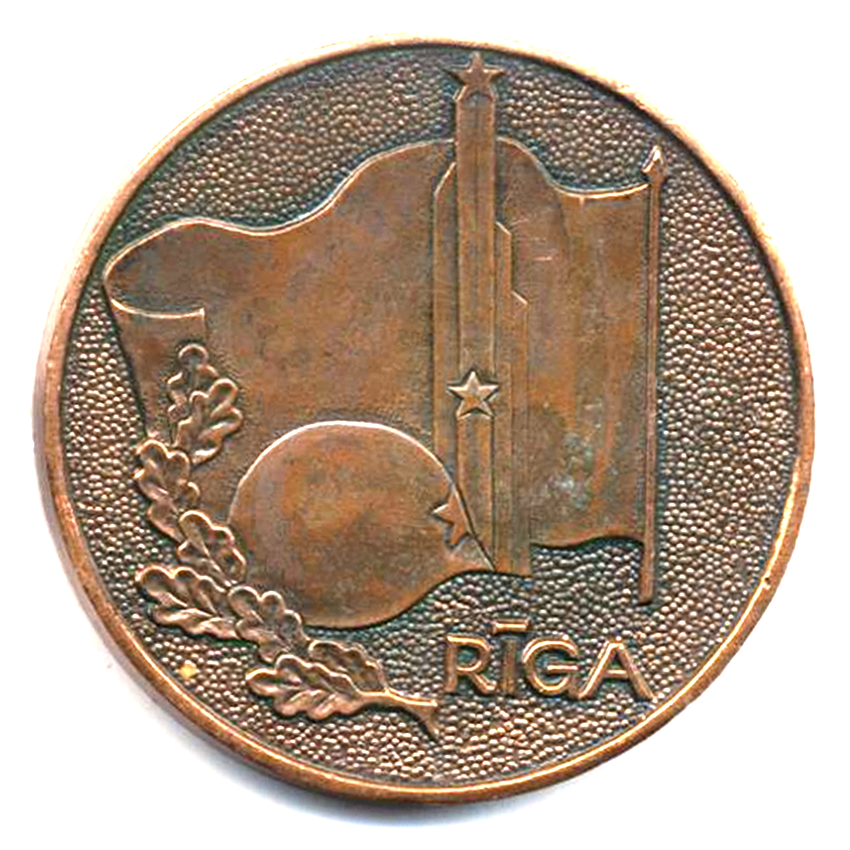
The Monument to the Liberators of Soviet Latvia and Riga from the German Fascist Invaders, unofficially known simply as the Victory Monument, was a memorial complex in Victory Park, Pārdaugava, Riga, Latvia, erected in 1985 to commemorate the Red Army soldiers who liberated Riga and the rest of Latvia from the invading German forces during the concluding stages of World War II (1944–1945). The complex comprised a 79-metre tall obelisk that consisted of five columns topped by five-pointed star, and two groups of sculptures – Homeland the Mother (Dzimtene-māte, Родина-мать) and a band of three soldiers. The monument was the subject of long-standing controversy in modern Latvian society, concerning the historical memory of World War II and the legacy of Soviet rule. Many ethnic Latvians regarded it not as a symbol of liberation, but, rather, the start of the Soviet re-occupation. The monument's obelisk was sometimes referred to in Latvian as "Moscow's Finger" (Maskavas pirksts) or okupeklis (a portmanteau of okupācija – 'occupation' and piemineklis – 'monument'), and juxtaposed to the Freedom Monument. Following the 2022 Russian invasion of Ukraine, a decision was made to remove the monument...
See also: Soviet occupation of Latvia in 1940, German occupation of Latvia during World War II, Riga offensive (1944), Baltic offensive, and Soviet re-occupation of Latvia in 1944
The monument was designed by architect Alexandr Bugaev [ lv ; ru ] and produced by sculptors Lev Bukovsky [ lv ; ru ] and Aivars Gulbis [ lv ; ru ] in 1985. In 1994, following restoration of Latvia's independence in the wake of the Soviet Union's dissolution, the Socialist Party of Latvia took initiatives to revive Victory Day celebrations at the monument. The following year, around 11,000 people gathered for a 9 May event chaired by the vice-chairman of Socialist Party and MP Filips Stroganovs [ lv ; ru ].
In 1997, the monument was unsuccessfully bombed by members of the Latvian ultranationalist group Pērkonkrusts, two of whom died during the bombing, while six others, including Igors Šiškins, were eventually sentenced to up to three years in prison in 2000. In 1998, the Victory Day celebration at the monument was organized by the For Human Rights in a United Latvia party for the first time; by 2005, the event had burgeoned to resemble an open-air festival attended by around 260,000 people.
In 2007, the Popular Front of Latvia and the Alliance of Latvian World War II Veterans sent an open letter to Prime Minister of Latvia Aigars Kalvītis urging him to prevent "any provocations that might discredit the Latvian state" and resolve any issues in regard to the monument's removal, claiming its existence led to "glorifying the ideals of a regime guilty of genocide that killed about 60 million people, including thousands of Latvians."
After the relocation of the Bronze Soldier in Tallinn in late April 2007, the issue of the monument was brought up again. Chairman of the far-right, ethnonationalist All for Latvia! party, Raivis Dzintars, called on Riga mayor Jānis Birks of the conservative TB/LNNK to organize a public discussion on the future of the monument. Birks, however, dismissed the calls as "very thoughtless and even harmful to Latvia". The chairman of the Union of Greens and Farmers parliamentary faction Augusts Brigmanis [ lv ] and the leader of Latvia's First Party/Latvian Way parliamentary faction Andris Bērziņš were similarly dismissive.
Popular petitions for and against removal
In 2013, more than 11,000 signatures were collected on the online petition website ManaBalss.lv supporting removal of the monument and reconstruction of Victory Square the way it was originally envisioned in the 1930s before the Soviet occupation, commemorating Latvian victory in 1919 over the joint German-Russian West Russian Volunteer Army led by Pavel Bermondt-Avalov during the Latvian War of Independence. Justice Minister of Latvia Jānis Bordāns was amongst the supporters of the initiative, whereas Russian Foreign Ministry representative Alexander Lukashevich condemned the calls for the monument's removal.
On 29 June 2016, the Saeima Mandate, Ethics and Submissions Committee rejected the petition based on the argument of the Riga City Council that the location had already been developed and the Ministry of Foreign Affairs of Latvia that concluded that the monument was protected by a Latvian-Russian 1994 agreement on preservation and maintenance of memorials and burial sites.
In 2019, a similar petition by the same initiator gathered more than 10,000 signatures, and on 2 April, the Saeima Mandate, Ethics and Submissions Committee began discussing it: some members supported the removal, some opposed it, whereas some offered alternative solutions, such as renaming the monument and building an interactive museum of occupation under it. Concurrently, a counterinitiative by the Latvian Russian Union leader Tatjana Ždanoka on "the protection of monuments against Nazism ", including the Monument to the Liberators of Soviet Latvia and Riga from the German Fascist Invaders, had gathered over 21,000 signatures.

In March 2022, following the 2022 Russian invasion of Ukraine, the Saeima prohibited public events within 200 metres of Soviet Army monuments on 9 May, while allowing individuals to lay flowers.
In April, a 2013 social media post by the Latvian Russian Union council member Jevgēņijs Osipovs [ lv ] was shared by him and other members and supporters of the party, in which he threatened with "war" if the monument was moved "by even a millimetre".
On 11 April, the monument complex was declared unsafe by the Riga City Council and fenced off. A few weeks later, Velta Čebotarenoka [ lv ], a representative of the 4 May Declaration Club uniting pro-independence members of the Supreme Council of Latvia, said that the "ghost symbolizing occupation, aggression, and russkij sovetskij mir [Russian Soviet world] " "should be removed at the earliest opportunity".
On 6 May, Latvian Prime Minister Krišjānis Kariņš announced that the monument's eventual removal was inevitable.
On 10 May, flowers laid at the monument the previous day were removed with a bulldozer, reportedly on the initiative of Riga City Council and without prior coordination with the police. Video of the removal spread online and was followed that evening by a spontaneous pro-Russian gathering at the monument, which ended in unrest and police detentions. Access to the monument was again restricted and later extended until 31 August, and three police officers present at the site on 10 May were suspended from duty.

On 12 May, a public demolition fundraising campaign was launched and more than 39,000 euros were donated by the end of the day when the Saeima voted to suspend the functioning of a section of an agreement between Latvia and Russia regarding the preservation of memorial structures.
The next day Riga City Council also voted in favour of the monument's removal, but the total amount of donations reached almost 200,000 euros. Russia submitted a request for compensation for the monument's removal, but was dismissed by Minister of Foreign Affairs of Latvia Edgars Rinkēvičs who made a reference to Vladimir Putin 's 2004 response to Latvia's wish to recover its former territory Abrene by saying that Russia "will get a dead donkey ears, not a compensation".
The object [i.e., the monument] in Pārdaugava is not a mute witness of history. It has always been a symbol of Soviet occupation. The Red Army drove German occupants from the country and then established a Soviet occupation regime. It lasted another 45 years and claimed tens of thousands of innocent people’s lives. We did not call for the first or the second group of occupants. For a long time this object has been used by Russia’s autocratic regime. Most people come to this monument not as much to commemorate the fallen, but to publicly promote Kremlin's imperialistic narratives and vision for the world. But after the 2022 Russian invasion of Ukraine, this object left by occupants in Pārdaugava acquired a new meaning. Events of last week indicated that it can motivate some people to extreme, Russian war crime -glorifying behaviour in public space,
— President of Latvia Egils Levits, 16 May 2022
On 20 May, a rally called "Getting Rid of Soviet Heritage" took place in Riga and was attended by approximately 5,000 people who walked from Freedom Monument to the Victory Monument, while a counter rally by Latvian Russian Union with a reverse route was not allowed over security concerns. According to a June 2022 survey, 49% of people supported the dismantling of the monument (72% ethnic Latvians and only 9% ethnic Russians ), while 25% didn’t support it (76% ethnic Russians and only 10% ethnic Latvians).
Closest places in our Latvia guide.
More places to explore in Latvia.