Ireland
Gortnaleck Court Tomb
Court cairn · County Sligo
Court cairn
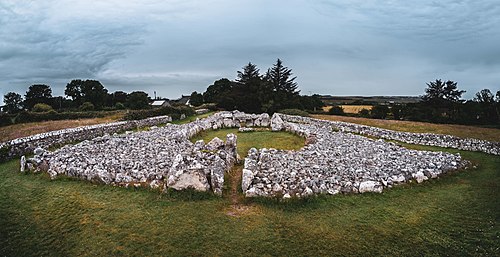
Creevykeel Court Tomb (Irish: Tuama Cúirte na Craobhaí Caoile) is one of the finest examples of a court tomb remaining in Ireland. The monument is located beside the N15 Donegal Town to Sligo road, 50 metres north of Creevykeel cross-roads, close to the village of Cliffoney in the north of County Sligo. The original name for the Creevykeel (An Chraobhaigh Chaol) monument is Caiseal an Bhaoisgin, the Fort of Bhaoisgin, Tobar an Bhaoisgin being the name of the well near the cairn. A second megalithic monument existed 300 metres to the north, but it was demolished around 1890.
The building of the tomb dates back to the Neolithic Period, 4000–2500 BC, when waves of colonising farmers migrated to Ireland from the continent. The Creevykeel Court Tomb is one of five megalithic monuments in the area. Creevykeel has not been dated using modern scientific methods, and is estimated to date from around 3500 BC with a long span of use and re-use.
The monument consists of a long, trapezoid-shaped cairn of stones which measures 55.5 meters along its east - west axis, 25 meters at the wider eastern facade, and 10 meters wide at the western end or tail of the cairn. The stones used to construct the monument are a hard local sandstone with a bluish tint.
The cairn encloses an oval-shaped full court 15 by 9 meters with an entrance passage through the east side. The entrance to the main chamber is located at the centre of an imposing megalithic facade on the west side of the court. The chamber is made up of two large compartments divided by a pair of jambs, which presumably supported an inner lintel like those at Shawley and Croaghbeg in County Donegal in Ulster.
Evidence of large corbel slabs used for roofing the structure survives in the inner chamber. In the west end of cairn three subsidiary chambers were built into the body of the monument, which have been described as being small passage-graves. However they seem to date from a later neolithic addition to the original monument.
Creevykeel is widely considered to be one of the finest and best-preserved examples of an Irish court tomb.
The Creevykeel Court Tomb was excavated from 25 July to 4 September in 1935 by the fourth Harvard Archaeological Mission, an American collaboration with the Irish Free State Government, which were the first modern scientific excavations to take place in Ireland. The director of the excavation was Hugh Hencken, the Curator of European Archaeology at the Peabody Museum in Harvard. Twenty-seven workers were involved in the dig, many being local labourers hired under an innovative State employment scheme.
The cairn material was removed entirely, leaving the large megalithic boulders in their original positions. The cairn was replaced again after the excavation had been completed. The excavators found that the large structural chunks of sandstone were resting on the old ground surface, rather than being placed in sockets. In many cases the stones had sunk into the soil.
A section of cobbled and paved surface dating to the neolithic was found to cover the western end of the court. A large, shallow pit, 25cm deep and filled with sand was found under the cobbles. Evidence of three fires was uncovered within the western end of the court area, beneath the cobbles.
The entrance to the double chamber is flanked by four huge megalithic orthostats, averaging two meters in height. The chamber is accessed by an opening 80 cm wide, flanked by two massive flat slabs. The chamber is nine meters long and three meters wide, divided by a pair of orthostats. Hencken termed the outer chamber C1 and the inner chamber C2.
The huge lintel was found lying within the chamber and had to be moved to allow excavation. Within the chamber, a polished stone axe was discovered buried between the twin orthostats dividing the chamber. Three pits within the chamber contained small amounts of cremated bone, which Hencken thought must be symbolic deposits.
"In small pits in the megalithic stratum were also four cremated burials. This term must be qualified, however, for though they seemed undisturbed, none consisted of more than a very few tiny chips of bone. These were so small and burned that it was impossible even to say that they were human."
A large number of items from both the neolithic and early Christian periods were discovered.
Two polished stone axe heads were found, one buried between the jambs dividing the main chamber; the other, a fine polished diorite example was found at the inner entrance of the court, again between two jambs. Other finds from the main chamber included a large flint knife, about 13 cm long, a lozenge-shaped arrow head made from limestone, pot sherds, some quartz crystals, and flint scrapers.
The remains of eight neolithic pots, including an example of a cardial ware vessel were found in sub chamber B on the north side of the western end of the cairn.
A grain-drying kiln gating from the Early Christian period was discovered east of and close to the entrance to the neolithic chamber. This is a circular structure with a hearth attached on the west side. A flue structure or vent extends north from the circular structure to the neolithic facade, where an orthostat from the court was removed and rolled over to make an opening. A number of drilled holes on the adjoining orthostat may have been used to attach some kind of leather roof used to cover the vent.
"Perhaps the most intriguing aspect of Creevykeel is the early Christian construction found in the northwestern part of the court, built when the original Late Neolithic – Early Bronze Age cairn was long derelict."
The Early Christian structure contained a mixture of charcoal, ashes and burnt soil. The three stones flanking the hearth were severely burnt. A large chunk of iron slag was found within the structure, and several more lumps of slag were found around the structure.
The chamber had been cleared out in recent times and contained a modern filling, near the bottom of which were foetal bones of at least two individuals, representing about the seventh month of foetal life. They were associated with the skeleton of a cat, a few bones of pig, ox and frog, and broken china.
Within the chamber of the monument, Hencken uncovered a very large hearth or fire pit lined with flat flags. The hearth contained the bones of ox, sheep, pig, dog and fish as well as periwinkle and limpet shells. A large stake hole may have been used to suspend cooking implements over the fire. Other finds from later times included two iron knives. A more substantial smelting pit or blast furnace was found on the north side of the chamber. The east side of this fire pit was lined with stake holes, which Hencken thought were part of a wattle structure presumably used as a wind-break.
Closest places in our Ireland guide.
More places to explore in Ireland.