
Australia
Queensland Air Museum
Aviation museum · Queensland
Historic site

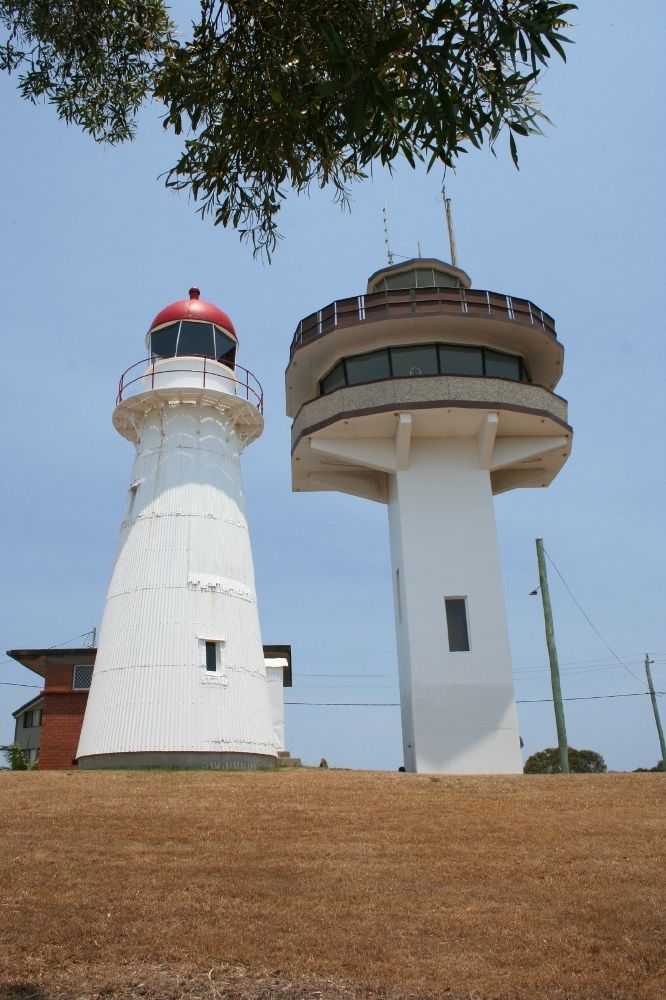
Caloundra Lighthouses are a heritage-listed pair of lighthouses at 3 Canberra Terrace, near Arthur Street, Kings Beach, Caloundra, Sunshine Coast Region, Queensland, Australia. The first, known as the Old Caloundra Light, was designed by Francis Drummond Greville Stanley and built in 1896; the second, New Caloundra Light, was built in 1968. They were added to the Queensland Heritage Register on 5 February 2010.
The Caloundra Head Lighthouses played an integral role in Queensland's system of coastal navigation aids from the 1890s to the 1970s and remain prominent landmarks from Moreton Bay and in the Caloundra district. From construction of the first lighthouse in 1896 through to the decommissioning of the second (1968) lighthouse in 1978 the lights on Caloundra Head guided mariners to the northern entrance to the North West Channel – the safest, most reliable and consequently the most used entry channel to the Port of Brisbane. Despite no longer operating as lighthouses, community support for the conservation of both structures has ensured their survival, while the image of the 1896 lighthouse, Caloundra's oldest surviving structure, has endured as one of the most significant symbols of the town.
When Queensland separated from New South Wales in 1859 the new colony had only one lightstation: Cape Moreton Light on Moreton Island, which had a stone lighthouse erected in 1856. (The Raine Island Beacon constructed in 1844 by the British navy was no longer in use.) This situation was untenable for a colony that relied heavily on coastal shipping. In the 1860s and 1870s the expansion of pastoral and mining activity in northern Queensland led to the establishment of new coastal ports to service the developing hinterlands and the provision of coastal navigation aids became essential.
In 1864 the Queensland Government appointed a select committee to investigate the state of harbours and rivers in the colony. A direct outcome of this inquiry was the construction of the Bustard Head Light south-east of Gladstone in 1867–68 and a lighthouse at Sandy Cape in 1870 – the first lighthouses built by the Queensland colonial government. These were prefabricated iron-framed structures with bolted or riveted cast-iron plate cladding and internal iron staircases, the whole imported from England.
By 1873, the year of the inaugural Intercolonial Coast Lighthouse Conference in Sydney, Queensland had 39 lights along its coastline. The conference was the first attempt to coordinate coastal lights and signals around Australia. Recommendations included the need for more coastal lights in Queensland. Although there was general agreement on the recommendations, there were no moves by any of the colonies to cede their control of lighthouses and other coastal signals to a centralised body or to adopt standardised designs for coastal lights. Lighthouse design continued to take into account local conditions and readily available building materials. Often the local materials were augmented with specialised fittings such as stairways, lantern rooms, lenses, and clock work mechanisms from overseas companies.
For the third lighthouse built by the Queensland colonial government ( Lady Elliot Island Light erected on Lady Elliott's Island in 1872–73), Colonial Architect FDG Stanley designed a structure which utilised readily available local timber, specifying a hardwood frame clad with plated iron sheeting. This reduced the cost of construction, and despite problems of termite infestation and rusting, this type of construction, or its derivative, a wooden frame with corrugated galvanised iron sheeting, became the standard for subsequent nineteenth century Queensland lighthouses. Between 1873 and 1901, 14 lighthouses were constructed in Queensland using hardwood framing and plated iron sheeting, and another 7 were constructed with hardwood frames and corrugated iron cladding. The latter were associated mostly with harbour entrances and included: Little Sea Hill Light (1876 – relocated); Grassy Hill Light (1886 – active); Goods Island Light (1886 – active); Bay Rock Light (1886 – inactive – relocated); Caloundra Head Light (1896 – inactive); North Point Hummock Light (1899 – demolished); Gatcombe Head Light (1900 – demolished). An eighth lighthouse of this type, Bulwer Island Light, was constructed at Bulwer Island in the Brisbane River in 1912, but is now inactive has been relocated.
From 1846, when declared a port of entry, Brisbane /Moreton Bay had been the principal port of Queensland. By the late 1850s the main northern channel lay about half a nautical mile west of Moreton Island and was marked by Cape Moreton Light, the lightship Rose, and covered lights: Comboyuro Point Light, North Point Light and Cowan Cowan Light. In 1879 George Poynter Heath, Portmaster of Queensland from 1862 to 1890 and Chairman of the Queensland Marine Board from 1869 to 1890, sounded a new channel from Caloundra Head along the eastern shore of Bribie Island to provide a deep water entry to the Port of Brisbane. This North West Channel quickly proved to be the safest and most reliable deep water entrance to the port, but remained unlit until 1896 when two leading lights on Bribie Island and at Caloundra Head (marking the entrance to the channel), were completed.
Main article: Old Caloundra Light A 25 acres (10 ha) Lighthouse Reserve had been proclaimed when the town of Caloundra was surveyed in 1883 but was never used. Instead, in the mid-1890s a site of little over 0.5 acres (0.20 ha) was chosen on land owned by Robert Bulcock, where he had built an observation platform on the highest portion of his property during the early 1880s, reputedly to keep watch for enemy ships during the "Russian Scare". Early photographs show that the first Caloundra Head Light was built close to Bulcock's observation platform, which stood to the south-west on what is now Canberra Terrace.
The lighthouse reserve was formally transferred to the Crown in 1896–97 and early in 1896 the Department of Harbours and Rivers called tenders for the construction of two lighthouse towers and cottages on Bribie Island and a lighthouse tower and cottage at Caloundra Head. Materials were shipped by barge from Brisbane and department officers supervised the erection of the lightstations using day labour. The Caloundra Head Lighthouse was a hardwood-framed structure, clad with corrugated iron. A fourth order dioptric apparatus, which operated by concentrating light by refraction, was imported from Chance Bros & Co near Birmingham. The towers for the two leading lights on Bribie Island were of a much simpler construction: open timber frames that could be moved as the channel changed.
The first light keeper at the Caloundra Head Lightstation was appointed when the light became operational in September 1896. One room of his cottage functioned as a postal receiving office, complete with telegraph facilities, with the light keeper appointed as the receiving office keeper. In 1910 the telegraph service was discontinued but was replaced by a telephone service in 1912. The post office remained at the lighthouse until 1934 and as a result, a rough track along the ridge was created by a steady stream of local residents, helping to foster closer settlement around the lighthouse in the immediate years after its erection. This rough track eventually became Canberra Terrace. As a married man with a large family, the arrival of the first lightkeeper also led to the establishment of the first Caloundra School, which for several months in the late 1890s was conducted at the light keeper's cottage.

An incandescent vapour light, the first of its kind in Queensland, was purchased from Chance Brothers and installed in 1910 and by 1912 its 1400 candle power was visible at least 22–25 miles (35–40 km) out to sea. Many mariners considered it the best light on the Queensland coast and the key to successfully traversing Moreton Bay. As a result, by 1920 all vessels entering and leaving the Port of Brisbane at night had to use the North West Channel.
Following the passage of the 1912 Commonwealth Navigation Act, from 1 July 1915 Queensland handed over responsibility for its 30 staffed lights and 37 unattended lights, beacons, and buoys to the Australian Government, who constructed additional lightstations and made substantial upgrades to existing lights, with many lighthouses converted to unattended acetylene lights. The bulk of the expenditure was concentrated north of Cooktown where seven new lighthouses were constructed to guide ships through the Torres Strait and the Great Barrier Reef. Staffed lighthouses were phased out in favour of less expensive, utilitarian-designed structures that did not need to be staffed.
Caloundra Head Lighthouse continued to signal the entrance to the North West Channel to the Port of Brisbane and by 1929 investment in new navigation marks and dredging to increase the depth of the channel ensured that most of the larger ships entering Brisbane used this channel.
The lighthouse also played an important role in the development of tourism on the North Coast (now Sunshine Coast ). From as early as the 1880s holiday makers were travelling to Caloundra by boat or by rail to Landsborough then overland to Caloundra and staying in one of the early guesthouses or camping grounds. "Lighthouse Hill" became well known as a lookout and beauty spot, a place to which tourists and visiting dignitaries alike were taken to see the view, and take a photograph from Bulcock's observation platform (which still existed in the early 1900s). The image of the lighthouse became a symbol of Caloundra, used on promotional material, estate maps, tourist brochures and postcards. With the improvement of roads in the 1930s, Caloundra became more popular as a tourist destination and underwent a period of rapid expansion.
With the advent of hostilities in south-east Asia and the Pacific in 1940 during World War II the operation of all Australian coastal lights was controlled by the Royal Australian Navy. With Brisbane becoming a major disembarkation point for soldiers and supplies for the war effort, the North West Channel through Moreton Bay became the only entrance to the Port making it a well used and vital route. For security purposes ships entering and leaving the channel had to travel in convoys and it was a common sight to see a host of vessels waiting off Caloundra Head to form a convoy before continuing to the Port of Brisbane or their next destination. For security purposes the channel was moved further east, away from the Bribie Island coast.

For the greater part of World War II the Royal Australian Navy set up an observation post within the grounds of the Caloundra Head Lighthouse reserve. Twenty-four hour watches were kept, and display of the light to shipping was controlled. The light was converted to 240 volt mains power in 1942 and a petrol standby engine was added. The lighthouse no longer needed to be staffed, so the Coastal Artillery occupied the lightkeeper's cottage and oversaw the operation of the light.
After the war the Caloundra Head Lighthouse remained unstaffed. The lightkeeper's cottage, no longer needed, was sold to a private owner and moved down the hill to Upper Gay Terrace in 1946 (this building was extant in 2009, but greatly modified). Canberra Terrace was widened and underwent a number of improvements, and by 1950 the unused northern portion of the lighthouse reserve had been opened as a public park, with the area around the lighthouse fenced off. The lighthouse image continued to be used on tourist brochures, pamphlets and postcards. Caloundra Primary School (and later the High School) adopted the lighthouse as its school crest with the motto "Giving Light". Various clubs and societies, such as the Caloundra Bowls Club, also adopted stylised versions of the lighthouse in their logos.
In 1950 the North West Channel was still the most used entrance to the Port of Brisbane. During the 1960s change and development in Australian industry and trade had a marked influence on the shipping industry. With the advent of road and rail transportation many of the smaller coastal ships became obsolete but the increase in large container ships meant that passages such as Moreton Bay's deep North West Channel became even more important.
- Main article: New Caloundra Light In May 1966 the Australian Government, responding to the changing nature of international shipping, granted permission for the Queensland Government to construct a composite structure comprising lighthouse, signal station and radar station, on the lighthouse reserve at Caloundra Head. The new structure was part of a pilot station scheme based at the Mooloolah River, and was to serve as a guide to the North West Channel and a signal light for Caloundra Harbour. Fully completed and operational by 1968, the new lighthouse was erected close to the 1896 lighthouse and for a time the two towers stood side by side. Constructed in reinforced concrete, the new lighthouse resembled an airport control tower. A new light that used a revolving table and comprised two stacks of sealed beam lamps was designed and installed. It was staffed 24 hours a day and four houses were built outside the reserve to accommodate the staff and their families. A similar signal station tower was constructed at Lytton Hill, making the Caloundra tower one of only two of this type built in Australia. With the Lytton Hill tower being demolished in the 1990s, the Caloundra tower remains the only surviving example.
In Queensland, the Australian Government constructed seven concrete lighthouses between 1964 and 1979: Cape Capricorn Light (1964); Caloundra Head (1968); Point Danger Light ( New South Wales, 1971); New Burnett Heads Light (1971); Fitzroy Island Light (1973); Point Cartwright Light (1978); and Archer Point Light (1979). In the 1980s, as lights became unstaffed and automatic, the emphasis shifted to less expensive structures with shorter lifespans.
Closest places in our Australia guide.
More places to explore in Australia.


.jpg?width=1200)


.jpg?width=1200)
.jpg?width=1200)
.jpg?width=1200)


