Ireland
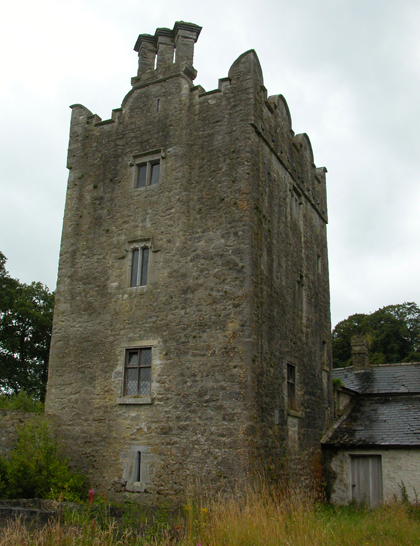
Grange Castle
Fortress · County Kildare
Fortress

Carbury Castle (Irish : Caisleán Chairbre) is a ruined fortified manor house situated atop Carbury Hill (historically known as Fairy Hill or Sidh Nechtain) in the townland of Carbury, near the border between County Kildare and County Offaly, Ireland. The site comprises multiple phases of construction, including a 12th-century motte-and-bailey, a 14th-century stone castle, and a late 16th/early 17th-century fortified house. The castle is both a Protected Structure and a Recorded Monument under Irish law. Carbury Castle was built in the 13th century by Pierce St. Leger.
Carbury is called after Cairbre, son of Niall of the Nine Hostages. The chieftain is supposed to have entertained St Patrick but instead of serving up a lamb or venison or other suitable roast, he served up a greyhound on a dish. This was done out of disrespect for the saint. The saint, however, before commencing dining, blessed the food and immediately the greyhound came back to life and walked off the table and out the door. Cairbre was reputedly married to Boinne, after whom the Boyne is called. The Boyne rises in the grounds of Newberry Hall, now owned by a Mr Robinson. Near the source of the Boyne is a Holy Well called Trinity Well, the water of which is supposed to cure Tooth Aches. The Berminghams occupied the Castle for 200(?) years after which it passed to the Colleys, ancestors of the Wellesleys.
The hill on which the castle stands has been a site of human activity since prehistoric times. Two round barrows beside the motte date to the Bronze Age (after c. 3000 BCE), indicating long-standing funerary or ritual use of the summit.
In Irish mythology, the hill was known as Sidh Nechtain (the Fairy-hill of Nechtain). According to ancient tradition, Nechtain was a King of Leinster and a celebrated poet who maintained a fortress near the summit. His queen, Boand, was associated with a nearby well, the source of the River Boyne, which later became known as Trinity Well after Christian missionaries dedicated it to the Holy Trinity.

The territory surrounding the hill was known as Cairbre Uí Chiardha, associated with the Ó Ciardha (O'Carey), a sept of the southern Uí Néill who were Lords of Carbury. The name Carbury derives from Cairbre (or Coirpre), a son of Niall of the Nine Hostages, a historical King of Tara who died c. 405.
Following the Norman invasion of Ireland, the lands of Carbury were granted in the 1170s to Meiler FitzHenry, a Cambro-Norman nobleman who had participated in the conquest of Leinster. FitzHenry likely constructed the original earthwork motte on the hilltop, which originally would have supported a timber fortification. The motte stands approximately 5 metres high and may have initially served as a motte-and-bailey stronghold before the site was later rebuilt in stone.
By the 14th century, Carbury had passed to the de Bermingham family, who are credited with the earliest surviving masonry phase of the castle. Stone construction using local materials began in the 1300s, producing thick rubble walls rising to three storeys with barrel vaults inserted in the late 13th century.
The de Berminghams were involved in several violent episodes at the site. In 1305, Peter de Bermingham orchestrated the massacre of approximately 30 leading O'Connors of Offaly and their followers within the castle walls, an event that sparked widespread warfare between the Anglo-Normans and the Irish. The family also conducted private wars against their neighbours in the Pale, culminating in the imprisonment of the Crown's representatives, including Thomas de Burley, Lord Chancellor of Ireland, after a failed parley at Carbury Hill in 1368.
In the second half of the 14th century, titular ownership of Carbury passed to the Preston family when Robert Preston, 1st Baron Gormanston, married Margaret, daughter and heiress of Walter de Bermingham, Lord of Carbury. However, during the turbulent 15th century, the castle was attacked and plundered on several occasions, passing in and out of diverse hands as native Irish clans reasserted control.

In 1466, the Earl of Desmond, serving as Lord Deputy of Ireland, was defeated by his brother-in-law O'Connor Faly, who took him prisoner and confined him in Carbury Castle. He was rescued within days by the people of Dublin, but the defeat permanently weakened the defence of the Pale. The castle was destroyed by Hugh Roe O'Donnell in 1475.
John Talbot, 1st Earl of Shrewsbury, reportedly had the castle rebuilt sometime after 1447.
In the mid-16th century, during the reign of Elizabeth I, the lands of Carbury were bestowed by the Crown on Sir Henry Colley, an English soldier who rose to become an Irish Privy Counsellor and was knighted in 1574. A 21-year lease had been granted to Colley from 23 October 1554, and by 1562 the family held full possession.
The Colleys carried out substantial remodelling of the castle in the late 16th and early 17th centuries, transforming it into a fortified Jacobean manor house. Their alterations included the insertion of large mullioned windows and the erection of four prominent chimney stacks, features that reflect a shift toward more comfortable domestic architecture while retaining defensive capability. The Colleys also established a church and a family mausoleum immediately south of the castle.
Henry Colley was succeeded by his son, also named Henry, who married Anne, eldest daughter of Adam Loftus, Archbishop of Dublin and first Provost of Trinity College Dublin. Several generations of Colleys followed at Carbury. In 1728, Richard Colley, a younger descendant, inherited the estates of Dangan and Mornington in County Meath from a cousin named Garret Wesley and legally adopted the Wesley surname. Richard Wesley was later created 1st Baron Mornington. Through this line, the Colley family were the patrilineal ancestors of the Dukes of Wellington, making Carbury Castle an ancestral seat of the 1st Duke of Wellington.

The castle was still inhabited by the Colleys around 1750. It was abandoned shortly afterwards when Arthur Pomeroy, who had married the last Colley heiress of Carbury, built a new Palladian residence, Newberry Hall, nearby in the 1760s.
During the Irish Rebellion of 1798, insurgent forces used the castle as a strongpoint. Rebels who had been pushed back from an attack on Leinster Bridge near Clonard retreated to the Hill of Carbury and spent the night there. Heavy fighting at the site left it severely damaged, contributing to its ruinous state.
Today, Carbury Castle survives as a substantial ruin. The outer walls remain largely standing, though the internal floors and room divisions have almost entirely disappeared. The most striking features are the tall chimney stacks, while inside the building the remnants of stone window mullions and large fireplaces can still be identified. Since the hill slopes steeply, there were likely more storeys on one side of the building than the other, with one portion containing a barrel-vaulted cellar.
The castle's hilltop position continues to command panoramic views of the surrounding flat Kildare countryside for many miles around. Adjacent features include an ancient graveyard, the ruins of a chapel's west gable, and the Colley mausoleum, which appears to date from the early 18th century.
Closest places in our Ireland guide.
More places to explore in Ireland.