Italy
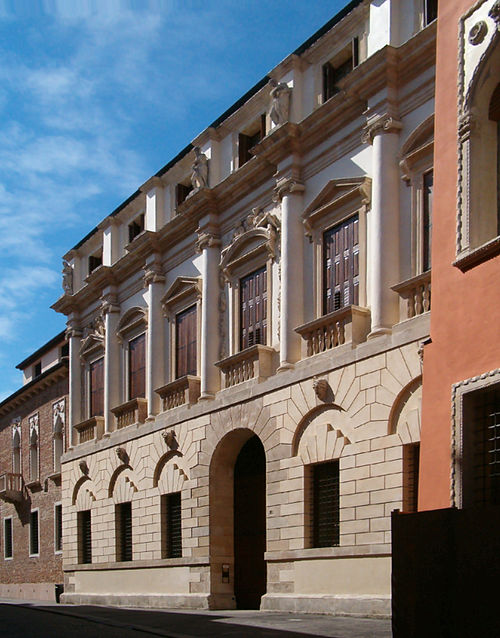
Casa Cogollo
Palace · Vicenza
Church building

The Santa Corona complex in Vicenza comprises one of the city’s most important churches—constructed in the second half of the 13th century and enriched over the centuries with numerous works of art—and the cloisters of the former convent of the Dominicans. It forms part of the city’s museum network. The Church of Santa Corona houses Renaissance paintings and the Valmarana Chapel, designed by Andrea Palladio, while the former convent serves as the home of the Naturalistic Archaeological Museum.
13th–14th centuries: A symbolic site of the city
The church was built at the behest of the Municipality of Vicenza, which, in October 1260, decided to erect a grand temple to house one of the thorns from the crown of Christ. This relic had been gifted to the blessed Bartholomew of Breganze, bishop of Vicenza from 1259 to 1270, by King Louis IX of France in Paris. The bishop aimed to bring about a profound political and religious renewal in the city. Following the tyrannical rule of Ezzelino III da Romano, the free Commune of Vicenza had been restored, and Bishop Bartholomew sought to counter, through the Dominicans —of which he was a member—the heresies prevalent in the city, particularly the well-established Cathar church, as well as civic issues such as family disputes and widespread usury. Consequently, Bishop Bartholomew entrusted the management of the church to his Dominican friars.
The construction of the church was supported by the enthusiasm of the entire population. Its location, rich in symbolic meaning, was chosen in the contrà del Collo, where the Cathar church and Ezzelino’s fortified seat, the Castrum Thealdum, had once stood. The Commune acquired land and rights on the slope descending toward the Bacchiglione River, and private citizens donated houses and palaces. Thus, the church was built—exceptionally large for its time and clearly derived from the Lombard prototypes of Cistercian abbeys —starting in 1261 and completed in less than a decade, at least in its essential parts.
However, the political climate soon changed: in 1264, Vicenza was subjugated by Padua, and Bartholomew lost much of his influence, spending his final years in distress and disappointment. He even requested Pope Clement IV to relieve him of his diocesan duties, but the pope did not accept his resignation. Bartholomew died in 1270 in Vicenza, after designating the Dominican convent of Santa Corona, then under construction, as the universal heir of his possessions. He was buried in the church, which was by then completed.

The following year, the first cloister—the smaller one, largely destroyed during the Anglo-American bombings of 1944—was built adjacent to the northern side of the church. The prestige of the Dominicans in the city grew, particularly after Pope Boniface VIII assigned them the Office of the Inquisition in 1303, replacing the Franciscans who had committed serious abuses. This office was established in the Santa Corona convent, and in 1327, when Vicenza had come under Scaliger rule, the Commune granted a plot of land—further evidence of the civic importance attributed to the mendicant orders—to build a dedicated house for the Inquisition. This tribunal remained in the convent until its suppression by Napoleon in 1797; it was briefly reconstituted under the Austrian government but was definitively abolished in 1820. The Inquisition’s activities were not solely spiritual: since it also prosecuted usurers, these individuals often made amends by donating to the church and charitable works rather than repaying the victims directly. By the 14th century, noble families such as the Da Sarego and Thiene began building their own altars and chapels in Santa Corona.
During this period, Santa Corona was the heart of Vicenza’s religious and civic life: the feast and procession of the Holy Thorn were celebrated with utmost solemnity, with procedures even prescribed by municipal statutes, and involved all the city’s guilds, led by those of judges and notaries. Even during the general religious decline that affected convents from the mid-14th century, the Dominicans—reformed by the Observance movement, supported by both municipal authorities and Venice —and the church maintained their prestige in the city.
The Dominicans also oversaw the nuns who, almost concurrently, established themselves in the city at the ancient borough near the Roblandine church in the San Domenico monastery. This monastery quickly amassed significant wealth through dowries brought by postulants, many from noble or affluent families. Some of these assets were donated to the Santa Corona convent, which enjoyed considerable privileges, including exemptions from tithing and taxes imposed by the Roman Curia, ensuring a relatively prosperous economic condition.
Santa Corona was also a center of culture: in 1372, the Dominicans, in gratitude to the Vicentines who had generously supported their General Chapter, opened a public school of philosophy in the convent. A school may have existed as early as the 13th century, alongside a library that housed the significant collection of books bequeathed by Bishop Bartholomew.
In 1463, a brief from Pope Pius II transferred the convent of Santa Corona to the Observants, toward whom both the population and the civic and Venetian authorities had always been favorable. Following this, the conventual community experienced significant growth.

15th–18th centuries: A symbolic place for noble families
During the 15th century, under the dominion of the Republic of Venice, Vicenza lost political significance. The city’s symbolic sites were then occupied by noble families who, under the pact of devotion to Venice, governed the territory. These families, driven by prestige but also by spiritual motives, first embraced the late Gothic style from Venice and later the Renaissance style from central Italy, adorning the city with palaces and enriching its churches with splendid works of art. Often, their patronage was motivated by a desire for a privileged burial place to ensure their salvation: many noble wills expressed a wish to be buried in Santa Corona, accompanied by bequests to the church.
Throughout the 15th century, many side chapels were constructed, and between 1481 and 1489, Santa Corona underwent significant modifications by Lorenzo da Bologna with the construction of the large apse, crypt, and transept. These structures were enriched over the following decades with increasingly elaborate artifacts, losing the austerity of the original construction. The funding for this substantial renovation came from noble families to whom the chapels were dedicated, the Commune, and the generous contributions of the Vicentine population, as when Cardinal Bishop Zeno, under a privilege from Pope Alexander VI, granted a plenary indulgence. As for the families, they competed to build chapels and altars: the Nievo and Monza erected two small chapels that were replaced in the 17th century by the Rosario Chapel, the Barbaran built the large transept chapel, and the Pagello, Monza, and Garzadori constructed altars along the left nave.
The crypt’s construction was granted in 1481 to the noble Valmarana family in exchange for their former chapel (now called the Holy Thorn Chapel). In 1520, the precious reliquary was transferred there, and it was consecrated as the Sanctuary of the Holy Thorn by Vicenza’s Archbishop Lodovico Chiericati in 1550. In the second half of the 16th century, the right side of the crypt was opened with the construction, based on designs by Andrea Palladio, of the Valmarana Chapel. From 1613 to 1642, the grand Rosario Chapel was built to commemorate the victorious Battle of Lepanto against the Turks.
Santa Corona was also home to confraternities, which at the time represented the greatest expression of the city’s religious life. Around 1450, the Confraternity of Saint Peter Martyr built the second chapel on the right nave, where it continued to gather until the Napoleonic suppression. In 1520, the Confraternity of Mercy renovated the Madonna of the Stars altar, and in 1562, thriving due to the presence of many affluent members, it built a first oratory, known as the Turchini, now lost, adjacent to the cloister, and a second oratory in the open field of the church’s cemetery. The Confraternity of the Rosary, established in the second half of the 16th century and renovated after the Battle of Lepanto, was influential due to the presence of wealthy merchants. It was based in Santa Corona, where it funded the construction of the eponymous chapel, which became the center of a devotion that spread rapidly across the territory. These were joined by the Confraternities of the Third Order of Saint Dominic.

Highlighting the Dominicans’ importance in the city during this period, around 1477, the dormitory and three sides of the larger cloister—the second in chronological order—were constructed. A few years later, with the generous contribution of Cristoforo Barbaran—who simultaneously funded the construction of his family’s large chapel in the right transept—the refectory and library were built, where, until the 17th century, municipal records were also stored. In the early 16th century, due to the dangers posed by the War of the League of Cambrai, the number of friars living at Santa Corona decreased but began to grow again after the conflict. In 1532, with the addition of the fourth side of the larger cloister, the convent complex was completed.
Andrea Palladio designed the Valmarana Chapel in the crypt, likely in 1576, on the occasion of Antonio Valmarana’s death, although it was not completed until 1597 by Leonardo Valmarana, the architect’s brother, after Palladio’s death. However, some argue that the date 1597, inscribed on a plaque on the floor, refers not to the chapel’s construction but to the transfer of the remains of parents and siblings, carried out by Leonardo, who in his will claimed responsibility for the chapel’s construction.
In the 17th century, life in the convent continued much as it had in the previous century. There was an emphasis on religious activities, such as establishing numerous Rosary Confraternities in nearly all of the territory's parishes, as well as organizing the convent school more effectively. Further renovations to the church and convent complex continued into the 17th and early 18th centuries.
Throughout the 18th century, the Santa Corona convent remained highly functional, with a community of around 25 religious members, including teachers and students. Each year, the feasts of Saint Pope Pius V, the Dominican pope of the Battle of Lepanto, as well as those of the Madonna of the Snow and the Holy Thorn, were solemnly celebrated.
However, in 1797, with the arrival of French troops, the convent was partially occupied. After the democratic government ended, the Dominicans returned to the convent from 1801 to 1810, but following Napoleon’s Compiègne decree, which ordered the dissolution of religious orders and confraternities, they were forced to leave permanently. Due to the reorganization of the city’s parishes, Santa Corona became the main subsidiary church of the Santo Stefano parish. In 1812, the Confraternity of the Rosary was dissolved, and its oratory was demolished.
Closest places in our Italy guide.
More places to explore in Italy.