Germany
Aachener Thermalquellen
Spring · Aachen
Palace

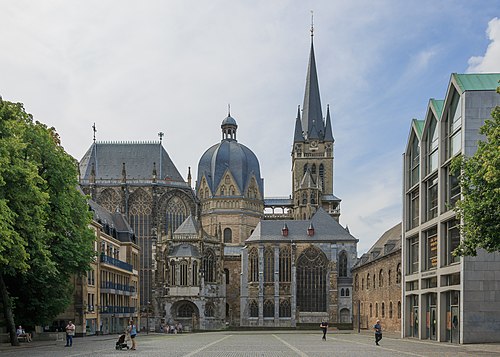
The Palace of Aachen was a group of buildings with residential, political, and religious purposes chosen by Charlemagne to be the center of power of the Carolingian Empire. The palace was located in the heart of the current city of Aachen, today in the German Land (or state) of North Rhine-Westphalia. Most of the Carolingian palace was built in the 790s but the works went on until Charlemagne's death in 814. The plans, drawn by Odo of Metz, were part of the program of renovation of the kingdom decided by the ruler. The Palatine Chapel that was part of the palace complex has been preserved and is considered a masterpiece of Carolingian architecture and a characteristic example of architecture from the Carolingian Renaissance. Also, the foundations and lower walls of the Aula Regia (council hall) are preserved in the current town hall as are the first three stories of its square tower (so-called Granus Tower).
In ancient times, the Romans chose the site of Aachen for its thermal springs and its forward position towards Germania. The site, called Aquae Granni, was equipped with 50 acres (20 ha) of thermae that remained in use from the 1st to the 4th century. The Roman city grew in connection with the thermae according to a classical grid plan similar to that of Roman legionary camps. A palace was used to accommodate the governor of the province or the Emperor. In the 4th century, the city and the palace were destroyed during the Barbarian invasions. Clovis made Paris the capital of the Frankish Kingdom, and Aachen Palace was abandoned until the advent of the Carolingian dynasty. The Pippinid Mayors of the Palace carried out some restoration works, but it was at the time only one residence among others. The Frankish court was itinerant and the rulers moved according to the circumstances. Around 765, Pepin the Short had a palace erected over the remains of the old Roman building; he had the thermae restored and removed its pagan idols. As soon as he came to power in 768, Charlemagne spent time in Aachen as well as in other villas in Austrasia. In the 790s, he decided to settle down in order to govern first his kingdom, then his empire, more efficiently.
The site of Aachen was chosen by Charlemagne after careful consideration in a key moment of his reign. Since his advent as King of the Franks, Charlemagne had led numerous military expeditions that had both filled his treasury and enlarged his realm, most notably towards the East. He conquered pagan Saxony in 772–780, but this area resisted and the war with the Saxons lasted for about thirty years. Charlemagne ended the Germanic custom of an itinerant court moving from place to place and established a permanent capital. As he was ageing, he decreased the frequency of military expeditions and, after 806, virtually did not leave Aachen.
Aachen's geographic location was a decisive factor in Charlemagne's choice: the site was situated in the Carolingian heartlands of Austrasia, the cradle of his family, East of the Meuse river, at a crossroads of land roads and on a tributary of the Rur, called the Wurm. From then, Charlemagne left the administration of the Southern regions to his son Louis, named King of Aquitaine, which enabled him to reside in the North.
Besides, settling down in Aachen enabled Charlemagne to control the operations in Saxony from a closer position. Charlemagne also considered other advantages of the place: surrounded with forest abounding in game, he intended to abandon himself to hunting in the area. The ageing emperor could also benefit from Aachen's hot springs.
The scholars of the Carolingian era presented Charlemagne as the "New Constantine "; in this context, he needed a capital and a palace worthy of the name. He left Rome to the Pope. The rivalry with the Byzantine Empire led Charlemagne to build a magnificent palace. The fire that destroyed his palace in Worms in 793 also encouraged him to follow such a plan.
Importance of the project entrusted to Odo of Metz
Historians know almost nothing about the architect of the Palace of Aachen, Odo of Metz. His name appears in the works of Eginhard (c. 775–840), Charlemagne's biographer. He is supposed to have been an educated cleric, familiar with liberal arts, especially quadrivia. He had probably read Vitruvius ' treatise on architecture, De Architectura.
The decision to build the palace was taken in the late 780s or the early 790s, before Charlemagne held the title of emperor. Works began in 794 and went on for several years. Aachen quickly became the favourite residence of the sovereign. After 807, he almost did not leave it any more. In the absence of sufficient documentation, it is impossible to know the number of workers employed, but the dimensions of the building make it probable that there were many of them.
The geometry of the plan chosen was very simple: Odo of Metz decided to keep the layout of the Roman roads and inscribe the square in 360 Carolingian feet, or 120 metres-side square. The square enclosed an area of 50 acres divided in four parts by a North-South axis (the stone gallery) and an East-West axis (the former Roman road, the decumanus ). To the north of this square lay the council hall, to the south the Palatine Chapel. The architect drew a triangle toward the East to connect the thermae to the palace complex. The two best-known buildings are the council hall (today disappeared) and the Palatine Chapel, included into the Cathedral. The other buildings are hardly identified. Often built in timber framing, made of wood and brick, they have been destroyed. Lastly, the palace complex was surrounded with a wall.
The arrival of the court in Aachen and the construction work stimulated the activity in the city that experienced growth in the late 8th century and the early 9th century, as craftsmen, traders and shopkeepers had settled near the court. Some important ones lived in houses inside the city. The members of the Palace Academy and Charlemagne's advisors such as Eginhard and Angilbert owned houses near the palace.
In ancient times, the Romans chose the site of Aachen for its thermal springs and its forward position towards Germania. The site, called Aquae Granni, was equipped with 50 acres (20 ha) of thermae that remained in use from the 1st to the 4th century. The Roman city grew in connection with the thermae according to a classical grid plan similar to that of Roman legionary camps. A palace was used to accommodate the governor of the province or the Emperor. In the 4th century, the city and the palace were destroyed during the Barbarian invasions. Clovis made Paris the capital of the Frankish Kingdom, and Aachen Palace was abandoned until the advent of the Carolingian dynasty. The Pippinid Mayors of the Palace carried out some restoration works, but it was at the time only one residence among others. The Frankish court was itinerant and the rulers moved according to the circumstances. Around 765, Pepin the Short had a palace erected over the remains of the old Roman building; he had the thermae restored and removed its pagan idols. As soon as he came to power in 768, Charlemagne spent time in Aachen as well as in other villas in Austrasia. In the 790s, he decided to settle down in order to govern first his kingdom, then his empire, more efficiently.
The site of Aachen was chosen by Charlemagne after careful consideration in a key moment of his reign. Since his advent as King of the Franks, Charlemagne had led numerous military expeditions that had both filled his treasury and enlarged his realm, most notably towards the East. He conquered pagan Saxony in 772–780, but this area resisted and the war with the Saxons lasted for about thirty years. Charlemagne ended the Germanic custom of an itinerant court moving from place to place and established a permanent capital. As he was ageing, he decreased the frequency of military expeditions and, after 806, virtually did not leave Aachen.
Aachen's geographic location was a decisive factor in Charlemagne's choice: the site was situated in the Carolingian heartlands of Austrasia, the cradle of his family, East of the Meuse river, at a crossroads of land roads and on a tributary of the Rur, called the Wurm. From then, Charlemagne left the administration of the Southern regions to his son Louis, named King of Aquitaine, which enabled him to reside in the North.
Besides, settling down in Aachen enabled Charlemagne to control the operations in Saxony from a closer position. Charlemagne also considered other advantages of the place: surrounded with forest abounding in game, he intended to abandon himself to hunting in the area. The ageing emperor could also benefit from Aachen's hot springs.
The scholars of the Carolingian era presented Charlemagne as the "New Constantine "; in this context, he needed a capital and a palace worthy of the name. He left Rome to the Pope. The rivalry with the Byzantine Empire led Charlemagne to build a magnificent palace. The fire that destroyed his palace in Worms in 793 also encouraged him to follow such a plan.
Historians know almost nothing about the architect of the Palace of Aachen, Odo of Metz. His name appears in the works of Eginhard (c. 775–840), Charlemagne's biographer. He is supposed to have been an educated cleric, familiar with liberal arts, especially quadrivia. He had probably read Vitruvius ' treatise on architecture, De Architectura.
The decision to build the palace was taken in the late 780s or the early 790s, before Charlemagne held the title of emperor. Works began in 794 and went on for several years. Aachen quickly became the favourite residence of the sovereign. After 807, he almost did not leave it any more. In the absence of sufficient documentation, it is impossible to know the number of workers employed, but the dimensions of the building make it probable that there were many of them.
The geometry of the plan chosen was very simple: Odo of Metz decided to keep the layout of the Roman roads and inscribe the square in 360 Carolingian feet, or 120 metres-side square. The square enclosed an area of 50 acres divided in four parts by a North-South axis (the stone gallery) and an East-West axis (the former Roman road, the decumanus ). To the north of this square lay the council hall, to the south the Palatine Chapel. The architect drew a triangle toward the East to connect the thermae to the palace complex. The two best-known buildings are the council hall (today disappeared) and the Palatine Chapel, included into the Cathedral. The other buildings are hardly identified. Often built in timber framing, made of wood and brick, they have been destroyed. Lastly, the palace complex was surrounded with a wall.
The arrival of the court in Aachen and the construction work stimulated the activity in the city that experienced growth in the late 8th century and the early 9th century, as craftsmen, traders and shopkeepers had settled near the court. Some important ones lived in houses inside the city. The members of the Palace Academy and Charlemagne's advisors such as Eginhard and Angilbert owned houses near the palace.
Closest places in our Germany guide.
More places to explore in Germany.