Germany
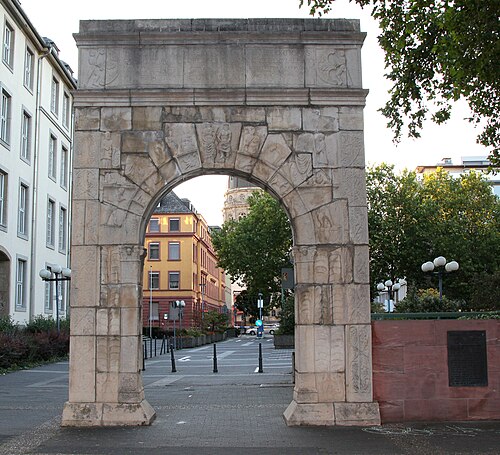
Arch of Dativius Victor
Triumphal arch · Mainz
Monument

The Great Mainz Jupiter Column is a civilian monument erected in the second half of the 1st century in Mogontiacum (present-day Mainz) in honor of the Roman god Jupiter. It is the oldest, largest, and most elaborate Jupiter column discovered to date in the German-speaking region. The Great Mainz Jupiter Column served as a model for further Jupiter columns, primarily erected in the 2nd and 3rd centuries in the Roman provinces of Germania Inferior (Lower Germany) and Germania Superior (Upper Germany). It was destroyed in the late period of the Roman Empire and rediscovered in 1904/05. Today, the reconstructed remains can be viewed in the Stone Hall of the Landesmuseum Mainz. Copies of the Great Mainz Jupiter Column are located in Mainz itself, at Saalburg Castle, in Saint-Germain-en-Laye, and in Rome.
In 13/12 BC, the construction of a legionary camp on the Mainz Kästrich (elevation above the Rhine Valley) marked the beginning of nearly 500 years of Roman presence in Mainz. Shortly thereafter, several Canabae (civilian settlements) emerged on the slopes of the Kästrich toward the Rhine and in Weisenau, quickly developing into individual, loosely connected civilian settlements. In the area of present-day Mainz Neustadt at the level of the customs and inland port, a settlement known in specialist literature as the “Dimesser Ort” was founded. Here, likely in the first half of the 1st century, there was a naval base of the Roman Rhine fleet. Additionally, archaeological finds suggest the presence of a larger transshipment point for goods transported by ship. In expert circles, the settlement is therefore regarded as a vicus of traders and long-distance merchants. By the beginning of the second half of the 1st century, this civilian settlement must already have had significant importance for civilian life in Mainz as well as a certain level of prosperity. An interpretation as an early civilian center of Mainz at that time is also assumed. During the reign of Emperor Nero, residents (canabarii) of this settlement donated the monument now known as the Great Mainz Jupiter Column. Together with an altar stone for thank-offerings, it was erected in the settlement as a sign of their devotion and loyalty to the imperial house.
In December 1904, the then director of the Römisch-Germanisches Zentralmuseum in Mainz, Ludwig Lindenschmit, became aware of bronze fragments that construction workers were selling to a scrap metal dealer. A foot clad in a sandal and remains of a thunderbolt bundle turned out to be parts of the larger-than-life Jupiter figure. After Lindenschmit located the find site at Sömmerringstraße No. 6 in Mainz Neustadt, the remains of the Jupiter column were uncovered in several weeks of follow-up excavations in early 1905 at a depth of two and a half meters. Nearly 2,000 fragments of various sizes were recovered in total. The find situation already indicated at the time that the column's debris resulted from a systematic and planned destruction and deposition of the fragments. Lindenschmit, who enjoyed a good reputation in Europe as a conservator, reconstructed the column from the debris in meticulous work. This was facilitated by assembly marks that determined the sequence of the individual column sections and their arrangement. He later wrote about this:
The assembly of the individual members, the base, column drums, etc., was carried out in such a way that first the matching parts of the outer side, often touching only at narrow fracture points, were joined together using brass dowels and stone mastic. Where larger pieces were missing inside the column, the connection to the outer sides was made with bricks embedded in a mass made of glue and plaster to avoid unnecessarily increasing the weight. Furthermore, the outward-facing parts were connected to each other and to the core by means of inserted metal lumps, wires, and clamps. All gaps inside and outside were filled with the aforementioned mass or stone mastic.
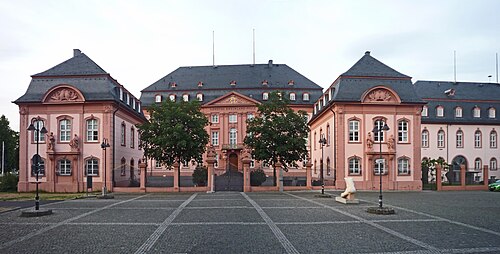
Despite the emerging supra-regional significance of the find, the Jupiter column was stored outdoors in various locations for several decades. From 1963, it was displayed in the Stone Hall (the former riding hall of the Electoral Marstall) of the present-day Landesmuseum Mainz. There, it is exhibited together with other significant stone monuments from the collection of Roman stone monuments from the Roman period in Mainz, comprising around 2,000 individual pieces. In autumn 2016, parts of the column were sent to the Fraunhofer Development Center for X-ray Technology in Erlangen for examination. There, over approximately two years of work, it is to be determined how the individual parts of the Jupiter column appeared 2,000 years ago. The replicas of the Great Mainz Jupiter Column in front of the Deutschhaus in Mainz and at the Saalburg closely follow the original. In some depictions, missing parts of the sculptures and decorative friezes have been supplemented to a minor extent. It could not be clearly determined whether the Jupiter figure was originally conceived as standing or seated. Painting of the Jupiter column can be assumed as possible but is not verifiable based on the finds. As of October 2016, the copy of the column in front of the Landtag of Rhineland-Palatinate in the Große Bleiche in Mainz is dismantled due to restoration work.
The Great Mainz Jupiter Column consists of two differently sized, almost cubic base stones and five column drums that taper slightly in diameter upward. In this section of the monument, a total of 28 different deities from Romano-Celtic mythology are depicted. Atop the column sits a richly decorated capital of the Corinthian order with a cubic finishing stone on which the Jupiter figure stood. The column measures 9.14 meters without the Jupiter figure; with the 3.36-meter-tall Jupiter figure, the Jupiter column had a total height of 12.50 meters. Like numerous other stone monuments of Roman Mogontiacum, it was made from Lorraine Keuper (limestone) from the area around Verdun.
The two lightly profiled base stones likely stood on a multi-stepped substructure, about which nothing is known. The lower of the two base stones shows Jupiter himself on the four image sides, as well as the goddess of fortune, Fortuna, and Minerva, the goddess of wisdom. Also included are Mercury, the god of trade, and possibly Salus, the female deity of personified well-being. Depicted alone on the fourth image side is Hercules. The second base stone shows Apollo, god of music and the arts, as well as the two Dioscuri. The front side of the Jupiter column (the side facing the sacrificial altar) contains the dedicatory inscription mentioned below. In addition to the god figures, the respective image sides feature rich surrounding decoration.
- Base stones (replica of the Great Mainz Jupiter Column in front of the Saalburg)
The column drums show the following deities or personifications in ascending order, some of which cannot be identified with absolute certainty: On the lowest column drum, the sea god Neptune, Diana, the goddess of the hunt, the victory goddess Victoria, and the war god Mars are depicted. The next drum shows two female deities that could be interpreted as the city goddess Roma (?) and the vegetation goddess Ceres (?), as well as Vulcan, the god of smithing, and possibly Virtus (?), the personification of bravery. On the next column drum, none of the depicted deities can be definitively identified. Possibly shown here are the peace goddess Pax, Aequitas, the personification of justice, the household goddess Vesta, and an indeterminable female goddess. The penultimate column drum shows a person possibly representing the Genius of Nero, the wine god Bacchus, and two Lares, protective gods of Roman mythology. On the final column drum, Luna, the goddess of the moon, and Sol, the god of the sun, are depicted. Luna is shown driving a biga (two-horse chariot), while Sol drives a quadriga.
The Corinthian capital atop the last column drum is typically decorated with richly ornate acanthus leaves in two superimposed rows. The finishing stone sitting on the capital is decorated with floral patterns and a diagonal design.
The Jupiter figure standing on the column survives only in a few fragments. It can be assumed that during the violent destruction of the Jupiter column, the gilded bronze Jupiter statue was smashed and melted down for its metal value. The over-three-meter-tall, larger-than-life figure was depicted standing or seated, holding a thunderbolt bundle as a typical attribute and with an eagle standing beside him. Preserved are the left foot (clad in a sandal), a finger, a thunderbolt wedge, an eagle's claw, and smaller parts of the body's midsection.
- Column drums and Jupiter figure (replica of the Great Mainz Jupiter Column in front of the Saalburg)
Reconstruction attempt of the Jupiter figure
The two lightly profiled base stones likely stood on a multi-stepped substructure, about which nothing is known. The lower of the two base stones shows Jupiter himself on the four image sides, as well as the goddess of fortune, Fortuna, and Minerva, the goddess of wisdom. Also included are Mercury, the god of trade, and possibly Salus, the female deity of personified well-being. Depicted alone on the fourth image side is Hercules. The second base stone shows Apollo, god of music and the arts, as well as the two Dioscuri. The front side of the Jupiter column (the side facing the sacrificial altar) contains the dedicatory inscription mentioned below. In addition to the god figures, the respective image sides feature rich surrounding decoration.
- Base stones (replica of the Great Mainz Jupiter Column in front of the Saalburg)
The column drums show the following deities or personifications in ascending order, some of which cannot be identified with absolute certainty: On the lowest column drum, the sea god Neptune, Diana, the goddess of the hunt, the victory goddess Victoria, and the war god Mars are depicted. The next drum shows two female deities that could be interpreted as the city goddess Roma (?) and the vegetation goddess Ceres (?), as well as Vulcan, the god of smithing, and possibly Virtus (?), the personification of bravery. On the next column drum, none of the depicted deities can be definitively identified. Possibly shown here are the peace goddess Pax, Aequitas, the personification of justice, the household goddess Vesta, and an indeterminable female goddess. The penultimate column drum shows a person possibly representing the Genius of Nero, the wine god Bacchus, and two Lares, protective gods of Roman mythology. On the final column drum, Luna, the goddess of the moon, and Sol, the god of the sun, are depicted. Luna is shown driving a biga (two-horse chariot), while Sol drives a quadriga.
The Corinthian capital atop the last column drum is typically decorated with richly ornate acanthus leaves in two superimposed rows. The finishing stone sitting on the capital is decorated with floral patterns and a diagonal design.
The Jupiter figure standing on the column survives only in a few fragments. It can be assumed that during the violent destruction of the Jupiter column, the gilded bronze Jupiter statue was smashed and melted down for its metal value. The over-three-meter-tall, larger-than-life figure was depicted standing or seated, holding a thunderbolt bundle as a typical attribute and with an eagle standing beside him. Preserved are the left foot (clad in a sandal), a finger, a thunderbolt wedge, an eagle's claw, and smaller parts of the body's midsection.
- Column drums and Jupiter figure (replica of the Great Mainz Jupiter Column in front of the Saalburg)
Reconstruction attempt of the Jupiter figure
Closest places in our Germany guide.
More places to explore in Germany.