Spain
Museum of the History of Tenerife
History museum · San Cristóbal de La Laguna
Monument

The Cathedral of San Cristóbal de La Laguna or Catedral de Nuestra Señora de los Remedios (Santa Iglesia Catedral de San Cristóbal de La Laguna in Spanish) is a Catholic church in Tenerife, Spain. Constructed between 1904 and 1915 to replace an earlier building begun in 1515 and designated a cathedral in 1818, it is dedicated to the Virgin of Los Remedios (patron of the Diocese of San Cristóbal de La Laguna and the island of Tenerife). The cathedral is the mother church of the diocese, which includes the islands of Tenerife, La Palma, La Gomera and El Hierro in the province of Santa Cruz de Tenerife. It is therefore where the episcopal seat of the bishop of this diocese, currently occupied by Bishop Eloy Alberto Santiago. This is one of the most important churches of the Canary Islands. The Cathedral of San Cristóbal de La Laguna is located in the city of San Cristóbal de La Laguna (Tenerife, Canary Islands, Spain). In the cathedral lie the remains of Alonso Fernandez de Lugo, conqueror of the island and founder of the city. The cathedral is located in the historic center of the city of La Laguna, and was declared a World Heritage Site in 1999 by UNESCO. The cathedral contains elements...
In 1511, a hermitage was erected on the site of the current Plaza de Fray Albino edifice. It was built by order of the conquistador, Alonso Fernández de Lugo. The area appears to have been an ancient Guanche necropolis. It is also known that the whole valley of Aguere (in which the city lies), especially the large lake that was in this place, was a place of pilgrimage for the indigenous people of the island.
This primitive chapel was originally dedicated to the Virgin Mary in her Expectation, which is celebrated every 18 December.
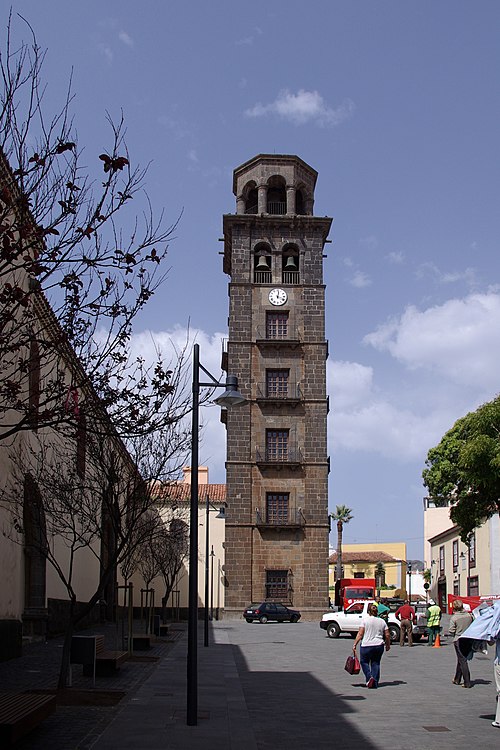
The chapel was replaced in 1515 with a major construction dedicated to the Virgin of Los Remedios in the Mudéjar architectural style, to which a tower was added in 1618. It was on 21 April 1515 when the site rose to the level of parish with the name Santa Maria de los Remedios. The feast day of the Nativity of the Virgin Mary is celebrated on 8 September.
That same year, the Portuguese mason Miguel Alonso built the main chapel, the main arch, the altar, the stands, the tabernacle and the door of the sacristy, all made of stone.

On 7 April 1534, Saint José de Anchieta was baptized in the church. He was born in the city of La Laguna, became a missionary, and later became the founder of the city of São Paulo and one of the founders of Rio de Janeiro, both in Brazil. Precisely the cathedral is the diocesan shrine of the saint in the Canary Islands.
In 1752 a new transept was built, the main chapel vestries were widened and spacious dressing rooms were added for the image of the patron saint, the Virgen de los Remedios. Don Domingo de la Guerra, who directed the work and was later Marqués de San Andrés, extended the main chapel, because he hoped that one day the temple would become the Cathedral of Tenerife.
Several times since the old chapel was converted into a parish in 1515, there were attempts to have it be designated a cathedral, collegiate, or auxiliary cathedral dependent on the Cathedral of Santa Ana of Las Palmas de Gran Canaria, with some of the members of the Canary Cathedral Chapter residing in the Church of Los Remedios. These initial applications were not successful.
In 1783, at the height of the Enlightenment (La Laguna was the center of this movement in the Canary Islands), a request was made for designation as a diocese to be located in the Church of Los Remedios but the request was received with suspicion by members of the Cathedral Chapter and the Bishop of Gran Canaria, and the establishment of an ecclesiastical institution on this island was again rejected.
Finally, on 1 February 1819, a papal bull approved the division of the Diocese of Canarias in two dioceses. The temple became a cathedral in 1819 by bull of Pope Pius VII, and the new diocese of La Laguna was created. The Diocese of San Cristóbal de La Laguna includes the islands of Tenerife, La Palma, La Gomera and El Hierro in the province of Santa Cruz de Tenerife.

In obtaining the title of cathedral and the creation of the Diocese it had an important role priest Cristóbal Bencomo y Rodríguez, confessor of King Ferdinand VII of Spain and Titular Archbishop of Heraclea. His tomb is now in the presbytery of the Cathedral of La Laguna, next to the Epistle.
At the time the building was constructed and dedicated as a cathedral, the capital of the island was the city of San Cristóbal de La Laguna, which is why the cathedral was built there and not in the current capital of the island ( Santa Cruz de Tenerife ). The diocesan headquarters still remains in San Cristóbal de La Laguna. On 5 October 1983, the Cathedral of La Laguna was declared a National Historic-Artistic Monument in Spain.
During the time of the suppression of the Bishopric of Tenerife (between 1851 and 1875) as a result of the Concordat of 1851, the Cathedral of La Laguna lost its cathedral title, becoming the collegiate church and being the only collegiate church that has existed in the Canary Islands. With the restoration of the diocese in 1875, the temple regains its status as a cathedral church with all the ecclesiastical privileges it enjoyed previously.
The cathedral is also a parish and a Marian shrine, as the Virgin of Los Remedios is the patron saint of the Roman Catholic Diocese of San Cristóbal de La Laguna and the island of Tenerife. There is some expectation that this church will be declared a minor basilica by the Holy See in the near future.
In 2002 the cathedral was closed to worship for a meticulous restoration, with the intention of reopening a few years later. However, due to bureaucratic disagreements, the cathedral remained closed for more than a decade. During the pre-restoration study, it had been discovered that the main dome and vaults were so damaged that the only viable solution was the demolition of these elements and their subsequent reconstruction. The new vaults and domes were built with a new material, polypropylene fiber, making the cathedral the first in the world to use this material. Finally, the doors were reopened on 25 January 2014, to be reopened to worship on 31 January of that year.

To mark the centenary and the reopening of the cathedral, a Jubilee Year was held from 27 April 2014, until 12 April 2015, both dates coinciding with the Divine Mercy Sunday. That Jubilee was decreed by a special mandate of Pope Francis, with the chance of winning the faithful a plenary indulgence.
During the remodeling, which included Cathedral Square in 2014, archaeological remains were discovered underground. Some evidence was unearthed in the rubble that suggested it belonged to the ancient Church of Los Remedios or to structures from the first European settlement in the city. Later, in 2018 human remains of the sixteenth century were discovered in the place. One thinks that in the place the old parochial cemetery was located.
In 1511, a hermitage was erected on the site of the current Plaza de Fray Albino edifice. It was built by order of the conquistador, Alonso Fernández de Lugo. The area appears to have been an ancient Guanche necropolis. It is also known that the whole valley of Aguere (in which the city lies), especially the large lake that was in this place, was a place of pilgrimage for the indigenous people of the island.
This primitive chapel was originally dedicated to the Virgin Mary in her Expectation, which is celebrated every 18 December.
The chapel was replaced in 1515 with a major construction dedicated to the Virgin of Los Remedios in the Mudéjar architectural style, to which a tower was added in 1618. It was on 21 April 1515 when the site rose to the level of parish with the name Santa Maria de los Remedios. The feast day of the Nativity of the Virgin Mary is celebrated on 8 September.
Closest places in our Spain guide.
More places to explore in Spain.