Italy
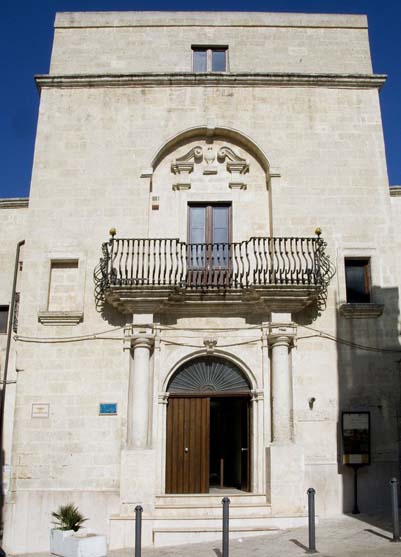
San Giovanni Battista, Oria
Church building · Oria
Church building

The Collegiate Basilica of the Most Holy Rosary, also known as the Matrix Church or Cathedral (Italian: Basilica minore del Santissimo Rosario) is a Catholic Minor Basilica located in Francavilla Fontana, an Italian municipality in the province of Brindisi in Apulia. It is the largest church in the Diocese of Oria, of which it is part, and has the highest dome in Salento, with a diameter of 13 meters. The present building is the result of reconstruction in 1743, after an earthquake had destroyed much of the church built in the 14th century at the behest of Philip I of Taranto.
The origin of the church, according to tradition, is linked to the discovery, near a spring close to Casale di San Salvatore, of a Byzantine icon depicting the image of Our Lady, which took place on September 14, 1310 by the prince of Taranto, Philip I of Taranto. Immediately after the discovery of the sacred image, the prince ordered that a church be built around that site in which the icon would be preserved.
However, among the various local historians who speak of the church's origin, Caesar Theophilatus claimed that as early as around 1300 there was a church dedicated to St. Mary of Francavilla on that site, which must have been of Greek rite and with a parish function distinct from the other parishes in the area. He also claimed that baptismal rites took place in an immersive manner, as attested by the font for the baptism of children placed in the atrium of the Imperiali Castle.
Around 1510 the church was enlarged, and at that time the main door was located between the present niches of St. Lawrence and St. Joseph and stretched as far as the altar of St. Anne, where, surrounded by a gate, the wall on which the painting stood was preserved. It was not until 1552 that Domenico di Brindisi and Stefano Salinaro were commissioned to build a chapel to house the Marian icon, adorned with various sculptures and enclosed by an iron gate. Further improvements were made in 1560, and so the new building was consecrated on February 24, 1572, by Monsignor Figuerroa, bishop of Brindisi and Oria.
In 1613 a new chapel was built to place the icon, which until then had been on a wooden altar surrounded by iron gates; other improvements were made in 1615.

The 1743 earthquake severely damaged the structure, and so instead of repairing it, it was preferred to be rebuilt. The entire population participated in the expenses for its reconstruction, from the prince, who offered more than half of the sum needed, to the University (the officials gave up their salaries), the Collegiate Chapter, and the people with their alms.
To solve the problems concerning the construction of the church, a special commission was appointed, which supervised the work that lasted from 1743 to 1759, and which, with the help of the architect Mauro Manieri and Prince Michele Imperiali, chose, among all those presented, a project that came from Rome.
The building site was directed for a year by Mauro Manieri and, after his death, by Friar Benedetto of the Pious Schools and Giuseppe di Lauro of Manduria.
On August 15, 1743, Michele Imperiali and his wife laid the first stone of the new mother church. As a symbolic gesture, a box of lead was inserted into the brick containing a coin depicting Benedict XII, a medal of Our Lady of the Fountain and a jar of oil. In 1759 the new church, although not fully completed, was inaugurated (a plaque placed on the right wall of the presbytery also testifies to this).
Church bell tower Initial design In 1764 the Chapter submitted a request to the University for the material left over from the construction of the church to be used in a new sacristy and for the bell tower. Despite the University's consent, the plans were not realized in a short time: from 1778 to 1784 the sacristy was built, while the bell tower was not started until 1791 (at the University's expense, not the Chapter's), following Manieri's original design, and was never completed, except in recent years, in the final part.

Once the building was finished, a dispute arose between the Chapter and the University because both claimed " jus patronatus." In 1792, following a meeting between the then bishop of Oria, the mayor and deputies of the Chapter, the University decided to provide only for material needs, giving up spiritual problems.
In 1842 the church was reconfirmed as Collegiate.
In 1864, due to another earthquake that had damaged its left side, the church needed consolidation work consisting of the construction of five barbicans, two at the arches of the Baptistery and Addolorata chapels and one at the end of the Blessed Sacrament chapel.
For several years the church was undergoing complete conservative restoration (dome, facade, exterior and interior). The work was then completed in 2012.
On April 8, 2012, the church was proclaimed a minor basilica thanks to the valuable cooperation of Vincenzo Pisanello, bishop of the diocese of Oria, upon the benevolence of Pope Benedict XVI, and officially elevated on Oct. 7, 2012, precisely on the feast of Our Lady of the Rosary, titular of the Basilica, in a celebration presided over by the bishop of Oria.

In the same year, in September, changes were made to the exterior and interior of the Basilica: the marble ambon and the pontifical and diocesan coats of arms. As of Oct. 26, 2020, the Basilica was closed for the continuation of interior work, more specifically the interior of the dome, with a modification of the electrical system inside and a considerable restoration to its interior, and the restoration of the transept of the majestic Church. On May 16, 2021 with a Eucharistic Celebration presided over by the Diocesan Bishop, it was reopened for worship.
The origin of the church, according to tradition, is linked to the discovery, near a spring close to Casale di San Salvatore, of a Byzantine icon depicting the image of Our Lady, which took place on September 14, 1310 by the prince of Taranto, Philip I of Taranto. Immediately after the discovery of the sacred image, the prince ordered that a church be built around that site in which the icon would be preserved.
However, among the various local historians who speak of the church's origin, Caesar Theophilatus claimed that as early as around 1300 there was a church dedicated to St. Mary of Francavilla on that site, which must have been of Greek rite and with a parish function distinct from the other parishes in the area. He also claimed that baptismal rites took place in an immersive manner, as attested by the font for the baptism of children placed in the atrium of the Imperiali Castle.
Around 1510 the church was enlarged, and at that time the main door was located between the present niches of St. Lawrence and St. Joseph and stretched as far as the altar of St. Anne, where, surrounded by a gate, the wall on which the painting stood was preserved. It was not until 1552 that Domenico di Brindisi and Stefano Salinaro were commissioned to build a chapel to house the Marian icon, adorned with various sculptures and enclosed by an iron gate. Further improvements were made in 1560, and so the new building was consecrated on February 24, 1572, by Monsignor Figuerroa, bishop of Brindisi and Oria.
In 1613 a new chapel was built to place the icon, which until then had been on a wooden altar surrounded by iron gates; other improvements were made in 1615.
Closest places in our Italy guide.
More places to explore in Italy.