Italy
Santa Maria in Traspontina
Church building · Rome
Church building

San Giacomo Scossacavalli (San Giacomo a Scossacavalli) was a church in Rome important for historical and artistic reasons. The church, facing the Piazza Scossacavalli, was built during the early Middle Ages and since the early 16th century hosted a confraternity which commissioned Renaissance architect Antonio da Sangallo the Younger to build a new shrine. This was richly decorated with frescoes, painted (among others) by mannerist artist Giovanni Battista Ricci and his students. The church was demolished in 1937, when Via della Conciliazione (the avenue leading to St. Peter's Basilica) was built and the piazza and central part of the Borgo rione were demolished. Many decorative elements still exist, since they were preserved from demolition.
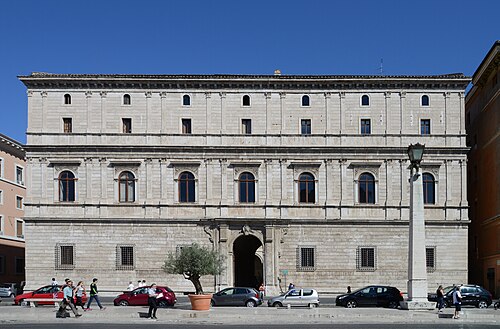
The church was located in Rome 's Borgo rione, on the east side of Piazza Scossacavalli, its facade facing west and opposite the Palazzo dei Convertendi. Its south side paralleled the Borgo Vecchio.
The church's name gave birth to a legend. When Helena (mother of Constantine the Great ) returned from her trip to the Holy Land, she brought back two stone relics : one from the presentation of Jesus at the Temple and one on which Abraham bound Isaac. The empress wanted to donate the stones to Saint Peter's Basilica, but when the convoy arrived at the site of the future church the horses ( Italian : cavalli ) refused to move further despite urging ( Italian : scossi ). A chapel hosting the stones was built, the origin of the church. The most probable reason for the name was the discovery, near the square, of a thigh from a Roman equestrian statue ( coxa caballi in Vulgar Latin ).
The church had an ancient origin: during the Middle Ages it was dedicated to the Redeemer ( Italian : Salvatore ), and was called San Salvatoris de Coxa Caballi in the papal bulls of Sergius I (r. 687–701) and Leo IV (r. 847-55). It is also mentioned in the main medieval catalogues of Roman churches, like that of Cencio Camerarius and of Paris.
According to some sources, the church could be identified with San Salvatore de Bordonia ; a bordone was the staff borne by pilgrims coming to St. Peter's. These would have left their staffs in San Giacomo before entering Saint Peter, exactly as they did after completing the Way of St. James, and this fact would explain also the late dedication to Saint James.

In 1250, relics of St. James were brought to the church and its dedication was changed. It was usually known in contemporary documents as S. Jacobus de Portico, where the Porticus in medieval Rome was the covered passage linking Saint Peter's with the Tiber ( Porticus Sancti Petri ). In 1198 Pope Innocent III (r. 1198–1216) entrusted the Chapter of Saint Peter ( Italian : Capitolo di San Pietro ) with the church's care, and in 1275 the church became a parish.
In 1520 the confraternity of the Blessed Sacrament ( Italian : Confraternita del Santissimo Sacramento ) was entrusted with the church's care. The confraternity originated in Borgo in 1509. On a windy evening of 1506, a Carmelite coming from the old Santa Maria in Traspontina church (lying near Castel Sant'Angelo ), followed by a lay brother bearing a candle, was bringing the sacramental bread to a sick person. Since the wind had extinguished the candle, the layman went into a nearby shop asking for fire, so that the priest was left alone. At the sight of the lone priest bearing the blessed Sacrament, several passers-by were moved, gathered around him and accompanied him, bearing a baldachin and torches. The group grew, and on 3 September 1509 its members formed a compagnia. The Carmelites assigned it to a chapel in Santa Maria in Traspontina, and in 1513 Pope Leo X (r. 1513–21) acknowledged the association, which in 1520 moved to San Giacomo.
The members wore clothing made from white hessian fabric ( Italian : sacchi ). It had a small figure on the left shoulder: a vermilion chalice and an image of Christ with open arms. The confraternity was committed to provide a doctor and barber to the poor of the parish, and each Holy Thursday in the church it exhibited a wax sculpture of the crucified Christ. An annual procession went to Santa Maria Sopra Minerva in Pigna, the Pauline Chapel in the Apostolic Palace and finally to St. Peter's. In 1578 Pope Gregory XIII (r. 1572–85) made the association an archconfraternity. The association's duties and privileges increased; each year beginning in 1580, the brothers gave four poor parish girls a white dress and twenty-five scudi as a dowry. In 1590, Pope Sixtus V (r.1585–90) gave the archconfraternity the privilege of setting free each year a person condemned to death..
Shortly after their assignment to San Giacomo, the brethren started to reconstruct it, choosing as architect Antonio da Sangallo the Younger, but due to lack of funds its facade was still unfinished in 1590. That year Ludovico Fulgineo, ecclesiastical referendary and governor of the archconfraternity, died, leaving his inheritance to the association. Thanks to his legacy, two years later, the construction was finished. In 1601, an oratory dedicated to Saint Sebastian was built behind the church.
San Giacomo underwent thorough restorations in the first half of the 17th century and the second half of the 18th. On 23 November 1777, the church was reconsecrated by Cardinal Henry Benedict Stuart.

It was damaged during the French occupation of Rome under Napoleon and restored in 1810 and 1880, when the stone socles were removed. In 1825 San Giacomo lost its status as a parish. In 1927 a fire damaged several works of art, and in 1929 it was assigned to the Sons of Divine Providence.
The church was demolished by 30 September 1937 for the construction of Via della Conciliazione. Its art was given to the Capitolo di San Pietro and then to the Museo Petriano; some chapel frescoes are on display at the Museo di Roma. Elements of the facade, including the 17th-century travertino portal decorated with cherubs, are in the comune storehouse at the Bastione Ardeatino. The two relics (of Isaac's sacrifice and the presentation of Jesus in the temple) were placed in the church of the Santi Michele e Magno, the national church of the Dutch in Borgo, during the early 1990s; the latter is now the church's main altar.
The church's name gave birth to a legend. When Helena (mother of Constantine the Great ) returned from her trip to the Holy Land, she brought back two stone relics : one from the presentation of Jesus at the Temple and one on which Abraham bound Isaac. The empress wanted to donate the stones to Saint Peter's Basilica, but when the convoy arrived at the site of the future church the horses ( Italian : cavalli ) refused to move further despite urging ( Italian : scossi ). A chapel hosting the stones was built, the origin of the church. The most probable reason for the name was the discovery, near the square, of a thigh from a Roman equestrian statue ( coxa caballi in Vulgar Latin ).
The church had an ancient origin: during the Middle Ages it was dedicated to the Redeemer ( Italian : Salvatore ), and was called San Salvatoris de Coxa Caballi in the papal bulls of Sergius I (r. 687–701) and Leo IV (r. 847-55). It is also mentioned in the main medieval catalogues of Roman churches, like that of Cencio Camerarius and of Paris.
According to some sources, the church could be identified with San Salvatore de Bordonia ; a bordone was the staff borne by pilgrims coming to St. Peter's. These would have left their staffs in San Giacomo before entering Saint Peter, exactly as they did after completing the Way of St. James, and this fact would explain also the late dedication to Saint James.

In 1250, relics of St. James were brought to the church and its dedication was changed. It was usually known in contemporary documents as S. Jacobus de Portico, where the Porticus in medieval Rome was the covered passage linking Saint Peter's with the Tiber ( Porticus Sancti Petri ). In 1198 Pope Innocent III (r. 1198–1216) entrusted the Chapter of Saint Peter ( Italian : Capitolo di San Pietro ) with the church's care, and in 1275 the church became a parish.
In 1520 the confraternity of the Blessed Sacrament ( Italian : Confraternita del Santissimo Sacramento ) was entrusted with the church's care. The confraternity originated in Borgo in 1509. On a windy evening of 1506, a Carmelite coming from the old Santa Maria in Traspontina church (lying near Castel Sant'Angelo ), followed by a lay brother bearing a candle, was bringing the sacramental bread to a sick person. Since the wind had extinguished the candle, the layman went into a nearby shop asking for fire, so that the priest was left alone. At the sight of the lone priest bearing the blessed Sacrament, several passers-by were moved, gathered around him and accompanied him, bearing a baldachin and torches. The group grew, and on 3 September 1509 its members formed a compagnia. The Carmelites assigned it to a chapel in Santa Maria in Traspontina, and in 1513 Pope Leo X (r. 1513–21) acknowledged the association, which in 1520 moved to San Giacomo.
The members wore clothing made from white hessian fabric ( Italian : sacchi ). It had a small figure on the left shoulder: a vermilion chalice and an image of Christ with open arms. The confraternity was committed to provide a doctor and barber to the poor of the parish, and each Holy Thursday in the church it exhibited a wax sculpture of the crucified Christ. An annual procession went to Santa Maria Sopra Minerva in Pigna, the Pauline Chapel in the Apostolic Palace and finally to St. Peter's. In 1578 Pope Gregory XIII (r. 1572–85) made the association an archconfraternity. The association's duties and privileges increased; each year beginning in 1580, the brothers gave four poor parish girls a white dress and twenty-five scudi as a dowry. In 1590, Pope Sixtus V (r.1585–90) gave the archconfraternity the privilege of setting free each year a person condemned to death..
Shortly after their assignment to San Giacomo, the brethren started to reconstruct it, choosing as architect Antonio da Sangallo the Younger, but due to lack of funds its facade was still unfinished in 1590. That year Ludovico Fulgineo, ecclesiastical referendary and governor of the archconfraternity, died, leaving his inheritance to the association. Thanks to his legacy, two years later, the construction was finished. In 1601, an oratory dedicated to Saint Sebastian was built behind the church.
San Giacomo underwent thorough restorations in the first half of the 17th century and the second half of the 18th. On 23 November 1777, the church was reconsecrated by Cardinal Henry Benedict Stuart.
Closest places in our Italy guide.
More places to explore in Italy.