
Switzerland
Viaduc de Chillon
Girder bridge · Veytaux
Water castle
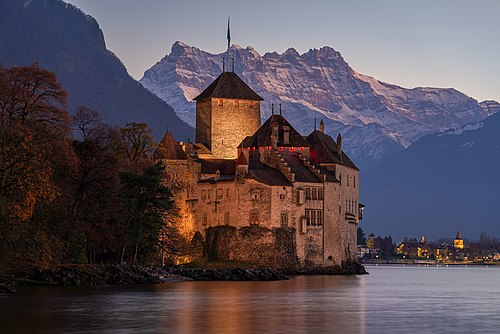
Chillon Castle (French: Château de Chillon, pronounced [ʃɑto d(ə) ʃijɔ̃]) is a medieval island castle located on Lake Geneva, south of Veytaux in the Swiss canton of Vaud. It is situated at the eastern end of the lake, on the narrow shore between Montreux and Villeneuve, which gives access to the Alpine valley of the Rhône. Chillon is amongst the most visited medieval castles in Europe. Successively occupied by the House of Savoy, then by the Bernese from 1536 until 1798, it now belongs to the canton of Vaud and is classified as a Swiss Cultural Property of National Significance.
According to the Swiss ethnologist Albert Samuel Gatschet, the name Chillon derives from the Waldensian dialect and means "flat stone, slab, platform". The name Castrum Quilonis, attested from 1195, would, therefore, mean "castle built on a rock platform".
The castle of Chillon is built on the island of Chillon, a small, steep-sided oval limestone rock that advances into Lake Geneva between Montreux and Villeneuve. The placement of the castle is strategic: it guards the passage between the Vaud Riviera [ fr ], which allows access to the north towards Germany and France, and the Rhone valley, a quick route to Italy, and offers a viewpoint over the Savoyard coast on the opposite side of the lake. A garrison could thus control (both militarily and commercially) the access to the road to Italy and apply a toll.
Chillon has been a military site since the central Middle Ages and the development of the current castle spans three periods: the Savoy Period, the Bernese Period, and the Vaudois Period.
A square donjon was built on the island in the 11th century; the identity of the works' commissioner is currently in question. It was built to control the road from Burgundy to the Great Saint Bernard Pass. A charter of 1150, in which Count Humbert III granted the Cistercians of Hautcrêt free passage to Chillon, shows that the castle was under the authority of the House of Savoy.
From the mid 12th century, the castle was the summer home for the Counts of Savoy, who kept a fleet of ships on Lake Geneva. The castle was greatly expanded in 1248 and 1266–7 by Count Peter II. During this time the distinctive windows were added by Master James of Saint George, who is believed also to have added similar windows to Harlech Castle in Wales at a later date.
The counts and dukes of Savoy used the castle as a residence but also to house prisoners. Its most famous prisoner was probably François de Bonivard, a Genevois monk, prior of St. Victor in Geneva and historian, who was imprisoned there for six years in 1530.
In 1536, the castle was captured by a Bernese army, and all the prisoners, including Bonivard, were released. The castle became the residence for the Bernese bailiff.
In 1798, the French-speaking canton of Vaud drove out the German-speaking Bernese authorities and declared the Lemanic Republic. The Vaudois invited in French troops to help them maintain autonomy from the other Swiss. When the French moved in and occupied, Chillon was used as a munitions and weapons depot.
A square donjon was built on the island in the 11th century; the identity of the works' commissioner is currently in question. It was built to control the road from Burgundy to the Great Saint Bernard Pass. A charter of 1150, in which Count Humbert III granted the Cistercians of Hautcrêt free passage to Chillon, shows that the castle was under the authority of the House of Savoy.
From the mid 12th century, the castle was the summer home for the Counts of Savoy, who kept a fleet of ships on Lake Geneva. The castle was greatly expanded in 1248 and 1266–7 by Count Peter II. During this time the distinctive windows were added by Master James of Saint George, who is believed also to have added similar windows to Harlech Castle in Wales at a later date.
The counts and dukes of Savoy used the castle as a residence but also to house prisoners. Its most famous prisoner was probably François de Bonivard, a Genevois monk, prior of St. Victor in Geneva and historian, who was imprisoned there for six years in 1530.
In 1536, the castle was captured by a Bernese army, and all the prisoners, including Bonivard, were released. The castle became the residence for the Bernese bailiff.
In 1798, the French-speaking canton of Vaud drove out the German-speaking Bernese authorities and declared the Lemanic Republic. The Vaudois invited in French troops to help them maintain autonomy from the other Swiss. When the French moved in and occupied, Chillon was used as a munitions and weapons depot.
At the end of the 19th century, a systematic restoration of the monument was undertaken, through which an ethic of monumental restoration was developed in one of the first cases of the application of archaeology and history to rebuild a structure in a historically accurate way. This was possible because of the combination of four factors:
- The involvement of pioneering specialists in restoration including Johann Rudolf Rahn, one of the founders of the Swiss Society of Historical Monuments in 1880, and Henry de Geymüller [ fr ], a specialist in Renaissance architecture who was closely associated with the restoration of buildings such as the Romanesque Church of Saint-Sulpice, Vaud [ fr ] in Saint-Sulpice, the Saint-François church [ fr ] in Lausanne, and the Lausanne Cathedral. The initial lead architect of the restoration at Chillon was Ernest Burnat, who had worked with de Geymüller in restoring Lausanne Cathedral. He initiated a general survey of the fortress, which was continued and intensified by his replacement as lead architect-archaeologist, Albert Naef [ fr ], who played a major role in the development of archaeology in the Canton of Vaud. Naef devoted twenty years to the study of Chillon. Subordinating aesthetics to historical accuracy, he undertook detailed research into historical archives and conducted extensive archaeological excavations. The process was conscientiously documented in plans, sketches, photographs, and a journal kept by Naef. Until it was abandoned in 1908 the restoration followed a painstaking process of indicating replacement stones with inscriptions on the cut stone (R Restored; RFS: Restoration facsimile; RL = Free Restoration), or by a change of colour or a red line on the masonry. Naef also restored the interior of the castle, including the tapestries of certain rooms, such as the great room of the bailiff, also called the "great Bernese kitchen".
- The creation in 1887 of The Association for the Restoration of Chillon. From the outset, the Association aimed for an "artistic" restoration with the intention of "giving back to objects the character with which they were clothed, almost a latent life, a life impression of the ideas of their time". It is also planned to create a historical museum at the castle.
- The appointment in 1889 of a Technical Commission comprising renowned art historians and architects who specialised in monument restoration. Alongside Rahn and de Geymüller, it included Théodore Fivel, architect in Chambéry and connoisseur of Savoyard castle architecture, Léo Chatelain [ fr ], restorer of the Collegiate Church of Neuchâtel [ fr ], and State architect Henri Assinare. The Commission first met on 27 October 1890 and closely supervised the restoration over subsequent years. De Geymüller played a key role in its success. Drawing on principles published in 1865, and enhanced in 1888, by the Royal Institute of British Architects, he established a framework in the Milestones for the Restoration Program printed in Lausanne in 1896. Naef also joined the Technical Commission on the death of Fivel in 1895.
- The adoption by the Canton of Vaud in 1898 of a law on historic monuments, the first of its kind in Switzerland, which planned to establish a cantonal Commission for historic monuments and to create a cantonal archeologist's post. Naef, who drafted the law, was the first appointee to this function and was responsible for putting in place protection of historical monuments. The result was judged to be exemplary. In an 1898 lecture to the Zurich Antiquity Society, Johann Rudolf Rahn boasted about it, while the German Emperor, William II, inquired about the Chillon model when planning the reconstruction of the fortress of Haut-Koenigsbourg. Due to these restorations, the castle is in excellent condition and is a good model of feudal architecture.
From the end of the 18th century, the castle attracted romantic writers and inspired poets from around the world, including Jean-Jacques Rousseau, Victor Hugo, Alexandre Dumas, Gustave Flaubert, Mary Shelley and Lord Byron. By 1939, helped by its proximity to the popular tourist destination Montreux, the castle was attracting over 100,000 visitors a year. By 2005, this number had increased to 300,000.
Closest places in our Switzerland guide.
More places to explore in Switzerland.


