
Australia
Gabarnmung
Archaeological site · Northern Territory
Indigenous cultural heritage site

Wurrwurrwuy stone arrangements is a heritage-listed indigenous site at Yirrkala, Northern Territory, Australia. It is also known as Wurrwurrwuy. It was added to the Northern Territory Heritage Register on 15 August 2007 and to the Australian National Heritage List on 9 August 2013.
During his circumnavigation of Australia in 1802–1803 Matthew Flinders found bamboo frameworks, lines of stone fireplaces, pieces of cloth and the stumps of trees cut down with metal axes, at a number of places along the coast of the Gulf of Carpentaria. He interpreted this as evidence of Chinese visits to this part of Australia. On 16 February 1803, he met a fleet of Macassan praus anchored in the waters off the English Company Islands group. It was here that he learnt from Pobassoo, the captain of the fleet, that Macassan praus came to the coast of northern Australia every year on the north-west monsoon winds to collect and dry trepang or bêche de mer which they then sold to the Chinese.
Interactions between Aboriginal people and Macassans
Main article: Makassan contact with Australia
Flinders' encounter with Pobassoo is the first Australian record of the north Australian trepang industry. Macassans had probably started to visit the northern Australian coast before 1650 but Dutch East India Company documents suggest that the intensive catching and processing of trepang for the Chinese market probably began in about 1750. Macassan involvement in the industry ended in 1906 when the South Australian Government, which administered the Northern Territory at that time, restricted the issuing of licenses to locally owned vessels.
The distribution of tamarind trees (an exotic species), trepang processing sites and the depiction of Macassan praus and other items of Macassan material culture in rock art provide direct material evidence for the Macassan trepang industry. Trepang processing sites are found on the Kimberley coast and on the Arnhem Land and Groote Eylandt coasts. While depictions of praus and items of Macassan material culture are not unusual in the rock art of Arnhem Land and offshore islands like Groote Eylandt, Chasm Island and Bickerton Island, such images are rare in the Kimberley. These data and Aboriginal oral tradition suggest that the relationship between Macassans and Aborigines in the Kimberley was different to the relationship between Macassans and Yolngu with the former relationship characterised by hostility.
Aboriginal people in Arnhem adopted a number of items of Macassan material culture including dugout canoes and iron. This transformed Aboriginal economies so they had an increased marine focus. This is shown by the large numbers of dugong and turtle bones in middens on the Coburg Peninsula that date from the time of the Macassan trepang industry and an increased marine focus on Groote Eylandt. There is also evidence for changes in the way Aboriginal people used space and evidence for changes in their exchange networks.
Aboriginal people living in Arnhem Land incorporated the memory of Macassans into their social and cultural life. For example, Macassans and their voyages are important in some ceremonies and song cycles where songs may reference Muslim prayers. Oral tradition also provides accounts of Aboriginal people working for Macassans on trepang sites and undertaking voyages on praus to the Celebes and further afield. The close relationship between Macassans and Aborigines is reflected in the large number of Macassan borrowed words found in Aboriginal languages in Arnhem Land and on Groote Eylandt which includes words for different parts of praus and the rigging on these vessels. Aboriginal people in these areas use the Macassan names for some parts of praus and their rigging that are depicted in rock art.
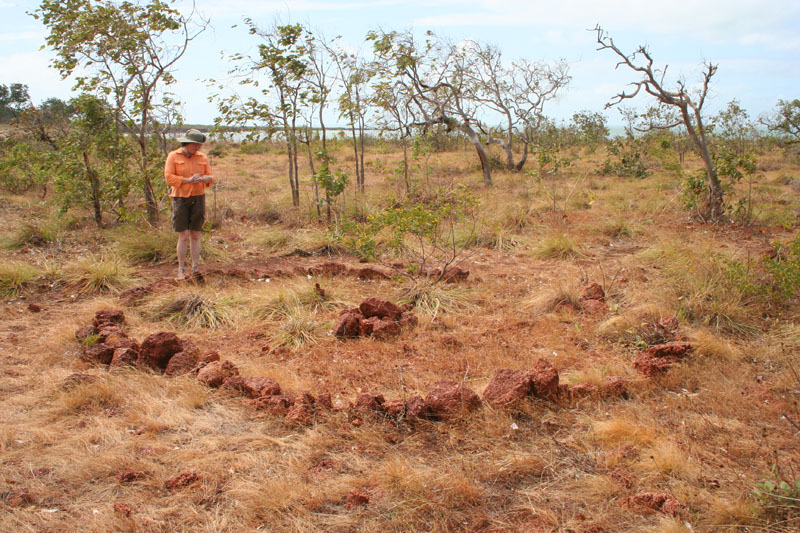
The stone pictures at Wurrwurrwuy are part of the story of Macassan Aboriginal interactions in Arnhem Land. They lie within the territory of the Lamomirri clan but on the death of the last responsible Lamomirri man they were taken into the custody of the Gumatj clan. A father and son, Yumbul and Dhatalamirri, created the pictures, probably in the second half of the nineteenth century. Oral histories recorded in 1967 indicate that Yumbul, possibly with the aid of some of his fellow clansmen, made the first pictures. The site was entrusted to his second son, Dhatalamirri, who added further pictures at a later date.
The stone pictures created by Yumbul and Dhatalamirri depict Macassan praus, canoes, houses with multiple rooms, fireplaces where trepang were boiled, trepang drying houses, a house for storing wood, and stones for sharpening iron knives. There are also pictures of an Aboriginal fish trap and Aboriginal dwellings that may not have been made by the father and son.
When Macknight and Grey recorded the site in 1967, two Aboriginal informants, Munggurrawuy (a Gumatj custodian) and Mawalan (a relative of Yumbul and Dhatalamirri), were able to explain how the divisions within the pictures of the praus represented different parts of the vessel: the crews' quarters, the galley, the eating space, the store and the water tank. They also provided Macassan names for the different parts of praus, the rudder, bowsprit and the tripod mast with its sail and rigging. These pictures show that Yolngu visited trepang sites and spent enough time on praus to learn the various parts of the vessels and where the crew lived and ate. This is consistent with historical records showing that Aboriginal people travelled in praus to the Celebes, a trip that was made by Munggurrawuy's father. The custodians told Macknight and Gray that Wurrwurrwuy was a legacy from the past with no sacred associations. They felt that it was useful as it provided younger men with some idea of the way of life of Macassans who had come to the area to collect trepang. The pictures are a permanent reminder of Yolngu knowledge about this past.
Main article: Makassan contact with Australia
Flinders' encounter with Pobassoo is the first Australian record of the north Australian trepang industry. Macassans had probably started to visit the northern Australian coast before 1650 but Dutch East India Company documents suggest that the intensive catching and processing of trepang for the Chinese market probably began in about 1750. Macassan involvement in the industry ended in 1906 when the South Australian Government, which administered the Northern Territory at that time, restricted the issuing of licenses to locally owned vessels.

The distribution of tamarind trees (an exotic species), trepang processing sites and the depiction of Macassan praus and other items of Macassan material culture in rock art provide direct material evidence for the Macassan trepang industry. Trepang processing sites are found on the Kimberley coast and on the Arnhem Land and Groote Eylandt coasts. While depictions of praus and items of Macassan material culture are not unusual in the rock art of Arnhem Land and offshore islands like Groote Eylandt, Chasm Island and Bickerton Island, such images are rare in the Kimberley. These data and Aboriginal oral tradition suggest that the relationship between Macassans and Aborigines in the Kimberley was different to the relationship between Macassans and Yolngu with the former relationship characterised by hostility.
Aboriginal people in Arnhem adopted a number of items of Macassan material culture including dugout canoes and iron. This transformed Aboriginal economies so they had an increased marine focus. This is shown by the large numbers of dugong and turtle bones in middens on the Coburg Peninsula that date from the time of the Macassan trepang industry and an increased marine focus on Groote Eylandt. There is also evidence for changes in the way Aboriginal people used space and evidence for changes in their exchange networks.
Aboriginal people living in Arnhem Land incorporated the memory of Macassans into their social and cultural life. For example, Macassans and their voyages are important in some ceremonies and song cycles where songs may reference Muslim prayers. Oral tradition also provides accounts of Aboriginal people working for Macassans on trepang sites and undertaking voyages on praus to the Celebes and further afield. The close relationship between Macassans and Aborigines is reflected in the large number of Macassan borrowed words found in Aboriginal languages in Arnhem Land and on Groote Eylandt which includes words for different parts of praus and the rigging on these vessels. Aboriginal people in these areas use the Macassan names for some parts of praus and their rigging that are depicted in rock art.
are part of the story of Macassan Aboriginal interactions in Arnhem Land. They lie within the territory of the Lamomirri clan but on the death of the last responsible Lamomirri man they were taken into the custody of the Gumatj clan. A father and son, Yumbul and Dhatalamirri, created the pictures, probably in the second half of the nineteenth century. Oral histories recorded in 1967 indicate that Yumbul, possibly with the aid of some of his fellow clansmen, made the first pictures. The site was entrusted to his second son, Dhatalamirri, who added further pictures at a later date.
The stone pictures created by Yumbul and Dhatalamirri depict Macassan praus, canoes, houses with multiple rooms, fireplaces where trepang were boiled, trepang drying houses, a house for storing wood, and stones for sharpening iron knives. There are also pictures of an Aboriginal fish trap and Aboriginal dwellings that may not have been made by the father and son.
When Macknight and Grey recorded the site in 1967, two Aboriginal informants, Munggurrawuy (a Gumatj custodian) and Mawalan (a relative of Yumbul and Dhatalamirri), were able to explain how the divisions within the pictures of the praus represented different parts of the vessel: the crews' quarters, the galley, the eating space, the store and the water tank. They also provided Macassan names for the different parts of praus, the rudder, bowsprit and the tripod mast with its sail and rigging. These pictures show that Yolngu visited trepang sites and spent enough time on praus to learn the various parts of the vessels and where the crew lived and ate. This is consistent with historical records showing that Aboriginal people travelled in praus to the Celebes, a trip that was made by Munggurrawuy's father. The custodians told Macknight and Gray that Wurrwurrwuy was a legacy from the past with no sacred associations. They felt that it was useful as it provided younger men with some idea of the way of life of Macassans who had come to the area to collect trepang. The pictures are a permanent reminder of Yolngu knowledge about this past.
Wurrwurrwuy stone arrangements is at about 1.41ha, 10 km south east of Yirrkala, being those parts of Northern Territory Portions 1044 and 1692 designated Northern Territory Portion 6647(A).
Closest places in our Australia guide.
More places to explore in Australia.


.jpg?width=1200)

.jpg?width=1200)
.jpg?width=1200)
.jpg?width=1200)


