
Australia
Hay War Memorial High School
Secondary school · New South Wales
Historical cultural heritage site

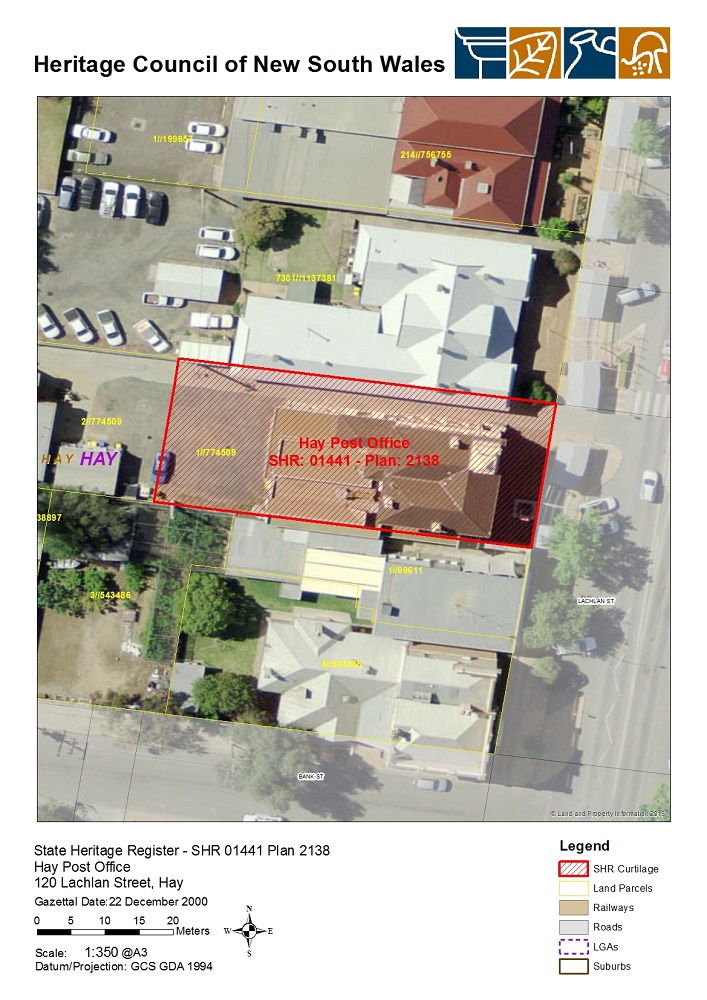
Hay Post Office is a heritage-listed post office at 120 Lachlan Street, Hay, New South Wales, Australia. It was designed by the Colonial Architect's Office under James Barnet, and built by E. Noble and Co. The ground floor is leased by Australia Post.
British occupation of the area In 1829 Charles Sturt and his men passed along the Murrumbidgee River on horses and drays. During the late-1830s stock was regularly overlanded to South Australia via the Lower Murrumbidgee. At the same time stockholders were edging westward along the Lachlan, Murrumbidgee, Billabong and Murray systems. By 1839 all of the river frontages in the vicinity of present-day Hay were occupied by squatters. By the mid-1850s pastoral runs in the western Riverina were well-established and prosperous. The nearby Victorian gold rush provided an expanding market for stock. The prime fattening country of the Riverina became a sort of holding centre, from where the Victorian market could be supplied as required.
The locality where Hay township developed was originally known as Lang's Crossing-place (named after three brothers named Lang who were leaseholders of runs on the southern side of the river). It was the crossing on the Murrumbidgee River of a well-travelled stock-route (known as 'the Great North Road') leading to the markets of Victoria. In 1856/57 Captain Francis Cadell, pioneer of steam-navigation on the Murray River, placed a manager at Lang's Crossing-place with the task of establishing a store (initially in a tent). In August 1858 steamers owned by rival owners, Francis Cadell and William Randell, successfully travelled up the Murrumbidgee as far as Lang's Crossing-place (with Cadell's steamer Albury continuing up-river to Gundagai ). By October 1859 Hay had been chosen as the name for the township [after John Hay, a wealthy squatter from the Upper Murray, member of the New South Wales Legislative Assembly and former Secretary of Lands and Works]. Hay, situated on the Murrumbidgee, was gazetted as a town in 1859. In the late nineteenth century, several grand buildings representing Hay's aspirations to become the capital of the Riverina were built. However inter-colonial disputes over trade thwarted these aspirations and instead of booming Hay remained small and isolated, but importantly connected to Sydney via the Hay railway line.
The first official postal service in Australia was established in April 1809, when the Sydney merchant Isaac Nichols was appointed as the first Postmaster in the colony of NSW. Prior to this, mail had been distributed directly by the captain of the ship on which the mail arrived, however this system was neither reliable nor secure.
In 1825 the colonial administration was empowered to establish a Postmaster General 's Department, which had previously been administered from Britain.
In 1828 the first post offices outside of Sydney were established, with offices in Bathurst, Campbelltown, Parramatta, Liverpool, Newcastle, Penrith and Windsor. By 1839 there were forty post offices in the colony, with more opened as settlement spread. During the 1860s, the advance of postal services was further increased as the railway network began to be established throughout NSW. In 1863, the Postmaster General W. H. Christie noted that accommodation facilities for Postmasters in some post offices was quite limited, and stated that it was a matter of importance that "post masters should reside and sleep under the same roof as the office".
The first telegraph line was opened in Victoria in March 1854 and in NSW in 1858. The NSW colonial government constructed two lines from the General Post Office, Sydney, one to the South Head Signal Station, the other to Liverpool. Development was slow in NSW compared to the other states, with the Government of New South Wales concentrating on the development of country offices before suburban ones. As the line spread, however, telegraph offices were built to accommodate the operators. Unlike the post office, the telegraph office needed specialised equipment and could not be easily accommodated in a local store or private residence. Post and telegraph offices operated separately until 1870 when the departments were amalgamated, after which time new offices were built to include both postal and telegraph services. In 1881 the first telephone exchange was opened in Sydney, three years after the first tests in Adelaide. As with the telegraph, the telephone system soon began to extend into country areas, with telephone exchanges appearing in country NSW from the late 1880s onwards. Again the Post Office was responsible for the public telephone exchange, further emphasising its place in the community as a provider of communications services.
The appointment of James Barnet as Acting Colonial Architect in 1862 coincided with a considerable increase in funding to the public works program. Between 1865 and 1890 the Colonial Architects Office was responsible for the building and maintenance of 169 Post Offices and telegraph offices in NSW. The post offices constructed during this period featured in a variety of architectural styles, as Barnet argued that the local parliamentary representatives always preferred "different patterns".
The construction of new post offices continued throughout the 1890s depression years under the leadership of Walter Liberty Vernon, who held office from 1890 to 1911. While twenty-seven post offices were built between 1892 and 1895, funding to the Government Architect's Office was cut from 1893 to 1895, causing Vernon to postpone a number of projects.
Following Federation in 1901, the Commonwealth Government took over responsibility for post, telegraph and telephone offices, with the Department of Home Affairs Works Division being made responsible for post office construction. In 1916 construction was transferred to the Department of Works & Railways, with the Department of the Interior responsible during World War II.

On 22 December 1975, the Postmaster General's Department was abolished and replaced by the Postal & Telecommunications Department with Australia Post and Telecom established. In 1989, the Australian Postal Corporation Act established Australia Post as a self-funding entity, heralding a new direction in property management, including a move away from the larger more traditional buildings towards smaller shop-front style post offices.
For much of its history, the post office has been responsible for a wide variety of community services including mail distribution, an agency for the Commonwealth Savings Bank, electoral enrolments, and the provision of telegraph and telephone services. The town post office has served as a focal point for the community, most often built in a prominent position in the centre of town close to other public buildings, creating a nucleus of civic buildings and community pride.
The town of Hay grew up around what was an important crossing on the Murrumbidgee River. Known as Langs Crossing, it was a major ford for droving cattle from Queensland across the river to the developing Victoria goldfields. With regular traffic crossing the river, a small settlement began to develop to serve the drovers. Captain Francis Cadell, a local landowner and river boat operator, made the first representations for a Post Office in the late 1850s. Cadell approached the Post Master General George Macleay for a post office, suggesting Alex Dunbar who looked after Cadell's store, as postmaster. This first request was rejected by the PMG, which preferred to wait until the town was officially gazetted until approving an office.
Hay was gazetted in 1859, being named after the local member of parliament Sir John Hay. With Hay an official town, the first postal service could commence. A weekly delivery between Condobolin and Hay began from 1 April 1859, with the delivery place being Cadell's store. The first postmaster appointed to Hay was Robert Neilson who had taken over the duties of Alex Dunbar at Cadell's store after Dunbar returned to England. Neilson resigned his position as postmaster in 1861, as the workload of running a store and the post office was too much. In 1862 the then postmaster Alfred Prince, who was manager of Cadell's former store (now owned by Mr Bardwell), operated the Post Office out of a new purpose-built, brick extension adjacent to the store.
In April 1864 a telegraph station was opened in Hay. Around this time, Alfred Prince resigned as postmaster and Bardwell acted as a temporary replacement. In January 1865 a temporary officer was sent to Hay from Sydney and operated the post office out of the telegraph station, a government-owned building. At this stage the postal and telegraph departments operated as separate government departments and subsequently usually operated out of separate buildings. With this in mind, a number of local businessmen in Hay offered to locate the post office within their businesses, at the charge of (Pounds)1 per week. However, it was decided that the local telegraph operator, C. A. Middleton, would also act as postmaster, with post and telegraph services operating out of the same building.

In 1869 Middleton was promoted to a position in Wagga and was replaced by E. D. Scott as Post and Telegraph Master. Scott received an assistant in 1870 after complaining to the Post Master General that his duties as post and telegraph master were too much for one person. Scott was responsible for repairing damaged telegraph lines in the district and would often be called away from the Post Office, leaving his wife in charge of the Post Office and the telegraph office closed. Scott was granted £25 per annum to pay for an assistant, but left the job soon after being replaced by W. H. Hilliard, who in turn was replaced in December 1870 by R. S. Arnott.
During the late nineteenth century, Hay was developing as an important centre for the Riverina. The improvements to community services were a direct result of this economic and population growth. In 1876 the Government Savings Bank opened a branch in the Hay Post Office, and it was recommended that a new post and telegraph office be erected. The following year, a postal inspector visited Hay and recommended that a new building be erected in Moppett Street at the rear of the Court House. The Hay Council rejected this site in August 1878 as being too isolated, with a site in Lachlan Street being suggested instead. Meanwhile, extensions had been made to the old building.
The site that the Council proposed was the site of the existing post and telegraph office. Adjacent to this site was the former Hay lock-up that was being replaced by a Hay Gaol, then in the course of construction. It was this site that was decided on for the new office. Tenders were called and early in 1881 the tender of E. Noble & Co. was adopted for erection of the new building at an estimated cost of £3,030. Designed by Colonial Architect James Barnet, the new post and telegraph building was completed and occupied by 18 December 1882. An iron-rail fence and stabling were added a couple of years later.
In 1890 a clock, which had been removed from the Bathurst Post Office, was placed on the balcony. This clock proved unreliable and it was decided to erect a clock tower to house a new clock. In July 1901 the clock tower was completed with a new four dial clock and hour bell installed at a total cost of £495. The design of the clock tower was possibly undertaken by the NSW Government Architect's Office under Walter Liberty Vernon. A local watchmaker, Mr Hardingham, was given the contract to wind and regulate the clock for £8 per annum.
In 1974 the Post Office was extensively renovated and restored, which included the addition of public telephone boxes on the southern side. In 1979 the office was classified by the National Trust of Australia (NSW). In 1988 Hay Post Office was painted in a sympathetic colour scheme and a pergola with climbing plants was constructed on the footpath at the front of the building.
Closest places in our Australia guide.
More places to explore in Australia.


.jpg?width=1200)
.jpg?width=1200)
.jpg?width=1200)


