Greece
Pavlos Vrellis Greek History Museum
Wax museum · Bizani municipality
Archaeological site

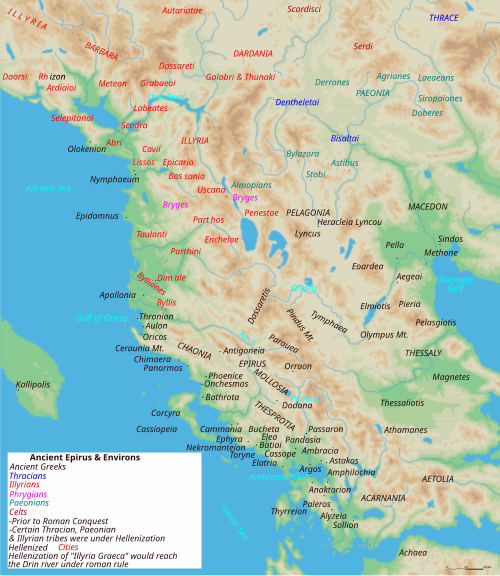
Dodona (; Doric Greek: Δωδώνα, romanized: Dōdṓnā, Ionic and Attic Greek: Δωδώνη, Dōdṓnē) in Epirus in northwestern Greece was the oldest Hellenic oracle, possibly dating to the 2nd millennium BCE according to Herodotus. The earliest accounts in Homer describe Dodona as an oracle of Zeus. Situated in a remote region away from the main Greek poleis, it was considered second only to the Oracle of Delphi in prestige. Aristotle considered the region around Dodona to have been part of Hellas and the region where the Hellenes originated. The oracle was first under the control of the Thesprotians before it passed into the hands of the Molossians. It remained an important religious sanctuary until the rise of Christianity during the Late Roman era.
During classical antiquity, according to various accounts, priestesses and priests in the sacred grove interpreted the rustling of the oak (or beech) leaves to determine the correct actions to be taken. According to a new interpretation, the oracular sound originated from bronze objects hanging from oak branches and sounded with the wind blowing, similar to a wind chime.
According to Nicholas Hammond, Dodona was an oracle devoted to a Mother Goddess (identified at other sites with Rhea or Gaia, but here called Dione ) who was joined and partly supplanted in historical times by the Greek deity Zeus.
Although the earliest inscriptions at the site date to c. 550–500 BCE, archaeological excavations conducted for more than a century have recovered artifacts as early as the Mycenaean era, many now at the National Archaeological Museum of Athens, and some in the nearby Archaeological Museum of Ioannina. There was an ancient tradition that Dodona was founded as a colony from the city, also named Dodona, in Thessaly.
Cult activity at Dodona was already established in some form during the Late Bronze Age (or Mycenaean period). Mycenaean offerings such as bronze objects of the 14th and 13th centuries were brought in Dodona. A 13th century cist tomb with squared shoulders was found at Dodona; it had no context, but a Mycenaean sherd of c. 1200 B.C. was also unearthed on the site, in association with kylix stems. Archaeological evidence shows that the cult of Zeus was established around the same time. During the post-Mycenaean period (or " Greek Dark Ages "), evidence of activity at Dodona is scant, but there is a resumption of contact between Dodona and southern Greece during the Archaic period (8th century BCE) with the presence of bronze votive offerings (i.e. tripods ) from southern Greek cities. Dedication to the Oracle of Dodona arrived from most of the Greek world including its colonies. Although an adjacent area there were few Illyrian dedication most probably because the Oracle preferred interaction with the Greek world. Until 650 BCE, Dodona was a religious and oracular centre mainly for northern tribes; only after 650 BCE did it become important for the southern tribes.
Zeus was worshipped at Dodona as "Zeus Naios" or "Naos" (god of the spring below the oak in the temenos or sanctuary, cf. Naiads ) and as "Zeus Bouleus" (Counsellor). According to Plutarch, the worship of Jupiter (Zeus) at Dodona was set up by Deucalion and Pyrrha.
The earliest mention of Dodona is in Homer, and only Zeus is mentioned in this account. In the Iliad (circa 750 BCE), Achilles prays to "High Zeus, Lord of Dodona, Pelasgian, living afar off, brooding over wintry Dodona" (thus demonstrating that Zeus also could be invoked from a distance). No buildings are mentioned, and the priests (called Selloi ) slept on the ground with unwashed feet. No priestesses are mentioned in Homer.
The oracle also features in another passage involving Odysseus, giving a story of his visit to Dodona. Odysseus's words "bespeak a familiarity with Dodona, a realization of its importance, and an understanding that it was normal to consult Zeus there on a problem of personal conduct."
The details of this story are as follows. Odysseus says to the swineherd Eumaeus (possibly giving him a fictive account) that he (Odysseus) was seen among the Thesprotians, having gone to inquire of the oracle at Dodona whether he should return to Ithaca openly or in secret (as the disguised Odysseus is doing). Odysseus later repeats the same tale to Penelope, who may not yet have seen through his disguise.
According to some scholars, Dodona was originally an oracle of the Mother Goddess attended by priestesses. She was identified at other sites as Rhea or Gaia. The oracle also was shared by Dione. By classical times, Dione was relegated to a minor role elsewhere in classical Greece, being made into an aspect of Zeus's more usual consort, Hera — but never at Dodona.
Many dedicatory inscriptions recovered from the site mention both "Dione" and "Zeus Naios".
According to some archaeologists, it was not until the 4th century BCE that a small stone temple to Dione was added to the site. By the time Euripides mentioned Dodona (fragmentary play Melanippe ) and Herodotus wrote about the oracle, the priestesses had appeared at the site.
Over 4200 oracular tablets have been found in Dodona, written in different alphabets, and dated approximately between the mid-6th and early 2nd centuries BCE. All the texts were written in Greek, and attest to over 1200 personal names from different areas; these were almost exclusively Greek, with non-Greek names (e.g. Thracian, Illyrian) making up around 1% of the total.
Though it never eclipsed the Oracle of Apollo at Delphi, Dodona gained a reputation far beyond Greece. In the Argonautica of Apollonius of Rhodes, a retelling of an older story of Jason and the Argonauts, Jason's ship, the " Argo ", had the gift of prophecy, because it contained an oak timber spirited from Dodona.
In c. 290 BCE, King Pyrrhus made Dodona the religious capital of his domain and beautified it by implementing a series of construction projects (i.e. grandly rebuilt the Temple of Zeus, developed many other buildings, added a festival featuring athletic games, musical contests, and drama enacted in a theatre). A wall was built around the oracle itself and the holy tree, as well as temples to Dione and Heracles.
In 219 BCE, the Aetolians, under the leadership of General Dorimachus, looted and set fire to the sanctuary. During the late 3rd century BCE, King Philip V of Macedon (along with the Epirotes) reconstructed all the buildings at Dodona. In 167 BCE, the Molossian cities and possibly Dodona itself were destroyed by the Romans (led by Aemilius Paulus). A fragment of Dio Cassius reports that Thracian soldiers instigated by King Mithridates sacked the sanctuary ca. 88 BCE. In the reign of the emperor Augustus the site was prominent enough to feature an honorary statue of Livia. The 2nd century CE traveller Pausanias noted a sacred oak tree of Zeus. In 241 CE, a priest named Poplius Memmius Leon organized the Naia festival of Dodona. In 362 CE, Emperor Julian consulted the oracle prior to his military campaigns against the Persians.
Pilgrims still consulted the oracle until 391-392 CE when Emperor Theodosius closed all pagan temples, banned all pagan religious activities, and cut down the ancient oak tree at the sanctuary of Zeus. Although the surviving town was insignificant, the long-hallowed pagan site must have retained significance for Christians given that a bishop of Dodona named Theodorus attended the First Council of Ephesus in 431 CE.
Panorama of the theatre of Dodona, the modern village Dodoni and the snow-capped Mount Tomaros are visible in the background
Although the earliest inscriptions at the site date to c. 550–500 BCE, archaeological excavations conducted for more than a century have recovered artifacts as early as the Mycenaean era, many now at the National Archaeological Museum of Athens, and some in the nearby Archaeological Museum of Ioannina. There was an ancient tradition that Dodona was founded as a colony from the city, also named Dodona, in Thessaly.
Cult activity at Dodona was already established in some form during the Late Bronze Age (or Mycenaean period). Mycenaean offerings such as bronze objects of the 14th and 13th centuries were brought in Dodona. A 13th century cist tomb with squared shoulders was found at Dodona; it had no context, but a Mycenaean sherd of c. 1200 B.C. was also unearthed on the site, in association with kylix stems. Archaeological evidence shows that the cult of Zeus was established around the same time. During the post-Mycenaean period (or " Greek Dark Ages "), evidence of activity at Dodona is scant, but there is a resumption of contact between Dodona and southern Greece during the Archaic period (8th century BCE) with the presence of bronze votive offerings (i.e. tripods ) from southern Greek cities. Dedication to the Oracle of Dodona arrived from most of the Greek world including its colonies. Although an adjacent area there were few Illyrian dedication most probably because the Oracle preferred interaction with the Greek world. Until 650 BCE, Dodona was a religious and oracular centre mainly for northern tribes; only after 650 BCE did it become important for the southern tribes.
Closest places in our Greece guide.
More places to explore in Greece.