Belgium
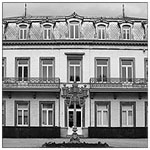
Leopold II Gallery
Monument · Spa
Municipality of Belgium
Spa
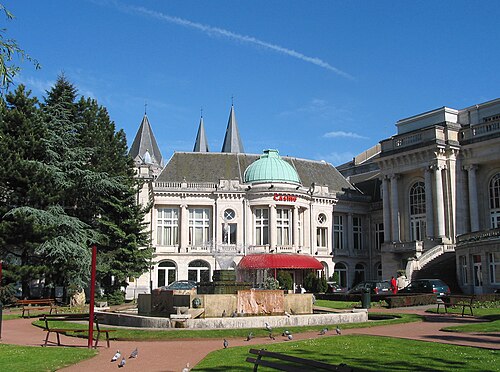
Spa (French pronunciation: [spa] ; Walloon: Spå) is a municipality and city of Wallonia in the province of Liège, Belgium, whose name became an eponym for mineral baths with supposed curative properties. It is in a valley in the Ardennes mountains 35 km (22 mi) south-east of Liège and 45 km (28 mi) south-west of Aachen. In 2006, Spa had a population of 10,543 and an area of 39.85 km2 (15.39 sq mi), giving a population density of 265/km2 (690/sq mi). Spa is one of Belgium's most popular tourist destinations, being renowned for its natural mineral springs, and production of "Spa" mineral water, which is exported worldwide. The motor-racing Circuit de Spa-Francorchamps, just south of the nearby village of Francorchamps, also hosts the annual Formula One Belgian Grand Prix and various endurance races such as the 24 Hours of Spa. The world's first beauty pageant, the Concours de Beauté, was held in Spa on 19 September 1888. The town also hosted the Tour de France on 5 July 2010, when stage 2 of the race ended there. In 2021, Spa became part of the transnational UNESCO World Heritage Site the Great Spa Towns of Europe, for its famous mineral springs and architectural testimony to the rise...
Among the various hypotheses put forward as to the etymological origin of the name Spa is that of "gushing spring", from the Latin sparsa meaning "scattered" and "gushing", past participle of spargere ("scatter", "sprinkle" or "moisten"). Another connects the word to the meaning of "free space", from the Walloon spâ and from the Latin spatia, plural of spatium.
The place has been known since Roman times, when the location was called Aquae Spadanae. For this reason, the city's name is sometimes presented as the acronym of various Latin phrases, such as salus per aquam or sanitas per aquam, meaning "health through water"; it is in reality a backronym, an a posteriori fabrication of a fictitious acronym.
The term Spa has since become eponymous with any place having a natural water source that is believed to possess special health-giving properties, known as a spa.
As the site of cold springs with alleged healing properties, Spa has been frequented as a "water-taking" place since classical antiquity. Pliny the Elder (died 79 CE) noted, "There is a famous spring in Tungri, a state of Gaul, whose water, sparkling with bubbles, has a ferruginous taste that is only noticeable when the drink is finished. This water purges the body, cures third-grade fevers and dispels calculous affections. The same water, put on the fire, becomes cloudy and eventually turns red." (C lib. XXXI VIII)
The spa town grew in the Middle Ages, in the oldest iron and steel centre of Liège Province. The ban Spa was created around 1335 and included two urban concentrations: vilhe of Creppe and vilhe Spas, 2 km (1.2 mi) away. Prior to the exploitation of mineral water, the steel industry developed communication lines, which made it possible to develop the spa town. [ citation needed ]
As early as 1547, Agustino, physician to the King of England, Henry VIII, stayed in Spa and helped give knowledge to the world of the value of the Spa water. In 1559, Gilbert Lymborh wrote of "acid fountains of the Ardennes forest and primarily those located in Spa". It was translated into Latin, Italian and Spanish. In July 1565, the gentry of the provinces met in Spa under the pretext of taking the waters. At the hotel "Aux Armes d’Angleterre", those present agreed to oppose the edicts of Philip II as austere and intolerant; this led to the historic 1566 " Compromise of Nobles ". In 1654, the stay of the exiled pretender to the English throne, Prince Charles, brought even greater fame to Spa. From 1699, a postal system was set up between Spa and the outside world. [ citation needed ]
Since the 18th century, casinos have been located in Spa. The town continued to grow as a fashionable resort in the 19th century, and was extended during the reign of King Leopold II. Buildings such as the Thermal Baths (1868), the Pouhon Peter the Great (1880), and the Leopold II Gallery (1880) date from this period.
During World War I, Spa operated as an important German convalescent hospital town between 1914 and 1917. In 1918, the German Army established its principal headquarters in Spa, and from there the delegates set out for the French lines to meet Marshal Foch and to sue for peace in the consultations leading up to the Armistice that ended the First World War. The general headquarters of Kaiser Wilhelm II were, in 1918, the last place where he resided before his abdication due to the German surrender. In July 1920, the town hosted the Spa Conference, a meeting of the Supreme Council, which dealt with the war reparations owed by the defeated Reich to the Allies. [ citation needed ]
The Circuit de Spa-Francorchamps was established in 1921, in the vicinity of Spa. Despite its name, the racetrack has never been located within Spa: it is instead in the nearby town of Stavelot.
World War II saw Spa reoccupied by the Germans, but the town escaped the Battle of the Bulge in 1945 that stopped, luckily for Spa, right at its gates. The Marshall Plan helped Belgium to recover quickly. In the 1950s and 1960s, mass tourism gradually developed, diminishing Spa's reliance on the elite as customers. These were decades of social tourism as well, with an increasingly large number of Flemish and Dutch customers, while the Walloons went en masse to the Belgian coast in Flanders. Relaxation tourism replaced the thermal aspect of Spa. [ citation needed ]
The 1980s and 1990s heralded the start of a renewal of the infrastructure and influence of Spa. On 17 May 1983, to mark the 400th anniversary of the export of Spa waters, HM King Baudouin visited the new facilities of the Spa Monopole SA, the Henrijean Hydrology Institute and the Thermal Establishment. In 1994, a new French song festival started: Les Francofolies de Spa. In 1997, the area of Spa-Bérinzenne opened the Regional Center for Initiation to the Environment, one of whose specialties is water.
The old Thermal Baths were closed in 2004. In 2005, a new thermal center, Thermoludism, opened on the Annette and Lubin hill with panoramic views of the city. It is directly linked by funicular to the heart of the city and a new luxury hotel.
In 2007, the Spa-Francorchamps circuit completely renewed its infrastructure to comply with the best international standards, allowing it to continue to host the annual Belgian Formula One Grand Prix 1, in addition to many other annual sporting events.
As the site of cold springs with alleged healing properties, Spa has been frequented as a "water-taking" place since classical antiquity. Pliny the Elder (died 79 CE) noted, "There is a famous spring in Tungri, a state of Gaul, whose water, sparkling with bubbles, has a ferruginous taste that is only noticeable when the drink is finished. This water purges the body, cures third-grade fevers and dispels calculous affections. The same water, put on the fire, becomes cloudy and eventually turns red." (C lib. XXXI VIII)
The spa town grew in the Middle Ages, in the oldest iron and steel centre of Liège Province. The ban Spa was created around 1335 and included two urban concentrations: vilhe of Creppe and vilhe Spas, 2 km (1.2 mi) away. Prior to the exploitation of mineral water, the steel industry developed communication lines, which made it possible to develop the spa town. [ citation needed ]
As early as 1547, Agustino, physician to the King of England, Henry VIII, stayed in Spa and helped give knowledge to the world of the value of the Spa water. In 1559, Gilbert Lymborh wrote of "acid fountains of the Ardennes forest and primarily those located in Spa". It was translated into Latin, Italian and Spanish. In July 1565, the gentry of the provinces met in Spa under the pretext of taking the waters. At the hotel "Aux Armes d’Angleterre", those present agreed to oppose the edicts of Philip II as austere and intolerant; this led to the historic 1566 " Compromise of Nobles ". In 1654, the stay of the exiled pretender to the English throne, Prince Charles, brought even greater fame to Spa. From 1699, a postal system was set up between Spa and the outside world. [ citation needed ]
Since the 18th century, casinos have been located in Spa. The town continued to grow as a fashionable resort in the 19th century, and was extended during the reign of King Leopold II. Buildings such as the Thermal Baths (1868), the Pouhon Peter the Great (1880), and the Leopold II Gallery (1880) date from this period.
During World War I, Spa operated as an important German convalescent hospital town between 1914 and 1917. In 1918, the German Army established its principal headquarters in Spa, and from there the delegates set out for the French lines to meet Marshal Foch and to sue for peace in the consultations leading up to the Armistice that ended the First World War. The general headquarters of Kaiser Wilhelm II were, in 1918, the last place where he resided before his abdication due to the German surrender. In July 1920, the town hosted the Spa Conference, a meeting of the Supreme Council, which dealt with the war reparations owed by the defeated Reich to the Allies. [ citation needed ]
The Circuit de Spa-Francorchamps was established in 1921, in the vicinity of Spa. Despite its name, the racetrack has never been located within Spa: it is instead in the nearby town of Stavelot.
Closest places in our Belgium guide.
More places to explore in Belgium.