Germany
Hohenschwangau Castle
Château · Schwangau
Palace
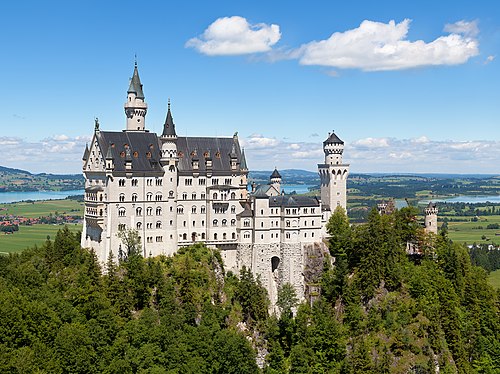
Neuschwanstein Castle (German: Schloss Neuschwanstein, pronounced [ˈʃlɔs nɔʏˈʃvaːnʃtaɪn]; Southern Bavarian: Schloss Neischwanstoa; lit. 'Newswanstone') is a 19th-century historicist palace on a rugged hill of the foothills of the Alps in the very south of Germany, near the border with Austria. It is located in the Swabia region of Bavaria, in the municipality of Schwangau, above the incorporated village of Hohenschwangau, which is also the location of Hohenschwangau Castle. The closest larger town is Füssen. The castle stands above the narrow gorge of the Pöllat stream, east of the Alpsee and Schwansee lakes, close to the mouth of the Lech into Lake Forggensee. Since 2025, the castle is part of the UNESCO World Heritage Site "The Palaces of King Ludwig II of Bavaria: Neuschwanstein, Linderhof, Schachen and Herrenchiemsee". According to Guinness World Records, at 65 metres (213 feet), it is the tallest castle in the world. Despite the main residence of the Bavarian monarchs at the time—the Munich Residenz—being one of the most extensive palace complexes in the world, King Ludwig II of Bavaria felt the need to escape from the constraints he saw himself exposed to in Munich, and commissioned...
The municipality of Schwangau lies at an elevation of 800 m (2,620 ft) at the southwest border of the German state of Bavaria. Its surroundings are characterised by the transition between the Alpine foothills in the south (toward the nearby Austrian border) and a hilly landscape in the north that appears flat by comparison. In the Middle Ages, three castles overlooked the villages. One was called Schwanstein Castle. In 1832, Ludwig's father, King Maximilian II of Bavaria, bought its ruins to replace them with the comfortable neo-Gothic palace known as Hohenschwangau Castle. Finished in 1837, the palace became his family's summer residence, and his elder son Ludwig (born 1845) spent a large part of his childhood here.
Vorderhohenschwangau Castle and Hinterhohenschwangau Castle sat on a rugged hill overlooking Schwanstein Castle, two nearby lakes (Alpsee and Schwansee), and the village. Separated by only a moat, they jointly consisted of a hall, a keep, and a fortified tower house. In the 19th century, only ruins remained of the twin medieval castles; those of Hinterhohenschwangau served as a lookout place known as Sylphenturm.
The ruins above the family palace were known to the crown prince from his excursions. He first sketched one of them in his diary in 1859. When the young king ascended the throne in 1864, the construction of a new palace in place of the two ruined castles became the first in his series of palace building projects. He called the new palace New Hohenschwangau Castle. Only after Ludwig's death was it renamed Neuschwanstein, which confusingly resulted in Hohenschwangau and Schwanstein effectively swapping names: his father's Hohenschwangau Castle replaced the ruins of Schwanstein Castle, and Neuschwanstein Castle replaced the ruins of the two original Hohenschwangau Castles.
Neuschwanstein embodies both the contemporaneous architectural fashion known as castle Romanticism ( German : Burgenromantik ) and King Ludwig II's enthusiasm for the operas of Richard Wagner. In the 19th century, many castles were constructed or reconstructed, often with significant changes, to make them more picturesque. Palace-building projects similar to Neuschwanstein had been undertaken earlier in several of the German states and included Hohenschwangau Castle, Lichtenstein Castle, Hohenzollern Castle, and numerous buildings on the Rhine, such as Stolzenfels Castle. Marienburg Castle, begun in 1858 for the King of Hanover, was completed in 1867. The more detailed inspiration for the construction of Neuschwanstein came from two journeys that Ludwig took in 1867: one in May to the reconstructed Wartburg near Eisenach, site of the mythical Sängerkrieg and thus setting of Wagner's opera Tannhäuser and the Singers' Contest at Wartburg, and another in July to the Château de Pierrefonds, which Eugène Viollet-le-Duc was transforming from a ruined castle into a historicist palace for Napoleon III.

Ludwig believed both buildings represented a Romanticist interpretation of the Middle Ages, as well as the musical mythology of his friend Wagner, whose operas Tannhäuser and Lohengrin had made a lasting impression on him. In February 1868, Ludwig's grandfather, King Ludwig I, died, freeing the considerable sums that were previously spent on the abdicated King's appanage. This allowed Ludwig II to start the architectural project of building a private refuge in the familiar landscape far from the capital Munich, so that he could live out his idea of the Middle Ages. In a letter to Richard Wagner in May 1868, Ludwig wrote:
It is my intention to rebuild the old castle ruin of Hohenschwangau near the Pöllat Gorge in the authentic style of the old German knights' castles, and I must confess to you that I am looking forward very much to living there one day (in 3 years);... you know the revered guest I would like to accommodate there; the location is one of the most beautiful to be found, holy and unapproachable, a worthy temple for the divine friend who has brought salvation and true blessing to the world. It will also remind you of "Tannhäuser" (Singers' Hall with a view of the castle in the background), "Lohengrin'" (castle courtyard, open corridor, path to the chapel)
The building design was drafted by the stage designer Christian Jank and realised by the architect Eduard Riedel. For technical reasons, the ruined castles could not be integrated into the plan. Initial ideas for the palace drew stylistically on Nuremberg Castle and envisaged a simple building in place of the old Vorderhohenschwangau Castle, but they were rejected and replaced by increasingly extensive drafts, culminating in a bigger palace modelled on the Wartburg. The king insisted on a detailed plan and on personal approval of each and every draft. Ludwig's control went so far that the palace has been regarded as his own creation rather than that of the architects involved. Whereas contemporary architecture critics derided Neuschwanstein, one of the last big palace building projects of the 19th century, as kitsch, Neuschwanstein and Ludwig II's other buildings are now counted among the major works of European historicism. For financial reasons, a project similar to Neuschwanstein— Falkenstein Castle —never got past the planning stages.
The palace can be regarded as typical of 19th-century architecture. The shapes of Romanesque (simple geometric figures such as cuboids and semicircular arches), Gothic (upward-pointing lines, slim towers, delicate embellishments), and Byzantine architecture and art (the Throne Hall décor) were mingled in an eclectic fashion and supplemented with 19th-century technical achievements. The Patrona Bavariae and Saint George on the court face of the Palas (main building) are depicted in the local Lüftlmalerei style, a fresco technique typical for Allgäu farmers' houses, while the unimplemented drafts for the Knights' House gallery foreshadow elements of Art Nouveau. Characteristic of Neuschwanstein's design are theatre themes: Christian Jank drew on coulisse drafts from his time as a scenic painter. The basic style was first planned to be neo-Gothic but the palace was primarily built in Romanesque style in the end. The operatic themes moved gradually from Tannhäuser and Lohengrin to Parsifal.
In 1868, the ruins of the medieval twin castles were completely demolished; the remains of the old keep were blown up. The foundation stone for the palace was laid on 5 September 1869; in 1872, its cellar was completed, and in 1876, everything up to the first floor, the gatehouse being finished first. At the end of 1882, it was completed and fully furnished, allowing Ludwig to take provisional lodgings there and observe the ongoing construction work. In 1874, management of the civil works passed from Eduard Riedel to Georg von Dollmann. The topping out ceremony for the Palas was in 1880, and in 1884 the King moved in to the new building. In the same year, the direction of the project passed to Julius Hofmann [ de ], after Dollmann had fallen from the King's favour. The palace was erected as a conventional brick construction and later encased in various types of rock. The white limestone used for the fronts came from a nearby quarry.

The sandstone bricks for the portals and bay windows came from Schlaitdorf in Württemberg. Marble from Untersberg near Salzburg was used for the windows, the arch ribs, the columns and the capitals. The Throne Hall was a later addition to the plans and required a steel framework. The transport of building materials was facilitated by scaffolding and a steam crane that lifted the material to the construction site. Another crane was used at the construction site. The recently founded Dampfkessel-Revisionsverein (Steam Boiler Inspection Association) regularly inspected both boilers.
For about two decades, the construction site was the principal employer in the region. In 1880, about 200 craftsmen were occupied at the site, not counting suppliers and other persons indirectly involved in the construction. At times when the King insisted on particularly close deadlines and urgent changes, reportedly up to 300 workers per day were active, sometimes working at night by the light of oil lamps. Statistics from the years 1879/1880 support an immense amount of building materials: 465 tonnes (513 short tons ) of Salzburg marble, 1,550 t (1,710 short tons) of sandstone, 400,000 bricks and 2,050 cubic metres (2,680 cu yd) of wood for the scaffolding. In 1870, a society was founded for insuring the workers, for a low monthly fee, augmented by the King. The heirs of construction casualties (30 cases are mentioned in the statistics) received a small pension.
In 1884, the King moved into the (still unfinished) Palas, and in 1885 he invited his mother Marie to Neuschwanstein on the occasion of her 60th birthday. By 1886, the external structure of the Palas (hall) was mostly finished. In the same year, Ludwig had the first, wooden Marienbrücke over the Pöllat Gorge replaced by a steel construction.
Despite its size, Neuschwanstein did not have space for the royal court but contained only the King's private lodging and servants' rooms. The court buildings served decorative rather than residential purposes: The palace was intended to serve King Ludwig II as a kind of inhabitable theatrical setting. As a temple of friendship, it was also dedicated to the life and work of Richard Wagner, who died in 1883 without visiting the building. In the end, Ludwig II lived in the palace for a total of only 172 days.
The King's demands expanded during the construction of Neuschwanstein, and so did the expenses. Drafts and estimated costs were revised repeatedly. Initially a modest study was planned instead of the great throne hall, and projected guest rooms were struck from the drafts to make place for a Moorish Hall, which could not be realised due to lack of resources. Completion was originally projected for 1872 but repeatedly deferred.

Neuschwanstein, the symbolic medieval knight's castle, was not King Ludwig II 's only huge construction project. It was followed by the Rococo style Lustschloss of Linderhof Palace and the Baroque palace of Herrenchiemsee, a monument to the era of absolutism. Linderhof, the smallest of the projects, was finished in 1886, and the other two remain incomplete. All three projects together drained his resources. The King paid for his construction projects by private means and from his civil list income. Contrary to frequent claims, the Bavarian treasury was not directly burdened by his buildings. From 1871, Ludwig had an additional secret income in return for a political favour given to Otto von Bismarck.
The construction costs of Neuschwanstein in the King's lifetime amounted to 6.2 million German gold marks (equivalent to €47 million in 2021), almost twice the initial cost estimate of 3.2 million marks. As his private means were insufficient for his increasingly escalating construction projects, the King continuously opened new lines of credit. In 1876, a court counselor was replaced after pointing out the danger of insolvency. By 1883, he already owed 7 million marks, and in spring 1884 and August 1885 debt conversions of 7.5 million marks and 6.5 million marks, respectively, became necessary.
Even after his debts had reached 14 million marks, King Ludwig II insisted on continuation of his architectural projects; he threatened suicide if his creditors seized his palaces. In early 1886, Ludwig asked his cabinet for a credit of 6 million marks, which was denied. In April, he followed Bismarck's advice to apply for the money to his parliament. In June, the Bavarian government decided to depose the King who was living at Neuschwanstein at the time. On 9 June, he was incapacitated and on 10 June, he had the deposition commission arrested in the gatehouse. In expectation of the commission, he alerted the gendarmerie and fire brigades of surrounding places for his protection. A second commission headed by Bernhard von Gudden arrived on the next day, and the King was forced to leave the palace that night. Ludwig was put under the supervision of Gudden. On 13 June, both died under mysterious circumstances in the shallow shore water of Lake Starnberg near Berg Castle.
At the time of King Ludwig's death, the palace was far from complete. The external structures of the Gatehouse and the Palas were mostly finished but the Rectangular Tower was still scaffolded. Work on the Bower had not started but was completed in a simplified form by 1892 without the planned figures of the female saints. The Knights' House was also simplified. In King Ludwig's plans, the columns in the Knights' House gallery were held as tree trunks and the capitals as the corresponding crowns. Only the foundations existed for the core piece of the palace complex: a keep of 90 metres (300 ft) height planned in the upper courtyard, resting on a three- nave chapel. This was not realised, and a connection wing between the Gatehouse and the Bower saw the same fate. Plans for a castle garden with terraces and a fountain west of the Palas were also abandoned after the King's death.
The interior of the royal living space in the palace was mostly completed in 1886; the lobbies and corridors were painted in a simpler style by 1888. The Moorish Hall, which was desired by the King and planned below the Throne Hall, was not realised any more than the Knights' Bath, which was modelled after the Knights' Bath in the Wartburg and was intended to render homage to the knights' cult as a medieval baptism bath. A Bride Chamber in the Bower (after a location in Lohengrin ), guest rooms in the first and second floor of the Palas and a great banquet hall were further abandoned projects. In fact, a complete development of Neuschwanstein had never even been planned, and at the time of the King's death there was not a utilisation concept for numerous rooms.
Closest places in our Germany guide.
More places to explore in Germany.