
Poland
St. Lawrence's Church
Church building · Warsaw
Eastern Orthodox church building

The St. John Climacus's Orthodox Church (Polish: Cerkiew św. Jana Klimaka, Russian: Церковь Святого Иоанна Лествичника, romanized: Tserkov Svyatogo Ioanna Lestvichnika) in Warsaw is an Orthodox parish church belonging to the Warsaw deanery of the diocese of Warsaw-Bielsk within the Polish Orthodox Church. It is located at 140 Wolska Street in the Ulrychów area of Wola district, inside the Orthodox cemetery. The church was built from 1903 to 1905 at the initiative of the Archbishop of Warsaw Hieronymus Ekziemplarski as a burial place for his son Ivan and for the future church hierarchy, as well as serving as a church for cemetery funerals and church services for the deceased. The Orthodox parish became associated with Russian rule during the interwar period where many Orthodox churches were demolished or closed. Except for the period between 1915 and 1919, the church continued services almost uninterrupted. It was damaged during World War II, and during the Wola massacre the Germans murdered its priests, their families, and the children from the Orthodox orphanage run by the parish. The building was designed by Vladimir Pokrovsky. It mimics the appearance of 17th-century church buildings...
The Orthodox church was founded as a private effort by the Archbishop of Warsaw Hieronymus within the cemetery in Wola. It was built to act as an auxiliary to St. Lawrence's Church, which had been confiscated from the Catholics after the November Uprising, but its immediate purpose was to commemorate the deceased son of the archbishop, Ivan Ilyich Ekzemplarskii.
In 1903, the archbishop acquired a plot of land with an area of 1237 square fathoms situated at the eastern cemetery wall by Wolska Street, which cost 4275 rubles. On June 28, 1903, the foundation stone was laid. It was designed by architect Vladimir Pokrovsky, and the building of the church and the iron fence surrounding it were entirely financed by the Archbishop of Warsaw. Construction was completed in June 1905, but the consecration, also conducted by the Archbishop, was delayed until October 15, 1905. Two weeks later, the Archbishop also died. In accordance with his wishes, he was buried next to his son. The ceremony, which took place in the unfinished church, was led by the Archbishop of Vilnius and Lithuania Nikander and the Bishop of Chelm Eulogius. As well as Orthodox believers, Catholics and Jews were also at the funeral.
In 1915, all Orthodox priests working in Warsaw were evacuated, and therefore the church was closed. It was looked after by Nikanor Skibin.
In 1919, Father Antoni Rudlewski came to Warsaw from Łódź to become pastor at the Church of the Holy Trinity in Podwale (Cerkiew Świętej Trójcy na Podwalu) and to regularly celebrate liturgy there. At his request, Father Jan Kowalenko also came to Warsaw and he took care of the church in Wola. At his initiative, the bell tower was erected in 1931 (the bells weigh 354 kg). Due to the return of some churches to Catholic ownership and others being demolished after the Russians left, the church in Wola became – along with the St. Mary Magdalene Cathedral in Praga – one of two free-standing Orthodox churches remaining in Warsaw.

In 1923, the murdered Metropolitan of Warsaw, Jerzy Jaroszewski, was buried in the church.
The church, especially its lower part, was often used as a refuge for civilians during the defence of Warsaw in September 1939. The church also served as a hiding place for the civilian population during the Warsaw Uprising.
On August 5, 1944, during the Wola massacre, the pastor Archimandrite Teofan (Protasiewicz) and one of his priests, Father Antoni Kaliszewicz and his family were killed there. German troops also murdered the children of the Orthodox orphanage run by the parish, its employees, and dozens of people from the nearby neighbourhood hiding in the lower part of the church, and burned their bodies. A mass grave of children and staff of the orphanage is located at the church on Wolska Street.
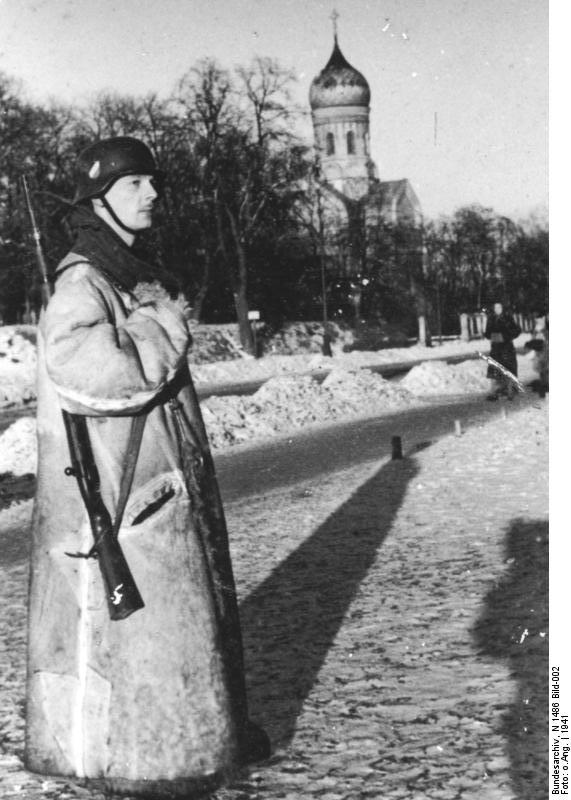
German soldiers repeatedly took part in acts of vandalism, including stealing the church's bells. After these events, the church was abandoned and remained unattended until January 1945.
Continuing the efforts of his predecessor, Father Aleksander Czubuk-Podolski became the new pastor of the parish in Wola at the end of 1945 and served until 1948. At the beginning of the next decade, the technical condition of the church building was described as good, however it needed restoration.

In the 1950s, two Tchorek plaques commemorating the victims of the Wola massacre were placed in the cemetery and on Wolska Street.
In the 1960s the church was completely renovated. In 1964, the facade and its dome underwent renovation. In 1966 the interior of the building was rebuilt including a choir with a painting depicting Christ's prayer in the wilderness. In the same decade, the parish of St. John Climacus organized Orthodox religious teaching for school-age children, with classes held in the church (the pastoral facility did not have a parish house). In the early 70s around 30 children were taking part in these classes.
On the night of May 22 and on May 23, 1968, unknown perpetrators broke into the building, stealing a number of historic icons, and Orthodox items.
In 1977 the lower church was renovated. In December 1978, the building was re-dedicated because of the extensive renovations. The ceremony presided over by the Metropolitan of Warsaw and the entire Polish basilica accompanied by Archimandrite Atanazy (Kudiuk), the superior of the monastery in Zhyrovichy ( Russian Orthodox Church ), and a group of their priests. Repair works were still happening after the ordination of the building. In 1980, frescoes at the top of the church were completed after seven years, while in 1987 the older belfry structure was replaced, designed by Michał Sandowicz. The next year, the church's millennium celebrations of the baptism of Rus' were held, where in addition to the attending Orthodox clergy, representatives of other Christian Churches also attended. A plaque inside the church commemorates the event.
In the 90s further repairs were carried out, including the restoration of frescoes in the upper church. On December 5, 1999, after the completion of the work, this was re-consecrated by the Metropolitan of Warsaw and leader of the Polish church, Metropolitan Sawa (Hrycuniak).
In 2009, on the western side of the building, a plaque in honour of Orthodox believers who died during World War II was unveiled.
In 2014, the lower part of the church was renovated again, replacing flooring and painting the ceiling. Efforts are underway for to restore Jerzy Nowosielski's frescoes due to their poor condition because of mould and damp.
The Orthodox church was founded as a private effort by the Archbishop of Warsaw Hieronymus within the cemetery in Wola. It was built to act as an auxiliary to St. Lawrence's Church, which had been confiscated from the Catholics after the November Uprising, but its immediate purpose was to commemorate the deceased son of the archbishop, Ivan Ilyich Ekzemplarskii.
In 1903, the archbishop acquired a plot of land with an area of 1237 square fathoms situated at the eastern cemetery wall by Wolska Street, which cost 4275 rubles. On June 28, 1903, the foundation stone was laid. It was designed by architect Vladimir Pokrovsky, and the building of the church and the iron fence surrounding it were entirely financed by the Archbishop of Warsaw. Construction was completed in June 1905, but the consecration, also conducted by the Archbishop, was delayed until October 15, 1905. Two weeks later, the Archbishop also died. In accordance with his wishes, he was buried next to his son. The ceremony, which took place in the unfinished church, was led by the Archbishop of Vilnius and Lithuania Nikander and the Bishop of Chelm Eulogius. As well as Orthodox believers, Catholics and Jews were also at the funeral.
In 1915, all Orthodox priests working in Warsaw were evacuated, and therefore the church was closed. It was looked after by Nikanor Skibin.
Closest places in our Poland guide.
More places to explore in Poland.


