Hungary
Hungarian National Gallery
Art museum · Budapest
Fortress

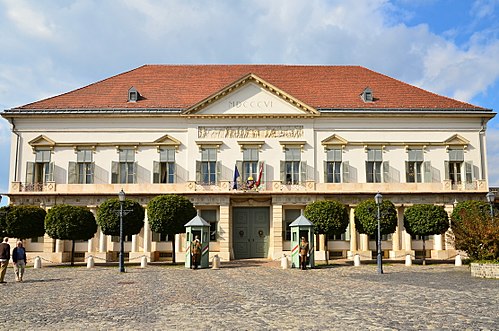
Buda Castle (Hungarian: Budavári Palota, German: Burgpalast), formerly also called the Royal Palace (Hungarian: Királyi-palota) and the Royal Castle (Hungarian: Királyi Vár, German: Königliche Burg), is the historical castle and palace complex of the Hungarian kings in Budapest. First completed in 1265, the Baroque palace that occupies most of the site today was built between 1749 and 1769, severely damaged during the Siege of Budapest in World War II, and rebuilt in a simplified Baroque style during the state communist era. Presently, it houses the Hungarian National Gallery, the Budapest Historical Museum, and the National Széchényi Library. The palace complex sits on the southern tip of Castle Hill (Hungarian: Várhegy). Its defensive walls extend to surround the entire Castle Quarter (Várnegyed) neighborhood to its north, which is well known for its medieval, Baroque, and neoclassical houses, churches, and other monuments. Several prominent government buildings, including Sándor Palace and the Carmelite Monastery of Buda, are located in the Castle Quarter. Locally, this neighborhood and the palace are collectively called a Vár (lit. 'the Castle'). Castle Hill is linked to Clark Ádám...
Main article: Medieval Royal Palace (Buda Castle)
The first royal residence on the Castle Hill was built by King Béla IV of Hungary between 1247 and 1265. It is uncertain whether it was situated on the southern tip of the hill or on the northern elevation, near the Kammerhof.
The oldest part of the present-day palace was built in the 14th century by Stephen, Duke of Slavonia, who was the younger brother of King Louis I of Hungary. Only the foundations remain of the castle keep, which was known as Stephen's Tower (Budapest) [ hu ] ' (Hungarian: István-torony ). The Gothic palace of King Louis I was arranged around a narrow courtyard next to the keep.
King Sigismund significantly enlarged the palace and strengthened its fortifications. Sigismund, as a Holy Roman Emperor, needed a magnificent royal residence to express his prominence among the rulers of Europe. He chose Buda Castle as his main residence, and during his long reign it became probably the largest Gothic palace of the late Middle Ages. Buda was an important artistic centre of the International Gothic style.
Construction began in the 1410s and was largely finished in the 1420s, although some minor works continued until the death of the king in 1437. The palace was first mentioned in 1437, under the name " fricz palotha ".
The most important part of Sigismund's palace was the northern wing, known as the Fresh Palace (Hun: Friss-palota ). On the top floor was a large hall called the Roman Hall (70 × 20 m or 230 × 66 ft) with a carved wooden ceiling. Great windows and balconies faced toward the city of Buda. The façade of the palace was decorated with statues, a and coat-of-arms. In front stood the bronze equestrian statue of Sigismund, later repaired by King Matthias Corvinus.
The southern part of the royal residency was surrounded with narrow zwingers. Two parallel walls, the so-called "cortina walls", run down from the palace to the River Danube across the steep hillside. The most imposing structure, the Broken Tower (Hun: Csonka-torony ), on the western side of the cour d'honneur, remained unfinished. The basement of the tower was used as a dungeon ; the top floors were probably the treasury of the royal jewels.
The last phase of large-scale building activity took place under King Matthias Corvinus. During the first decades of his reign the king finished the work on the Gothic palace. The Royal Chapel, with the surviving Lower Church, was likely built at that time.
After the marriage of Matthias and Beatrice of Naples in 1476, Italian humanists, artists and craftsmen arrived at Buda. The Hungarian capital became the first centre of Renaissance north of the Alps. The king rebuilt the palace in an early Renaissance style. The cour d'honneur was modernised and an Italian loggia was added. Inside the palace were two rooms with golden ceilings: the Bibliotheca Corviniana and a passage with the frescoes of the twelve signs of the Zodiac. The façade of the palace was decorated with statues of John Hunyadi, László Hunyadi and King Matthias. In the middle of the court there was a fountain with a statue of Pallas Athene.
Only fragments remain of this Renaissance palace: some red marble balustrades, lintels and decorative glazed tiles from stoves and floors.
In the last years of his reign Matthias Corvinus started construction of a new Renaissance palace on the eastern side of the Sigismund Courtyard, next to the Fresh Palace. The Matthias Palace remained unfinished because of the king's early death. The palace had a monumental red marble stairway in front of the façade. Matthias Corvinus was usually identified with Hercules by the humanists of his court; the bronze gates were decorated with panels depicting the deeds of Hercules, and a great bronze statue of the Greek hero welcomed the guests in the forecourt of the palace complex, where jousts were held.
The walled gardens of the palace were laid out on the western slopes of the Castle Hill. In the middle of the enclosure, a Renaissance villa was built by Matthias. Only one column survives of this so-called Aula Marmorea.
After the death of Matthias Corvinus, his successor, King Vladislaus II, carried on the works of the Matthias Palace, especially after his marriage with Anna of Foix-Candale in 1502.
Under the reign of King John Zápolya (the last national ruler of Hungary) the palace was repaired. On the southern tip of the Castle Hill, the Great Rondella was built by Italian military engineers. The circular bastion is one of the main surviving structure of the old palace.
After the Battle of Mohács, the medieval Kingdom of Hungary collapsed. The Ottoman Turks occupied the evacuated town on 11 September 1526. Although Buda was sacked and burned, the Royal Palace was not damaged. Sultan Suleiman the Magnificent carried away all the bronze statues (the Hunyadis, Pallas Athene and Hercules) with him to Constantinople. The statues were destroyed there in a rebellion a few years later. The Sultan also took many volumes from the Bibliotheca Corviniana.
In 1529 the Ottoman army besieged and occupied Buda again, and the palace was badly damaged. On 29 August 1541 Buda was occupied again by the Ottomans, without any resistance. Buda became part of Ottoman Empire and the seat of the Budin Eyalet. The original German and Hungarian population left the city, immigrants from the Ottoman Empire and the Balkan peninsula came to their place.
Although Turkish travel writers wrote enthusiastically about the beauty of the palace of the Hungarian kings, the new Ottoman government let the palace decay. It was partially used as barracks a storage place and stables, and otherwise it stood empty.
The palace was called Iç Kala ("Inner Castle") and Hisar Peçe ("Citadel") by the Turks. The name of the cour d'honneur was "Seray meydani". The favourite nickname of the complex was "Palace of the Golden Apples".
The economic decline of Buda was characterised by the stagnation of population, which was not larger in 1686, than the population of the city two centuries earlier in the 15th century. The Ottomans allowed the Hungarian royal palace to fall into ruins. The disused palace was later transformed into a gunpowder storage and magazine by the Ottomans, which caused its detonation during the siege in 1686. The original Christian Hungarian population did not feel secure during the Ottoman conquest, their numbers significantly shrank in the next decades, due to their fleeing to the Habsburg ruled Royal Hungary. The proportion of the population who were of Jews and Gypsy families increased during the Ottoman rule in Buda.
Closest places in our Hungary guide.
More places to explore in Hungary.