
Australia
Beelu National Park
National park of Australia · Western Australia
Astronomical observatory

The Perth Observatory is the name of two astronomical observatories located in Western Australia (WA). In 1896, the original observatory was founded in West Perth on Mount Eliza overlooking the city of Perth (obs. code 319). Due to the city's expansion, the observatory moved to Bickley in 1965. The new Perth Observatory is sometimes referred to as Bickley Observatory (obs. code 322, 323).
The original Perth Observatory was constructed in 1896 and was officially opened in 1900 by John Forrest, the first premier of Western Australia. The observatory was located at Mount Eliza overlooking the city of Perth. Its chief roles were keeping Standard Time for Western Australia and meteorological data collection. The observatory dome was demolished in the 1960s to make way for Dumas House, after the Observatory of the city was relocated elsewhere. The house of the chief astronomer of the old observatory remains today, the current tenant is the National Trust.
William Ernest Cooke was appointed the first Western Australian Government Astronomer in 1896 after a similar posting at the Adelaide Observatory. On arrival in Perth, his first task was to determine the exact latitude and longitude of the colony. He was also able to determine the time of day with greater accuracy. Before his arrival clocks could vary by up to half an hour. The time was announced each day by a cannon still present on the grounds. The design was by the government architect, George Temple-Poole, and features a bold combination of styles. [ citation needed ]
Cooke's successor as Government Astronomer was Harold Curlewis who wrote in 1929:
Since the prevailing winds blow over the huge extent of King's Park, its excellence for astronomical work is not impaired by its proximity to the city, as is so often the case with other observatories....A glance from the tower, from which a wonderful panorama of Perth may be obtained, shows that no growth of the city can ever adversely affect observing conditions
See also: Western Australia border In 1920 and 1921 Curlewis was involved with the Government Astronomer of South Australia, Dodwell, in determinations to fix positions for marking of the West Australian border on the ground with the South Australian border at Deakin, Western Australia. In 1921 the same group from the Deakin determinations travelled by the State Ship, MV Bambra to Wyndham, where they were guided by M.P. Durack to a point on Rosewood station near Argyle Downs close to the 129th meridian east longitude ( 129° east ). They used the relatively new technology of the day, wireless radio time signals, and other methods to fix a position for the Northern Territory border with Western Australia.
These early determinations led to the 1968 agreement for the formation of Surveyor Generals Corner.
The WA border is not straight (see Western Australia border ) ; at the 26th parallel south ( 26° south ) there is an approximately 127-metre (417 ft) "sideways" section of the WA / NT border, which runs east–west.
Curlewis's successor as Government Astronomer was Hyman Solomon Spigl between 1940 and 1962. Spigl, who was from a surveying background, progressed rebuilding a post war ravaged Observatory by rejuvenating the time service, seismology services, completing the Astrographic Catalogues, became involved in the International Geophysical Year by installing a Markowitz Moon camera and restarted the publications for the Royal Astronomical Society. Additionally, through a National Science Foundation of America grant, he was in the process of refurbishing the Observatory's 150-millimetre (6 in) meridian transit circle to recommence meridian observations. While he never achieved this before his death, and it was never used again, the instrument sits in the foyer of the Perth Observatory now fully refurbished.
In 1958 Spigl was awarded a Gledden Travelling Fellowship by the University of Western Australia ; Spigl spent 12 months travelling in the US, UK and Europe. Spigl was actively searching for a new site for the Perth Observatory as a result of the decision for it to be relocated as an outcome of the implementation of the 1955 Stephenson-Hepburn Report. Spigl spent many years lecturing in surveying at the University of Western Australia and was involved in the Astronomical Society of Western Australia.
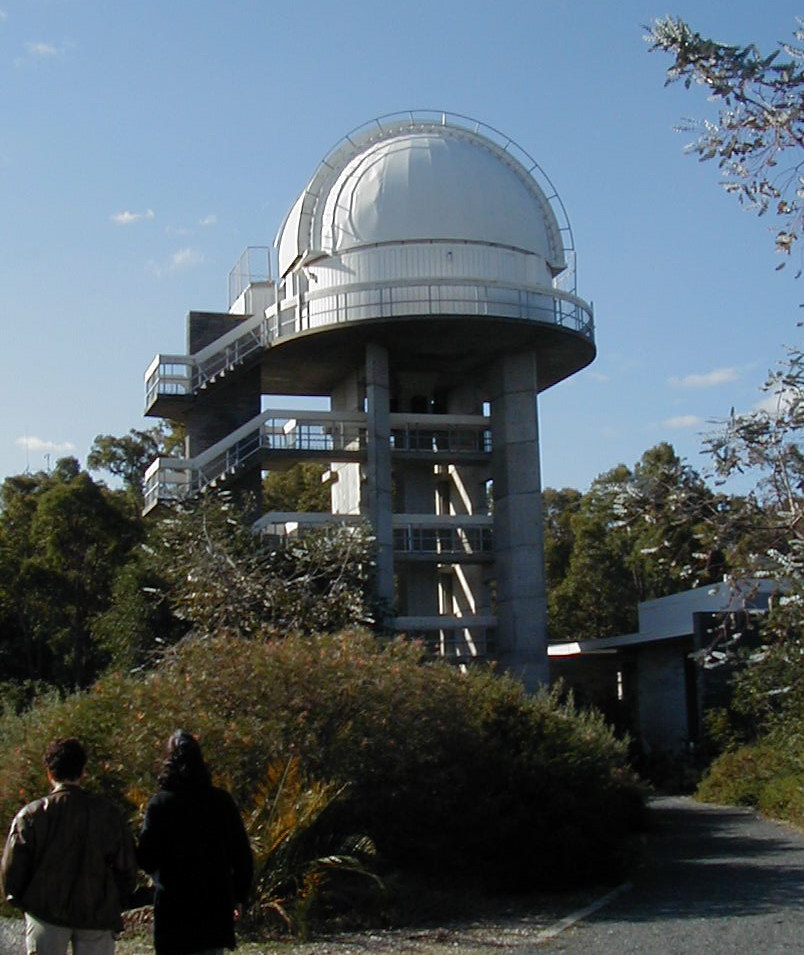
Upon the death of Spigl on 20 August 1962, John Bertrand Harris, who had been Spigl's assistant since 1957, became the fourth Government Astronomer of the Perth Observatory between 1962 until the end of 1974. Harris had to step in to the position of Government Astronomer at a time when the Perth Observatory was on the move to its new site in the Darling Range, Bickley, some 24 kilometres (15 mi) east of its original position in the City of Perth. Clearing of the land in the State Forrest in Bickely commenced in February 1964, with excavations commencing in May 1964 and construction works on buildings continuing through 1965; staff moved in on 19 December 1965.
With the new Bickely site complete, in 1967, Harris oversaw the installation of a meridian circle telescope at the Observatory as part of an expedition by astronomers from the Hamburg Observatory in Germany. The expedition worked on the international Southern Reference Stars program that resulted in a revised, larger and more accurate meridian catalogue of the Southern Hemisphere : the Perth 70 meridian catalogue. In 1970 Harris was successful in forming a dedicated Perth Observatory Meridian section to assist the German expedition in their work. After the German expedition left over the 1971/72 Christmas/New Year period, Harris successfully negotiated the loan of the Hamburg telescope indefinitely and obtained funding from the Government of Western Australia to increase the Meridian staff numbers. This Perth Observatory Meridian team continued and expanded on the German expedition work, resulting in the Perth 75 meridian catalogue.
In 1967, Harris worked with the University of Western Australia to install a 410-millimetre (16 in) telescope at the Observatory that was built and used by the University of Western Australia staff and students, as well as Perth Observatory astronomers.
Harris then moved the astrographic telescope, which had been in storage since August 1963, to the new site after arranging its refurbishment; the telescope recommenced observations on 29 March 1968, taking second epoch photographic plates for proper motion studies.
In 1968, the Lowell Observatory of Flagstaff Arizona USA, located a 610-millimetre (24 in) Boller and Chivens telescope at the Perth Observatory as part of the International Planetary Patrol Program. The program was designed to collect 35-mm format photographic data on the atmospheric and surface features of Solar System planets, mostly Mars, Jupiter and Venus; Harris was to be a regular observer outside his normal daytime Government Astronomer role.
Harris was successful in increasing the technical and astronomical staff numbers at the new Bickley Perth Observatory as its role moved to that of more of a scientific function, however Harris also restarted the public tours on 23 October 1966 and maintained the provision of information services to Western Australia. Harris also continued time and tide services for Western Australia, however as had been the case in 1908 for Meteorology, the move saw seismic monitoring activities being relocated to Mundaring under the Commonwealth Government control.
Harris was responsible for the August 1973 IAU Symposium No. 61 in Perth on "New Problems of Astrometry". Like his predecessor, he died at an early age, 49, but had raised the standing of the Perth Observatory to a well respected scientific institution within Australia and internationally. [ citation needed ]
With the death of Harris on 23 December 1974, Nikoloff was to act in the role of Government Astronomer of the Perth Observatory until 30 May 1979 when he officially became the fifth Government Astronomer of the Perth Observatory.
After arriving in Australia in 1964, he commenced at the Perth Observatory as an Astronomer Grade II on 1 May 1964 and worked on the Observatory's astrograph ; his previous experience also saw him set up and calibrate the recently acquired Zeiss plate measuring machine. With the relocation of the Perth Observatory from Perth to Bickley, Nikoloff's surveying skills were extensively used in setting up the new Observatory during 1965.
Nikoloff worked with the German Hamburg Observatory meridian circle telescope expedition on the Perth 70 catalogue, from 1969 until 1971, before the expedition astronomers returned to Germany that Christmas.
Closest places in our Australia guide.
More places to explore in Australia.


.jpg?width=1200)
.jpg?width=1200)
.jpg?width=1200)


